
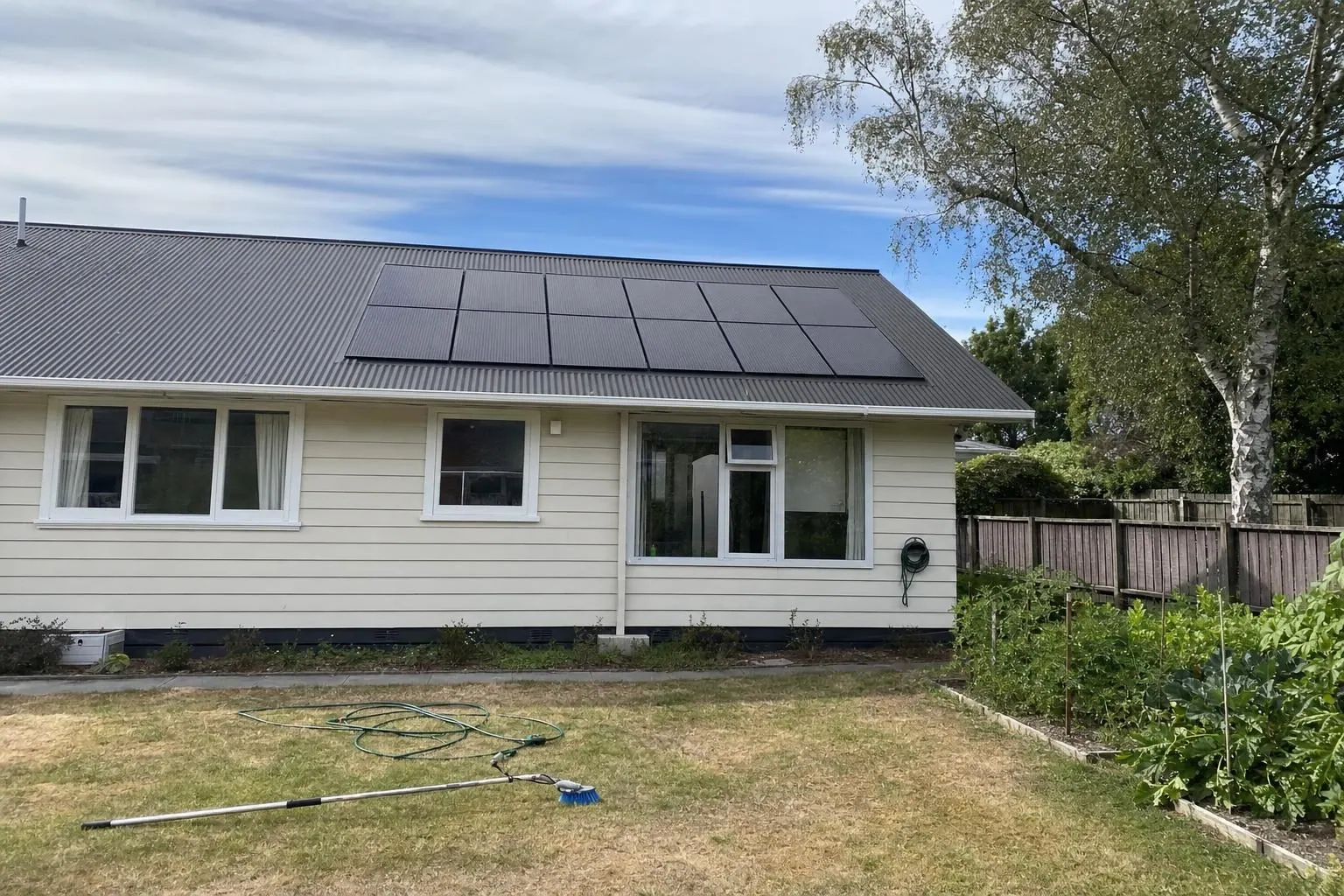
Does rain clean solar panels?
Mostly, yes, if they are tilted. Rain running off the glass carries loose dust with it, which is why many homeowners never clean their panels at all. EECA’s guidance for farm systems, the most detailed it publishes on upkeep, says cleaning once a year is often sufficient, and that every three to six months may be appropriate where panels collect dust, pollen, leaves, bird droppings or coastal salt spray.
Rain does less for two things. Bird droppings and lichen stick to the glass and need a brush. And panels laid flat or close to flat, common on flat and membrane roofs, do not shed water the way a 30° panel does, so dirt is left behind as puddles dry. If your panels sit at a low angle, expect to clean them more often than a neighbour with a pitched roof.
Why Canterbury is different
NIWA’s climate normals for 1981 to 2010 put Christchurch Airport’s average rainfall at 618 mm a year, with 86 days of at least 1 mm. That is low by New Zealand standards, and the summer months are the driest: January averages 38 mm and February 42 mm. NIWA also records that a dry spell, 15 days or more with less than 1 mm on any day, happens in Christchurch about once every four months on average.
The timing matters. Summer is when panels make most of their power, so any dirt that builds up over a dry spell is costing you in the months that count most. Our Christchurch solar output data shows a 5 kW north-facing system making 2,205 kWh from December to February, 31% of its year, while those months bring 21% of the year’s rain.

Rainfall also varies a lot across the region. These are NIWA’s annual averages for 1981 to 2010:
| Station | Rainfall (mm a year) |
|---|---|
| Tara Hills (Omarama) | 506 |
| Timaru | 550 |
| Lake Tekapo | 591 |
| Christchurch (airport) | 618 |
| Waipara | 620 |
| Ashburton | 681 |
| Rangiora | 688 |
| Kaikōura | 721 |
| Darfield | 756 |
| Methven | 895 |
| Akaroa | 969 |
NIWA describes the inland Mackenzie basins as among the driest places in New Zealand. The plains have their own dust sources too: cultivated paddocks, gravel roads and building sites in new subdivisions. Homes on lifestyle blocks and farms, and homes near the coast at Kaikōura, Akaroa, Sumner or New Brighton where salt spray reaches the roof, are the ones most likely to need EECA’s three-to-six-month interval. A tilted roof in suburban Christchurch away from dust and the sea may need cleaning rarely, if ever.
How to tell if your panels need cleaning
Dirt builds up slowly, so it shows as a gradual shortfall rather than a sudden drop. Three checks, in order:
- Look from the ground. An upstairs window, the top of a section or a neighbour’s yard often gives a view of the panels. Bird droppings, lichen at the bottom edge or a dull grey film are worth cleaning. Clean-looking glass usually means cleaning will not change much.
- Compare with the same month last year. Most inverter apps show monthly totals. Weather varies from year to year, so a gap of a few percent means little. A summer month that falls well short of the year before, with similar sunshine, is the signal to look further.
- Compare with what a system like yours should make. On our model, each kilowatt of north-facing panels at 30° in Christchurch makes about 5 kWh a day in January and about 2 kWh a day in June after normal losses (782 and 316 kWh in those months for a 5 kW system). Long-run averages hide year-to-year weather, so treat a big gap as a reason to check, not proof of dirt. The Canterbury solar calculator gives figures for other roof directions and towns.
A sudden fall, or a day with no output at all, is more likely a fault than dirt. Check the inverter for a fault light or error message and contact your installer. If your app looks fine but the bill does not, our guide to when the app and the bill disagree explains why the two can differ.
What a dirty array is costing you
There is no published New Zealand measurement of how much output household panels lose to dirt, so we will not put a single figure on it. What you can work out is what each lost percent is worth, and compare that with the cost of a clean.
A 5 kW north-facing system in Christchurch makes about 7,060 kWh a year on our model, so each 1% lost is about 71 kWh. On one published Christchurch price list (Toast Electric’s low-user plan from 1 April 2026, used in our power bill guide), power bought costs 28.81c a kWh and exported power earns 12.5c. That makes each 1% of output worth:
| If the lost power would have been | Value a year | Loss a $100 clean must recover |
|---|---|---|
| Used in the house (28.81c a kWh) | about $20 | about 5% of a year’s output |
| Exported (12.5c a kWh) | about $9 | about 11% of a year’s output |
Most homes use some of their solar and export the rest, so the real value sits between those rows. The practical reading: a clean that costs a few hundred dollars only pays for itself in a year if the panels were visibly and heavily soiled. For a lightly dusty tilted array, the monitoring check above will usually tell you to leave it to the rain. A clean you can do yourself from the ground with a hose and brush costs almost nothing, so that is the one to do when you are unsure.
How to clean solar panels safely
EECA’s guidance is short and clear:
- Use a soft brush and plain water. A tiny amount of detergent is fine if grime is stuck.
- Do not use hot water, a pressure washer, abrasive brushes or steel wool. They can damage the panels.
- For roof-mounted, elevated or hard-to-reach panels, get a contractor to clean them safely.
A few practical points follow from that. Clean early in the morning or in the evening, when the glass is cool and water will not dry into streaks straight away. Work from the ground with a soft brush on a telescopic pole and a garden hose if you can reach. Do not lean a ladder against the panels or the frame, and do not stand or kneel on panels. Your panels’ warranty comes from the manufacturer, so ask your installer for the maker’s installation or maintenance manual and follow any cleaning instructions in it.
Stay off the roof
WorkSafe calls a fall from height the most serious hazard in roof work. Its fact sheet on working on roofs says more than half of falls are from less than three metres, and about 70% are from ladders and roofs. Its guidance on roof maintenance makes the point that people on single-storey houses need the same protection as people on two-storey ones, and says not to go onto brittle roofs at all: fibrolite sheets (which usually contain asbestos), clear roofing, skylights and badly corroded metal.
Roof type matters for the roof as well as for you. Concrete and clay tiles crack under a footstep in the wrong place, which our tile roof guide explains, and older long-run iron can be thinner than it looks; see our metal roof guide. If the only way to reach your panels is to climb onto the roof, that is a job for someone with the equipment and training for it.
Hiring someone to clean your panels
Window cleaners, roof cleaners and some solar installers offer panel cleaning. Before you agree to a price, ask:
- How will you get to the panels, and what fall protection will you use?
- What will you clean with? The answer should be soft brushes and water, not a water blaster or chemicals.
- Will you photograph the panels before and after, and tell me about any cracked glass, loose fixings or damage you see?
- Do you carry public liability insurance if something is damaged?
Combine the visit with a look at the rest of the system if your installer offers it. A cleaner who spots a cracked panel or a loose rail has saved you more than the clean.
Other checks worth doing
EECA’s upkeep list goes beyond cleaning, and most of it can be done from the ground:
- After storms and strong winds, look for cracked panels, loose mounting hardware or damage from debris. NIWA records an average of 52 days a year with gusts over 61 km/h at Christchurch Airport, so this is a real check in Canterbury, not a formality.
- Trim trees and shrubs that have grown into the panels’ sun, especially around midday. EECA notes even partial shading can noticeably reduce output. Our roof suitability guide covers shade in more detail.
- Keep an eye on your monitoring. EECA says it helps spot faults early, before they affect output. Without a monitoring app, compare the generation and grid purchases on your power bills.
- Plan for the inverter. EECA says panels should work well for 25 to 30 years. Inverters and other components may need replacing during that time, so ask your installer how long the inverter warranty runs.
If you are still choosing a system, ask each installer how the panels can be reached for cleaning and repairs later. Our common solar quote mistakes guide lists other questions to settle before you sign.
Common questions about cleaning solar panels
How often should solar panels be cleaned in New Zealand?
EECA says once a year is often sufficient, and every three to six months where panels collect dust, pollen, leaves, bird droppings or coastal salt spray. Tilted panels in a suburban street may need it less often, because rain does much of the work.
Do solar panels need cleaning in Christchurch?
Sometimes. Christchurch averages 618 mm of rain a year, and its summers are dry, so dust can build up over a dry spell just when panels make most of their power. Check your monitoring against the same month last year, or look from the ground for droppings, lichen or a film of dust, before paying for a clean.
Can I use a water blaster on solar panels?
No. EECA warns against pressure washers, hot water, abrasive brushes and steel wool because they can damage panels. Use a soft brush and plain water, with a tiny amount of detergent only if grime is stuck.
Is it safe to clean solar panels myself?
From the ground, yes. Going onto the roof is a different matter: WorkSafe says more than half of falls happen from less than three metres, mostly from ladders and roofs. If you cannot reach the panels from the ground, EECA advises using a contractor.
How much output do dirty solar panels lose?
It depends on the dirt, the tilt and the rain, and there is no published New Zealand measurement for household roofs. For a 5 kW system in Christchurch, each 1% of output lost is worth roughly $9 to $20 a year, depending on whether the power would have been exported or used at home.
Does rain clean solar panels?
Rain rinses loose dust off tilted panels, which is why many never need cleaning. It does less for bird droppings and lichen, and little for panels laid flat, where water sits and dries.
When is the best time to clean solar panels?
Early morning or evening, when the glass is cool. In Canterbury, a clean in late spring or early summer, before the driest months, gives the most benefit if your panels need one.
Canterbury solar quotes
Planning solar? Ask how the panels will be reached later.
Tell us about your roof and your power bill, and get quotes from solar installers who cover your part of Canterbury. Ask each one how the array can be cleaned and checked safely once it is up.
Get Canterbury solar quotesSources and review date
Checked on 20 November 2026 against EECA’s guide “Get the most out of your on-farm solar” (cleaning interval, cleaning method, inspection, shading, monitoring and panel life); NIWA, “The climate and weather of Canterbury”, 2nd edition (G. R. Macara, 2016), Tables 4, 6 and 10 and its section on dry spells, using 1981–2010 normals; WorkSafe’s fact sheet “Be safe working on roofs” (2015), its “Working on roofs” good practice guidelines and its roof restoration and maintenance guidance; and Toast Electric’s Christchurch price list from 1 April 2026 as published on our power bill guide. Output figures are NZ Solar’s analysis of EU PVGIS 5.3 (PVGIS-ERA5, 2005–2023) for a 5 kW roof-mounted system with 14% system losses; the data is on our Christchurch solar output page.
NZ Solar is an independent quote matching service and is not affiliated with EECA, NIWA, WorkSafe or any panel cleaner. This page is general information. For local advice, see our Canterbury solar guide.