
Start with what runs in daylight
This guide is for working farms with real daytime loads: a dairy shed, irrigation pumps, a workshop, cool stores or a packhouse. If the property is a lifestyle block where the main question is house roof or shed roof, our guide to solar on lifestyle blocks is the better place to start.
EECA’s checklist for farm solar makes the main point plainly: solar has the biggest payoff during daytime hours. Every kilowatt-hour the farm uses as it is generated avoids buying one at the import price. A kilowatt-hour sent to the network earns only the retailer’s buy-back rate, and EECA describes solar as generally a cost-reduction investment rather than a reliable income stream. DairyNZ’s practical guidance for solar on farms (May 2026) says the same: using your own generation, rather than selling it back, tends to be the most profitable approach.
So the first job is not a roof measurement. It is a list of the loads on the farm, what time of day each one runs, and which electricity connection supplies it.
Dairy sheds: the milking timing problem
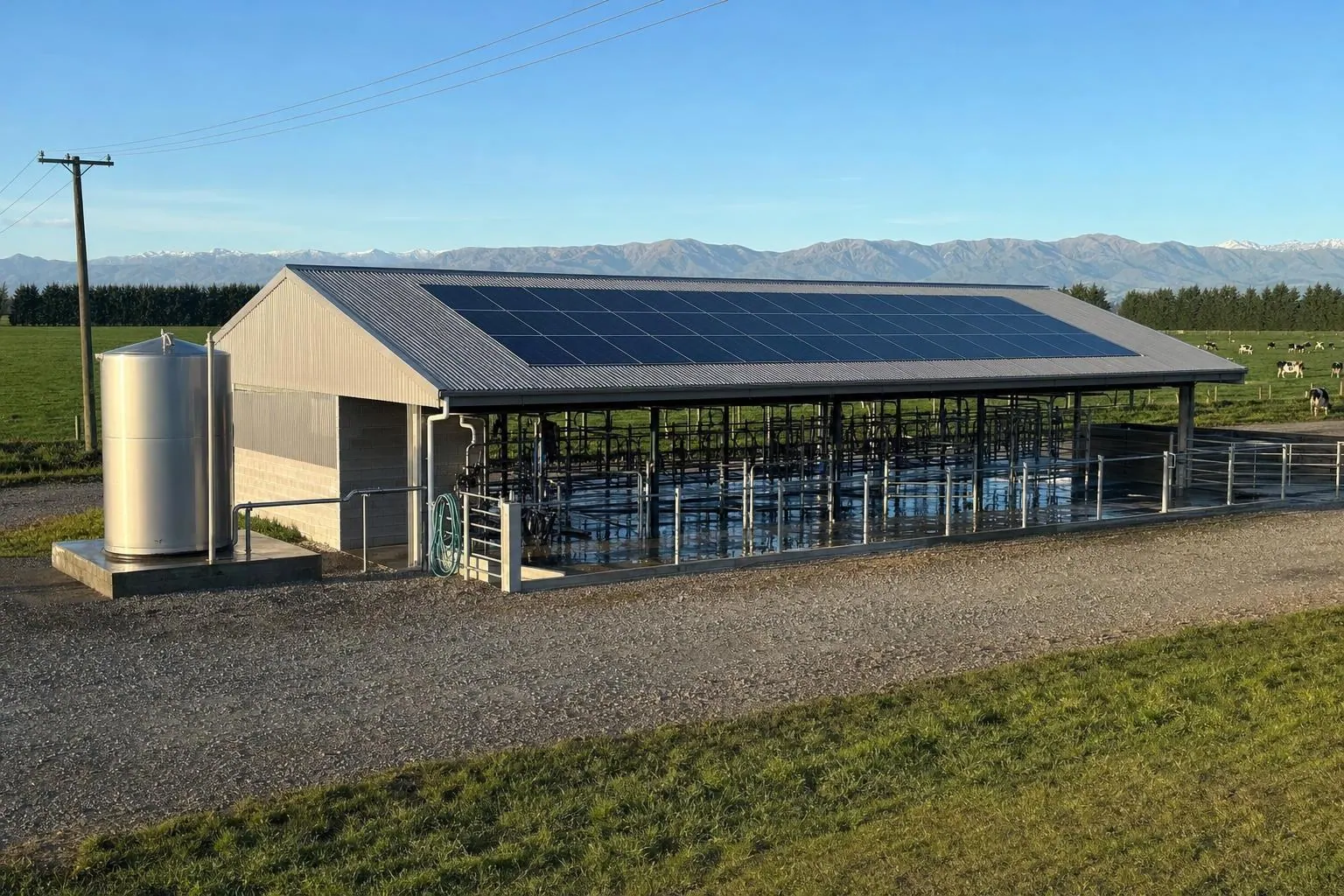
A dairy shed uses a lot of power, but much of it is tied to the morning and afternoon milkings, while solar output peaks in the middle of the day. That mismatch is the main thing a dairy farm solar design has to solve. DairyNZ quotes EECA saying generation peaks in the middle of the day and is especially useful for water heating, milk cooling and shed services, and suggests a battery to store excess energy for use during the morning and afternoon milkings.
Before paying for a battery, look at what can move into the day. These are the measures EECA and DairyNZ name:
| Load | What the guidance suggests |
|---|---|
| Hot water for washdown and plant cleaning | Heat it during the day. DairyNZ says heating water with solar power or on night rates can be 20 to 50% cheaper, and recommends timers on cylinders. |
| Milk cooling | EECA suggests storing energy indirectly by chilling tanks or pre-cooling. DairyNZ notes that pre-chilling water helps farms use cheaper power. |
| Heat recovery | DairyNZ says using heat from the milk chiller to preheat water can cut a shed’s electricity bill by up to 30%. It reduces the load solar has to cover. |
| Vacuum and milk pumps | DairyNZ says variable-speed drives can save up to 15% of their electricity. These run during milking, so they shrink the load rather than shift it. |
| Pumping, compressors and heaters | EECA suggests timers or controllers that start them when solar output is available. |
The order matters. Efficiency measures such as heat recovery and variable-speed drives cut the load, and a smaller load needs a smaller system. Do them, or at least price them, before sizing the panels. DairyNZ’s energy saving page lists more.
The hot water principles are the same as in a house, on a bigger scale. Our guide to timers, diverters and batteries for hot water explains the choice.
Irrigation and pumps
Irrigation is the load that lines up best with solar. It runs in summer, in dry, sunny weather, which is when panels produce most. EECA’s advice on getting the most from farm solar puts irrigation first in its list of energy-intensive tasks to schedule for when solar output is available, and its demonstration programme advice is to start with irrigation.
Two cautions. Irrigation stops when it rains, and in winter, so a system sized to the irrigation load will export much more in those months, at the buy-back rate. And on parts of the Mid Canterbury network, EA Networks says export constraints are most likely when irrigation load falls after rain while solar output stays high. Our EA Networks guide explains that pattern and lists the congested areas.
Stock water and dairy shed water pumps are smaller, but they can often be run on a timer through the middle of the day into a tank. Ask the installer to show which pumps the system can usefully run.
Which connection the panels feed
EECA puts it simply: a solar system connects to a single ICP, which means only the electricity used through that ICP can be offset. An ICP is the identifier for a connection to the network, and a farm can have several: the house, the dairy shed, and separate supplies for irrigation pumps out on the property.
That changes the design. Panels on the dairy shed roof cannot cut the bill for a pump on its own connection a kilometre away. Check the ICP on each power account, and match each proposed array to the loads on the same connection. EECA also says it is simpler and cheaper to install solar close to the main switchboard and the ICP.
If the farm is leased, or run with a sharemilker, EECA’s checklist says to clarify who pays for the system and who benefits from the savings. Put that agreement in writing before the quote is accepted, as it decides who carries the payback.
Sizing a farm system
EECA warns that oversizing a system to meet short peak demands will reduce your payback. A system sized to cover the few hours of a milking peak will spend most of the day producing more than the shed uses, and that surplus is exported at a low rate, or not at all where the export limit is low.
Space is rarely the constraint on a farm. EECA gives a range from around 150 square metres for smaller systems to 1,000 square metres or more for larger ones. It also says that if a major roof repair is due in the next 10 years, it is usually best to do that first. For a metal shed roof, our guide to solar on metal roofs covers condition, fixings and corrosion checks.
Ask the installer for a forecast that shows, month by month, how much of the output the farm uses itself and how much it exports. A forecast that only shows a total annual saving hides the mix, and the mix is what decides the payback. Our system sizing guide explains how panel size, inverter size and export fit together.
Above 10 kW: the application changes
Most house systems go through the simplified route for systems of 10 kW or less. A farm system often does not. Once the system is larger, each Canterbury lines company uses a separate process, with a higher fee and more information to supply. Find out which lines company serves each ICP first: our Canterbury lines company table shows which network covers each district.
| Network | Larger route and application fee, up to 100 kW | What else it says |
|---|---|---|
| Orion (Christchurch, Selwyn, Banks Peninsula) | Above 15 kW: $770 excluding GST (fees from 1 April 2026) | To export more than 15 kW you need a three-phase connection with balanced output. Larger solar applications may take 10 working days. |
| MainPower (Waimakariri, Hurunui, Kaikōura) | More than 10 kW: $770 excluding GST, plus $180 for observing testing and inspection (from 1 October 2026) | Three-phase installations are assessed case by case. Its rural single-wire (SWER) lines on its published list are held to a 2 kW export limit. |
| EA Networks (Ashburton District) | Above 10 kW: $770 excluding GST ($885.50 including GST) | Separate guidelines and forms for over 10 kW up to 300 kW. Six areas are listed as export-congested. |
| Alpine Energy (Timaru, Mackenzie, Waimate) | Over 10 kW: fee not in the pack for small systems; ask for the current fee | A separate information pack and a longer form asking for equipment, protection, maximum output and the point of connection, such as a pole number. |
The fees and rules above were checked against each company’s own pages: Orion’s on 4 November 2026, and the others on the dates shown in our guide to each network. Confirm the current figures when you apply.
Orion’s page for systems over 15 kW and under 100 kW sets out its steps. The inverter must conform to AS/NZS 4777.2. You must talk to your electricity retailer about import/export metering, and the retailer may charge a meter change fee. The application is lodged with the fee, and Orion will not process it until the fee is paid. After installation, the Certificate of Compliance and Record of Inspection must reach Orion within ten working days, and the system must not be switched on until Orion acknowledges them. Orion also says the application is required for any connection that can export, even if you do not plan to export straight away.
A system just under a network’s threshold costs less to apply for, and that can be a sensible design choice if the farm would not use the extra output. Ask the installer which route the whole design needs and what a slightly smaller inverter would cost in output, then get the network’s written approval before installation.
Three-phase supply
Many farm connections are not single-phase. Alpine Energy’s brochure notes that rural properties are usually two- or three-phase, against single-phase for most urban homes. For a larger solar system that matters, because the output has to be spread across the phases.
Orion is the most specific of the four. To export more than 15 kW it requires a three-phase connection and balanced output, and the difference in export between any two phases must not exceed 5 kW. That usually means a three-phase inverter, or single-phase inverters split evenly across the phases. MainPower assesses three-phase installations case by case. EA Networks’ published 10 kW limit is for single-phase connections only, so ask it directly how a three-phase farm connection would be assessed.
Ask the installer to show on the quote which phase each inverter connects to, how much each phase can export, and how that meets the network’s rule.
Batteries and outages
EECA’s checklist says a solar array on its own may not keep a farm running during an outage. A grid-connected inverter shuts down when the network does, and backup power needs a battery set up to supply chosen circuits.
On a dairy farm the backup question is real. DairyNZ reports that Fairbank Farm, an 800-cow farm near Drummond in Southland, kept milking through an October 2025 windstorm thanks to its solar array and a 100 kWh battery. That was one farm’s set-up, with a battery sized for it. If you need to milk through an outage, write that requirement into the brief and ask the installer which loads the battery will supply, for how long, and how the system switches over.
A battery that can export also needs to be in the lines company application. Our battery or no battery guide sets out how to test whether storage pays on its own.
Payback claims and support
EECA says a new on-farm solar system can pay for itself in as little as four years, and that large systems and systems with batteries will likely take longer. DairyNZ’s May 2026 guidance quotes typical payback of around four to six years, against 10 to 12 years a few years ago. Both are general figures, not a forecast for your farm. A system that exports much of its output, or sits on a connection with a low export limit, will take longer.
Test the installer’s figure against your own power bills: the import rate you pay at the times the panels produce, the share of output the farm uses itself, and the buy-back rate on your plan. Our buy-back rate guide covers export prices, and our guide to common quote mistakes lists the assumptions to check.
EECA ran a co-funded solar and battery demonstration programme for farms. Its September 2025 announcement offered up to 40% of the cost of inverters and batteries and up to 20% of solar panels, capped at $200,000 a farm, with systems to be installed by 30 June 2026. EECA’s demonstration farms page listed 37 farms as at 22 May 2026, including five in Canterbury and 11 dairy farms. That installation deadline has passed, so do not build a budget around the funding. EECA still runs a solar helpline on 0800 300 643, and DairyNZ’s guidance says EECA can help farmers compare quotes.
Election promises on solar loans and grants are covered in our guide to waiting for a solar subsidy after the election. For finance options available now, see our solar finance guide.
Seven things to get in writing
- The connection: the ICP the system connects to, the lines company, and whether the supply is single-, two- or three-phase.
- The loads: which farm loads the design assumes will use solar output, and at what times of day.
- The split: a month-by-month forecast of output used on farm and output exported, at the export limit the network is expected to approve.
- The route and fee: which application route the design needs, the fee, and who pays it and any retailer meter charge.
- The phases: which phase each inverter connects to and how the design meets the network’s balance rule.
- The roof: the roof’s condition, the fixing method and whether any repair should come first.
- Backup: if you need it, which circuits a battery supplies in an outage and for how long.
Common farm solar questions
Is solar worth it for a dairy shed?
It can be, if the system is sized to what the shed uses in daylight. EECA and DairyNZ both say farm solar pays best when the output is used on site. Moving hot water heating and some cooling into the middle of the day, and cutting load with heat recovery and variable-speed drives, does more for the payback than adding panels.
How much does it cost to apply to connect a farm solar system in Canterbury?
Orion charges $770 excluding GST above 15 kW and under 100 kW. MainPower charges $770 plus $180 for testing and inspection above 10 kW, and EA Networks $770 excluding GST above 10 kW. Alpine Energy has a separate pack for systems over 10 kW: ask it for the current fee.
Do I need three-phase power for a large solar system?
On Orion’s network, yes, to export more than 15 kW, with the output balanced so no two phases differ by more than 5 kW. MainPower assesses three-phase systems case by case. Ask EA Networks and Alpine Energy how they would assess your connection.
Can panels on the dairy shed run my irrigation pumps?
Only if the pumps are on the same electricity connection (ICP) as the panels. EECA says a solar system can offset only the electricity used through the ICP it connects to. Pumps on a separate supply need their own system, or the wiring has to change.
Will farm solar keep the shed running in a power cut?
Not on its own. EECA says backup power needs a battery. Specify which loads must keep running and for how long, and have the installer design the battery and switching for that.
Is EECA funding still available for farm solar?
EECA’s demonstration programme offered up to 40% of inverter and battery costs and up to 20% of panel costs, capped at $200,000 a farm, but systems had to be installed by 30 June 2026. Check with EECA on 0800 300 643 before assuming any funding is open.
Canterbury solar quotes
Give installers the farm’s loads, not just the roof.
Tell us about the property, the connections and what runs during the day so installers can respond to the same brief.
Get Canterbury solar quotesSources and review date
Checked on 4 November 2026 against EECA’s farm solar checklist, its guidance on getting the most from on-farm solar, its demonstration farms page (figures as at 22 May 2026) and its September 2025 announcement of demonstration funding; DairyNZ’s practical guidance for solar on farms (updated 18 May 2026), its March 2026 news item on the demonstration farms and its energy saving page; and Orion’s generation page, its page for systems over 15 kW and under 100 kW, and its connection charges and fees schedule from 1 April 2026. MainPower, EA Networks and Alpine Energy rules are from their own pages, as checked for our guides to each network in October 2026. Confirm current requirements with the lines company and your installer when applying.
NZ Solar is an independent quote matching service and is not affiliated with EECA, DairyNZ or any lines company. For broader local advice, see our Canterbury solar guide.