
The part of the bill solar cannot touch
A power bill has two parts. One is the electricity you buy, charged per kWh. Solar cuts that directly, because every unit your panels supply to the house is a unit you do not buy. The other is the daily charge, a fixed amount for being connected. It is the same on a cloudless January day as on a wet one in July, and it does not fall when you use less.
Retailers set their own daily charge, so there is no single Canterbury figure. As a real example, Toast Electric publishes its full price list for Christchurch and central Canterbury. From 1 April 2026, including GST, it charges:
| Plan | Daily charge | Power bought | Solar buy-back |
|---|---|---|---|
| Low user (under 9,000 kWh a year) | $1.67 | 28.81c a kWh | 12.5c a kWh |
| Standard user | $2.02 | 27.38c a kWh | 12.5c a kWh |
The daily charges are $1.6675 and $2.0183 before rounding, and the per-kWh price shown is the uncontrolled rate. Over a year the daily charge alone comes to $609 on the low-user plan and $737 on the standard plan. Your retailer’s numbers will differ, so read them off your own bill. The method below works with any figures.
Part of that charge is passed on from the lines company. Orion’s price schedule from 1 April 2026 sets its own fixed charge at 90c a day for a low-user home and $1.25 for a standard one, before GST. The retailer adds its costs on top.
How much you would have to export to cover it
The sum is one division:
daily charge ÷ buy-back rate = kWh you must export each day
On the standard plan above, $2.0183 ÷ $0.125 is 16.1 kWh a day. On the low-user plan, $1.6675 ÷ $0.125 is 13.3 kWh a day. The table gives the answer for other combinations, so you can find the row and column closest to your own plan.
| Daily charge | At 8c | At 10c | At 12.5c | At 20c |
|---|---|---|---|---|
| $1.67 | 20.8 | 16.7 | 13.3 | 8.3 |
| $2.02 | 25.2 | 20.2 | 16.1 | 10.1 |
| $2.50 | 31.3 | 25.0 | 20.0 | 12.5 |
| $3.00 | 37.5 | 30.0 | 24.0 | 15.0 |
The $2.50 and $3.00 rows and the 8c, 10c and 20c columns are round numbers for comparison, not quotes from a retailer.
Put both figures on the same GST basis before you divide. Retailers show the daily charge including GST. Powerswitch, Consumer NZ’s comparison site, lists solar buy-back rates excluding GST. Our guide to comparing buy-back plans covers the other conditions to check.
Month by month in Christchurch
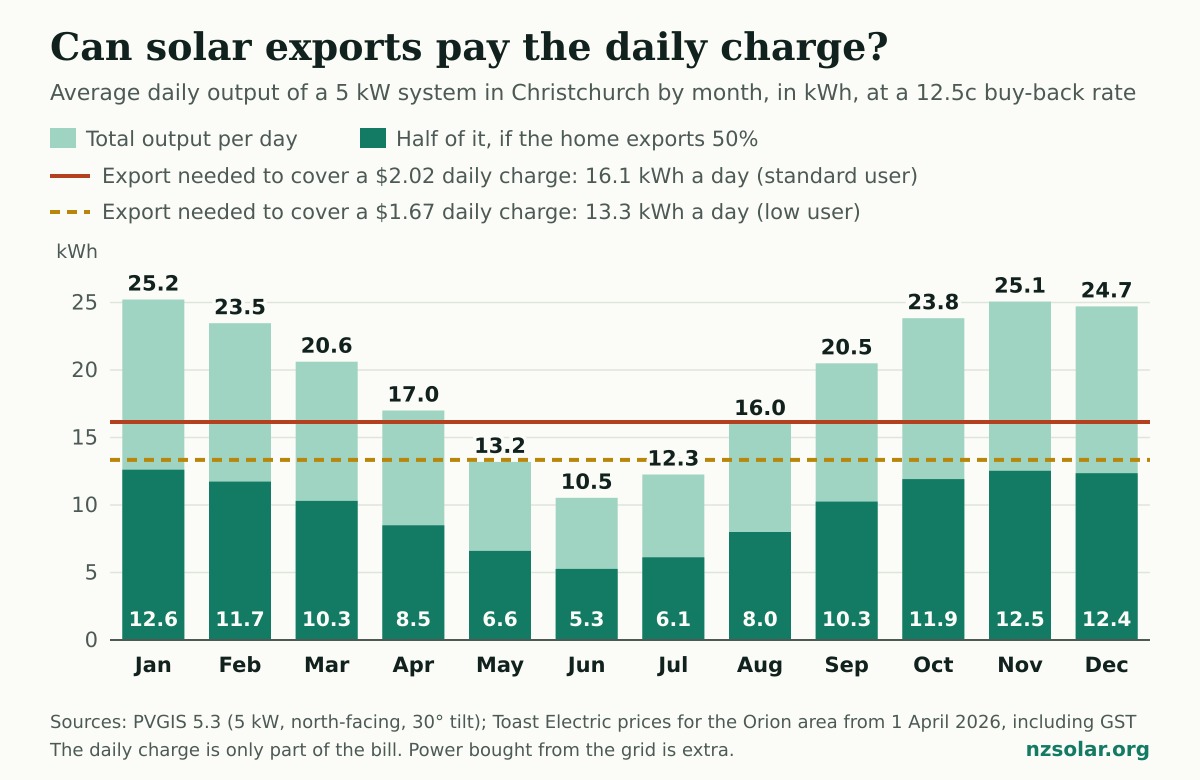
Now compare that with what a system makes. Our PVGIS analysis for Christchurch puts a 5 kW north-facing system at 7,061 kWh a year, which averages 25.2 kWh a day in January and 10.5 kWh a day in June. The chart sets each month’s average day against the two export targets. The dark part of each bar is half the output, which is what reaches the grid if the home uses the other half itself.

| Month | Total output | Half of it |
|---|---|---|
| January | 25.2 | 12.6 |
| February | 23.5 | 11.7 |
| March | 20.6 | 10.3 |
| April | 17.0 | 8.5 |
| May | 13.2 | 6.6 |
| June | 10.5 | 5.3 |
| July | 12.3 | 6.1 |
| August | 16.0 | 8.0 |
| September | 20.5 | 10.3 |
| October | 23.8 | 11.9 |
| November | 25.1 | 12.5 |
| December | 24.7 | 12.4 |
Three things stand out.
- Exporting half is never enough. The best month, January, sends 12.6 kWh a day to the grid at a 50% export share. That is short of the 13.3 kWh the low-user charge needs and well short of the 16.1 kWh for the standard one.
- In winter even the whole output falls short. In May, June and July the system makes less in total than the low-user target. In August it makes 16.0 kWh a day against a standard-user target of 16.1.
- Across the year it takes most of what the system makes. Paying off a $737 daily charge at 12.5c needs 5,893 kWh of export, which is 83% of the system’s yearly output. The $609 low-user charge needs 4,869 kWh, or 69%.
These are averages. A clear summer day beats them and a week of southerly cloud does not come close.
A whole year’s bill, worked through
The daily charge is only the first hurdle. A solar home still buys power at night and on dull days. Here is a full year for a Christchurch home that uses 8,000 kWh, on the low-user prices above, with the same 5 kW system. We have assumed the home uses 40% of its solar directly and exports the rest. That share is an assumption for the example, not a measurement. A house that is empty all day will use less of its own power, and one with daytime hot water heating or an EV at home will use more.
| Line on the bill | Without solar | With 5 kW of solar |
|---|---|---|
| Power bought | 8,000 kWh, $2,305 | 5,176 kWh, $1,491 |
| Daily charge, 365 days | $609 | $609 |
| Export credit | none | 4,237 kWh, −$530 |
| Bill for the year | $2,913 | $1,570 |
The system takes about $1,343 a year off the bill, a cut of 46%. That is a good result, and it is nowhere near zero. Most of the saving, $814, comes from power the home no longer buys. The exports add $530, which does not quite cover the $609 daily charge.
This is an example built from published prices, not a forecast for your house. The cost guide sets savings like these against what a system costs.
What a zero bill would take
To wipe out the example bill with exports alone, the credits would have to cover the $1,491 of bought power as well as the $609 daily charge. At 12.5c a kWh that is 16,799 kWh of export a year, against the 4,237 kWh the 5 kW system sends out. The extra 12,562 kWh would need roughly 9 kW more panels, all of it exporting, for a system close to three times the size.
That rarely makes sense. The extra panels would earn 12.5c a kWh, less than half of what a kWh used in the house is worth. A system that large also has to fit your lines company’s rules. Our guide to Orion’s export limits explains what can be approved. Sizing the system around what you use gives a better return than sizing it to chase a zero.
Three things do move a bill closer to zero without oversizing:
- Use more of your own power. Each kWh used at home saves 28.81c in the example. Exported, it earns 12.5c. Running the hot water cylinder in the middle of the day is the cheapest way to shift, and our hot water guide compares a timer, a diverter and a battery for the job.
- A battery. It cuts evening imports, so it works on the larger part of the bill. It is also a large cost of its own. See battery or no battery and how far one goes on a Canterbury winter night.
- Better-paid exports. Time-varying buy-back plans pay more at peak times, and Orion credits 6c a kWh on winter weekday peaks. Both mostly reward homes that can export in the evening, which means a battery.
Some homes do see bills in credit over summer. Ask your retailer whether credits carry forward to winter or are paid out, because that decides whether a strong December can offset a weak June.
Low-user plans stop being compulsory in April 2027
Since 2004, regulations have required every retailer to offer a low-user plan with a capped daily charge. In Christchurch and further south, “low user” means under 9,000 kWh a year. Elsewhere it is 8,000 kWh. Solar homes usually qualify, because they buy less from the grid. The home in the example buys 5,176 kWh.
The cap has been rising by 30c a year and the regulations end altogether on 1 April 2027, according to the Ministry of Business, Innovation and Employment.
| From | Cap per day |
|---|---|
| Before 1 April 2022 | 30c |
| 1 April 2022 | 60c |
| 1 April 2023 | 90c |
| 1 April 2024 | $1.20 |
| 1 April 2025 | $1.50 |
| 1 April 2026 | $1.80 |
| 1 April 2027 | No cap. Retailers no longer have to offer the plan. |
The current cap of $1.80 is $2.07 with GST. The ministry’s 2025 review found retailers had generally not raised their charges all the way to the cap, and the $1.67 in our example is below it.
Nobody has published prices for April 2027 yet, so we will not guess at them. What is on the record is that Orion calls 2026 the final year of the regulations and says it will review how it splits its costs between fixed and per-kWh charges from 1 April 2027.
The direction matters to a solar home for a simple reason. If more of the bill moves into the daily charge and per-kWh prices fall to match, each kWh your panels save you is worth a little less, and the fixed part that solar cannot reduce gets bigger. The two plans in the first table show the trade today: the standard plan charges 35c a day more and 1.43c a kWh less. For the example home buying 5,176 kWh, the low-user plan is cheaper by about $54 a year. That gap is small, and it is the kind of sum to redo when your retailer announces its 2027 prices.
What to aim for instead of zero
- Judge a quote on the yearly saving and the payback, not on whether any single bill reaches zero. Be wary of a sales pitch that promises to eliminate your bill. Ask the installer to show the daily charge in their savings estimate.
- Ask what share of the output the estimate assumes you use yourself. It drives the result more than any other number, as the example shows.
- Compare power plans on the total for the year. A higher buy-back rate with a higher daily charge can leave you worse off.
- Run the division for your own bill. Daily charge divided by buy-back rate. If the answer is more than your system exports on an average day, the daily charge is not being covered, and that is normal.
Common questions
Will solar panels eliminate my power bill in New Zealand?
Not usually. Solar cuts the power you buy, but the daily charge stays and you still import at night and in winter. In our Christchurch example a 5 kW system cuts a $2,913 yearly bill to $1,570.
How many kWh do I need to export to cover the daily charge?
Divide your daily charge by your buy-back rate. A $2.02 charge at 12.5c a kWh needs 16.1 kWh a day. A $1.67 charge needs 13.3 kWh a day.
Do I still pay the daily charge if my panels cover all my use?
Yes. The daily charge is for the connection, not for electricity used. The only way to avoid it is to disconnect from the grid, which means a much larger system with batteries and backup.
Can my bill go into credit in summer?
It can, if you export a lot and use little. A 5 kW system in Christchurch averages about 25 kWh a day in January, so a home exporting most of that would earn more than the daily charge. Check whether your retailer carries the credit forward or pays it out.
Will a battery get my bill to zero?
A battery reduces what you buy in the evening, so it cuts the bill further. It does not remove the daily charge, and in a Canterbury winter the panels often cannot fill it. Compare the extra saving with the battery’s price.
What happens to low-user plans in April 2027?
The regulations that require them end on 1 April 2027. Retailers may keep offering low-user plans but will not have to, and the cap on the daily charge goes. No Canterbury prices for that date have been published yet.
Method and sources
Retail prices are from Toast Electric’s published price list for Christchurch and central Canterbury, effective 1 April 2026 and including GST, read on 9 October 2026. We used it because it shows the daily charge, per-kWh prices and buy-back rate on one page. It is one retailer and is not a recommendation. Lines charges are from Orion’s delivery price schedule and pricing update for 1 April 2026. The low-user thresholds, the yearly caps and the 1 April 2027 end date are from the Ministry of Business, Innovation and Employment and the Electricity (Low Fixed Charge Tariff Option for Domestic Consumers) Regulations 2004 as amended in 2021.
Solar output is from our PVGIS 5.3 analysis for a 5 kW north-facing system at a 30° tilt in Christchurch: monthly output divided by the days in the month. Export needed is the daily charge divided by the buy-back rate. The yearly example assumes 8,000 kWh of household use, 40% of solar output used in the home (2,824 kWh) and the rest exported (4,237 kWh), at the uncontrolled low-user rate with no discounts or time-of-use pricing. Dollar figures are rounded to the nearest dollar. This article is general information, not financial advice. Information reviewed on 9 October 2026.
Canterbury solar quotes
Get quotes sized to what you use.
Tell us about your home and share a recent power bill. We pass that brief to installers who work in your area, so their savings estimates start from your real daily charge and usage.
Get solar quotes