
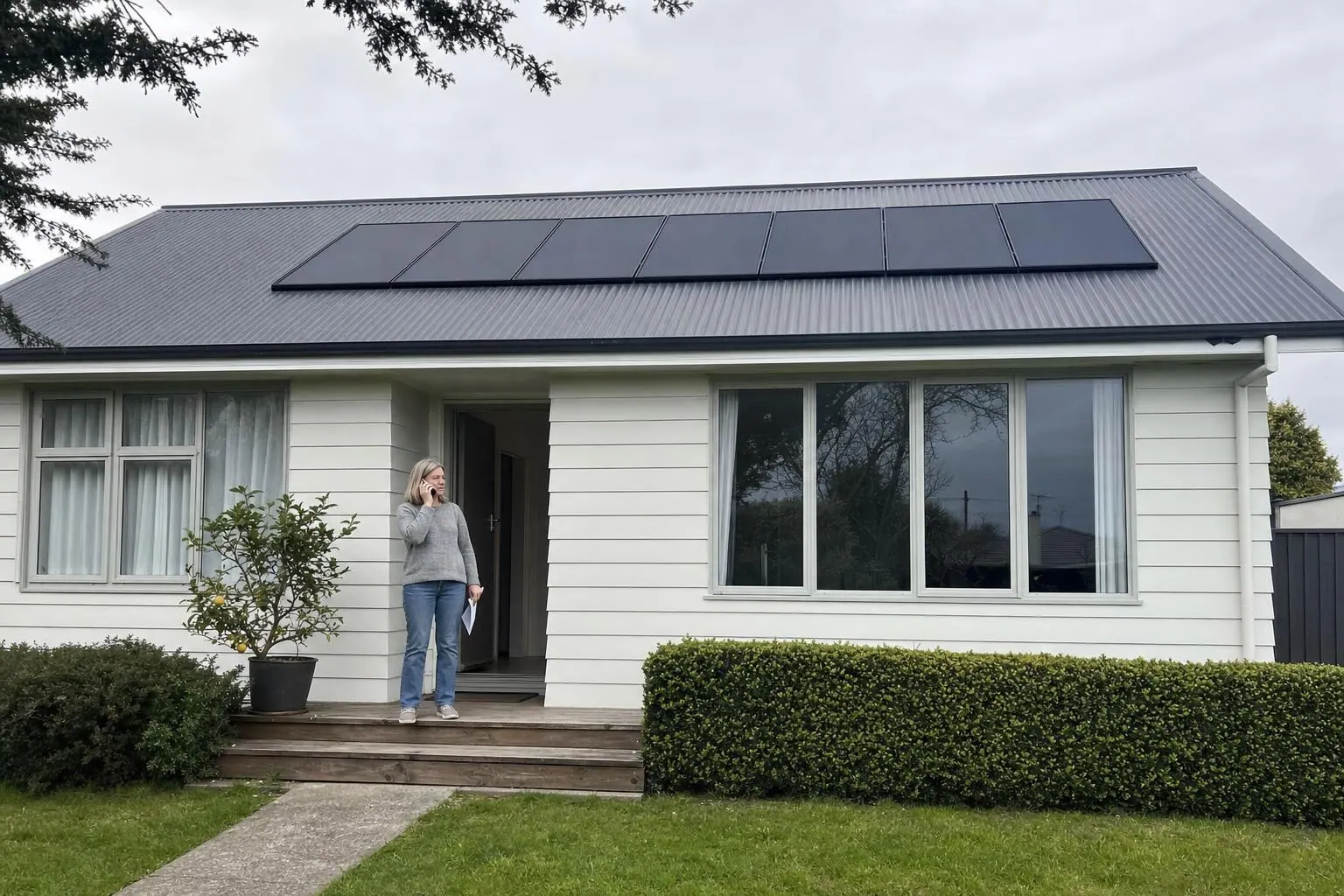
What the import/export meter does
When your panels make more power than the house is using, the surplus flows out to the street. An import/export meter records that flow separately from the power you buy, and your retailer pays you for the exported units at its buy-back rate. Without it, the exports still happen but nothing on your bill counts them.
Many homes already have a smart meter that can measure exports. Utilities Disputes points out that it still has to be configured before you start receiving export credits, so having a smart meter on the wall does not mean you are being paid. Some newer credits need more than a basic export reading: Meridian, for example, says its winter peak rate needs a communicating smart meter that records when you export, and our guide to Orion’s winter peak export credit explains why timing matters in Christchurch.
Who does what
Four or five organisations touch a solar connection, and the meter sits between them. The Electricity Authority tells new solar owners to contact their retailer, metering provider and lines company about connecting, selling power back and installing an import/export meter.
| Who | What they do |
|---|---|
| Your installer | Designs and installs the system and arranges the inspection and certificate of compliance. Meridian says the meter is typically handled by the company installing the rest of your setup. |
| Your lines company | Approves the system before it is connected and sets the export limit. In Canterbury that is Orion, MainPower, EA Networks or Alpine Energy. |
| Your retailer | Agrees to buy your exports, orders the meter change or reconfiguration, and pays the credits. Utilities Disputes says the retailer is ultimately responsible for coordinating the work and for keeping you informed. |
| The metering company | Supplies the meter, sends a technician to install or reprogram it, and updates the national registry that tells everyone what meter your home has. It works for your retailer, not for you. |
The practical point is that your retailer is the one to chase. Utilities Disputes cannot take complaints against metering companies or contractors directly, but it can look at their work when they are acting for your retailer or lines company.
How long it should take
There is no regulated deadline for setting up a solar meter. What retailers publish varies:
- Contact says that once your buy-back application is approved, you may need a new meter, and a standard install takes up to 15 working days. It charges a meter change fee and starts paying for exports once the meter is in place.
- Meridian says an import/export meter costs around $150, and suggests asking whether the export meter can be installed before the solar system goes in.
Other retailers set out their process in their own help pages, so ask yours for its timeframe and any fee in writing before you sign the installation contract. In the cases Utilities Disputes has handled, the wait was sometimes far longer than any published figure: in one, a household waited three months for the meter and another three months for a retailer switch to go through, six months in all before it saw a credit.
What the complaints show
Utilities Disputes, the free dispute service for electricity customers, published a paper on solar metering complaints in October 2026. Solar made up 3.7% of the electricity complaints it received in its 2025–26 year, when it received 11,592 electricity complaints in all, and 5.2% so far in the current year. It describes solar complaints as essentially doubling each year, and says half of the complaints it accepted for investigation in the past 12 months had a solar aspect.
| Issue | Complaints |
|---|---|
| Delays installing or switching on an import/export meter | 80 |
| Getting access to meter data | 32 |
| Inverter or solar app not matching the meter | at least 27 |
| Cost of an import/export meter | 17 |
| Export limits | 3 |
| Price paid for exports | 3 |
| All solar metering complaints | 219 |
The paper also lists missing credits, where the export credits on the bill are not the amount the household expected, as a common issue. It notes that many people who complain have already followed up with their retailer many times.
Why meters get stuck
Utilities Disputes says the reasons are not always revealed to the customer, but it sees the same patterns:
- Out-of-date promises. Call centre staff give the standard timeframe even after it has passed, which may reflect how little they can see of the job.
- Technician availability. Metering companies and contractors face high demand and regional differences, and remote homes wait longer. That matters for rural Canterbury, from the lifestyle blocks of Selwyn to Hanmer and the Mackenzie.
- Paperwork between companies. Retailers rely on the metering company to finish the paperwork and registry update, and have few alternatives if it is slow.
- IT upgrades. Some providers had recently changed their systems, which Utilities Disputes calls a foreseeable cause of delay.
- Registry errors. A home recorded wrongly, for example as commercial rather than residential, needs the lines company to check and correct it before the meter can be set up.
- Switching too early. A switch to a new retailer requested before the meter details are final in the registry can be rejected because the meter details do not match.
Before your install: five things that prevent most delays
- Choose your retailer and plan first. Compare buy-back rates before the install, not after, so the meter is set up once with the retailer you intend to stay with. Our buy-back plan comparer helps.
- Ask the installer who is applying for the meter. Get it in writing whether the installer or you will contact the retailer, and when.
- Ask the retailer to start the meter request early. Meridian suggests asking whether the export meter can go in before the panels do. Ask your retailer for its timeframe, any fee and whether it needs the lines company approval or the electrical certificate first.
- Keep copies of every document. The lines company approval, the electrical certificate of compliance and the retailer’s confirmation are what a retailer or Utilities Disputes will ask for.
- Write down the meter reading on the day the system is switched on. A photo of the meter display with the date gives you a reference point if credits later look wrong.
Our common solar quote mistakes guide covers what else to settle before you sign.
If your meter or credits are stuck
- Ask your retailer for the job status and the next date. Ask whether the meter change has been ordered, which metering company has it, whether the registry has been updated, and what date the retailer expects. Note who you spoke to and when.
- Ask for your meter data. Under the Electricity Industry Participation Code, your retailer must give you your consumption information within five business days of a complete request. The Electricity Authority’s procedures say this covers exports as well as imports, can be requested by phone, in writing or online, and is free unless you have made more than four requests in the past 12 months. The data shows whether exports are being recorded at all.
- Ask about the lost months. If the delay was the retailer’s doing, ask what it will do about the exports you were not credited for. In one case Utilities Disputes reported, the retailer had already offered compensation for the lost months, and the Commissioner recommended an extra customer service payment on top.
- Make it a formal complaint. If dates keep slipping, tell the retailer in writing that you are making a complaint, and keep a dated log of every contact.
When the app and the bill disagree
Your inverter app and your meter measure different things. The app measures what the inverter produces and, depending on the setup, what part of the house it can see. The meter measures what actually flows in and out at the boundary, and that is what you are billed on.
Utilities Disputes describes a household whose solar app showed no consumption while the retailer kept billing it. A meter test found no fault. The missing load was a hot water cylinder on ripple control, wired on a circuit the solar app could not see. The retailer waived the meter test fee and the household changed how the cylinder was wired. If your bill looks too high against the app, check what the app is not measuring before you pay for a meter test. Our solar hot water guide explains how cylinders are usually set up with solar.
Switching retailers with solar
Wait until the meter is finished before you switch. In the six-month case above, the household switched retailer a week after the install without knowing the registry had not been updated, and the switch then took another three months. In another case, a household that switched after installing solar received no bill for four months, and when it came there were no export credits on it; the new retailer found the missing data, recalculated the bills, apologised and made a customer service payment.
If you do switch, ask the new retailer to confirm that it can see your import/export meter and is recording exports, and check that your first bill shows an export line.
Taking it further
If your retailer cannot resolve the problem, Utilities Disputes takes complaints about electricity, including solar. It is free for the customer. It can look at meter delays, missing credits, data access and billing, including work done by a metering company or contractor on the retailer’s behalf.
A problem with the panels, the inverter or the installer’s work is different: that is between you and the company you bought the system from, under your contract. Our quote page FAQ covers how to check an installer before you sign. If the problem is a subscription or leased system, our SolarZero contracts guide covers who now holds those agreements.
Common questions about solar export meters
Who arranges the import/export meter for solar in New Zealand?
Your electricity retailer. The installer may start the request and a metering company does the physical work, but Utilities Disputes says the retailer is ultimately responsible for coordinating it and keeping you informed.
How long does it take to get a solar export meter installed?
There is no regulated timeframe. Contact says a standard install takes up to 15 working days once your application is approved. Utilities Disputes has handled cases where it took three months, and one where a household waited six months in all because it switched retailer before the meter was finished.
How much does an import/export meter cost?
It depends on the retailer and whether the meter needs replacing or only reprogramming. Meridian says an import/export meter costs around $150, and Contact charges a meter change fee. Ask your retailer for its fee in writing before the install.
I have a smart meter. Do I still need a new meter for solar?
Not always, but it still has to be configured to record exports before you are paid for them. Your retailer arranges that. Some time-of-use buy-back rates also need a communicating smart meter that records when you export.
Will I be paid for exports made before the meter was set up?
Not automatically. Retailers generally pay once the meter is in place and recording exports. If the delay was the retailer’s fault, ask it to compensate you for the lost months; Utilities Disputes has handled a case where the retailer offered compensation and the Commissioner recommended an extra payment.
Why does my solar app show different figures from my power bill?
The app measures the inverter and the circuits it can see; the bill comes from the meter at the boundary. Loads the app cannot see, such as a hot water cylinder on ripple control, can make the bill look wrong when it is not. Ask your retailer for your meter data to compare.
Can I complain to Utilities Disputes about a solar meter delay?
Yes. Utilities Disputes resolves complaints about electricity, including solar, and it is free for consumers. Raise it with your retailer first and keep a record of every contact.
Canterbury solar quotes
Planning solar? Get the paperwork right from the start.
Tell us about your roof and your power bill, and get quotes from solar installers who cover your part of Canterbury. Ask each one who applies for the meter and when.
Get Canterbury solar quotesSources and review date
Checked on 18 November 2026 against Utilities Disputes’ paper “Solar metering complaints” (October 2026), including its complaint figures and case examples, in which names were changed; the Utilities Disputes home page; the Electricity Authority’s solar power page for consumers and its procedures for requests for consumer consumption information (Electricity Industry Participation Code 2010, clause 11.32B); Contact Energy’s solar FAQs and alternative energy page; and Meridian Energy’s solar page and its guide to getting solar installed. Retailer fees, timeframes and processes change; confirm them with your retailer before you sign.
NZ Solar is an independent quote matching service and is not affiliated with Utilities Disputes, the Electricity Authority or any electricity retailer. This page is general information, not legal advice. For local advice, see our Canterbury solar guide.