
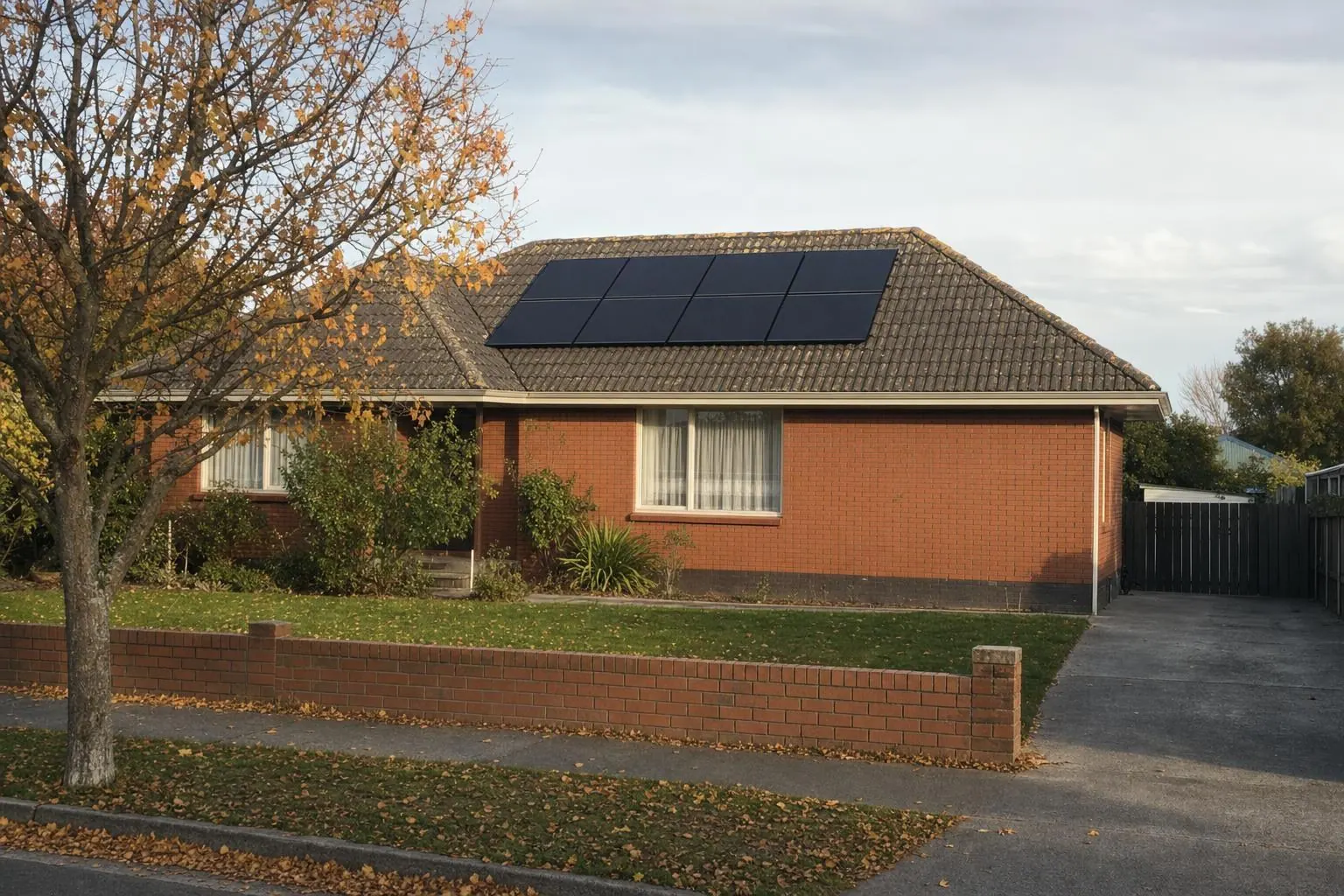
Which tiles do you have?
“Tile roof” covers three quite different roofs in New Zealand, and each one changes how panels go on. Concrete tiles are the heavy, usually grey, charcoal or brown profiled tiles found on many brick-and-tile houses. Clay tiles, often called terracotta, are fired clay and usually orange-red. Pressed metal tiles are steel pressed into a tile shape, often with a stone-chip coating, and are sold under names such as Gerard and Decramastic.
If you are not sure, look at a broken edge or the underside of a tile in the roof space, or ask a roofer. A quote should name the tile type it has allowed for. If it just says “tile roof”, ask.
| Tile type | How panels are usually fixed | Main risk | Ask the installer |
|---|---|---|---|
| Concrete tiles | Stainless steel tile hooks screwed to the rafters, coming out between tile courses | Cracked tiles and tiles that no longer sit flat over a hook | How many hooks, how you will walk the roof, and who supplies spare tiles |
| Clay (terracotta) tiles | The same hook method, with more care on access | Brittle tiles, especially on an older roof | Have you fitted panels to clay tiles before? Can spare tiles be matched? |
| Pressed metal tiles | Brackets designed for that tile system, or mounts the tile maker approves | Dented tiles and coatings damaged by roof traffic | Does the tile maker approve this mount, and does it affect the roof warranty? |
Pressed metal tiles are covered by the New Zealand Metal Roofing Manufacturers code of practice, which classes them as restricted-access cladding: people should walk only in the pan of each tile, where the batten supports it, in flat soft-soled shoes. Gerard sells its own solar brackets that fit under its tiles and fasten through the battens to the rafters, leaving no holes in the roof, for wind zones up to and including Extra High. Its solar bracket flyer describes fitting them while the tiles are being laid, so on an existing roof ask whether tiles have to be lifted and relaid to fit them. For long-run and corrugated steel, our metal and Colorsteel roof guide covers the very different fixing method.
How panels are fixed to a concrete or clay tile roof
On long-run metal, the installer screws brackets through the roofing. On tiles, nothing should be screwed through a tile. The usual method is a stainless steel tile hook. The installer lifts or slides a tile out, screws the hook to the rafter underneath, and lays the tile above back over the hook so its arm comes out between two courses of tiles. Rails bolt to the hooks and the panels clamp to the rails, the same as on any roof. Clenergy, one of the large mounting makers, sells hooks for most tiled roofs and extenders for high-profile tiles such as Spanish tiles.

The tile above the hook keeps the roof dry
A tile hook does not pierce the tiles, so the water still runs over them as normal. That only works if every lifted tile goes back down flat. A tile that rocks on the hook can crack or let wind-driven rain past.
To make the tile above sit flat, installers often grind a shallow notch in its underside where it crosses the hook. The alternative some installers offer is replacing the tile at each hook with a flashed metal or composite replacement piece. Either can work. What matters is that you know which one is planned, and that the quote includes it.
The rails and panels also need room to breathe. BRANZ says panel frames must meet wind and seismic loading requirements, be isolated so different metals do not corrode each other, and leave about 100 mm behind crystalline silicon panels for cooling airflow. Its photovoltaic systems guidance covers the basics.
Cracked tiles and leaks: where tile roof jobs go wrong
Consumer NZ’s tile roof guide says tiles can be damaged by weather or by people walking on the roof, that tiles become more brittle as they age, and that anyone working on a tile roof should use planks or a roof ladder. It also warns that older tile roofs may have no underlay, so water that gets past a tile can go straight into the roof space.
An installation means people on the roof for a day or more, carrying panels and rails. Some cracked tiles are a normal risk on an older roof. The problem is a cracked tile nobody notices, hidden under the array, letting water in for years. Set the expectations before work starts:
- Ask the installer to note any tiles that are already cracked, chipped or slipping, with photos, before anyone walks on the roof.
- Agree who supplies spare tiles and who pays to replace tiles broken during the job. Some tile profiles are no longer made, so ask now rather than after a tile breaks.
- Ask for photos of the finished array area, including the tile courses around each hook, before the scaffolding comes down.
- Check the ceiling below the array and the roof space after the first heavy rain.
Once the array is on, fixing a cracked tile beneath it can mean removing panels. That makes the pre-installation check and the handover photos worth insisting on.
Should you replace a tile roof before adding solar?
EECA’s guide to planning a home solar system sorts roof condition into three bands: ideal is a new or recently rejuvenated roof, good is one that will not need replacement or major maintenance within 10 years, and poor is one that will. EECA says a poor rating does not rule solar out, but on a tile roof the cost of getting it wrong is high: taking panels off, re-roofing and putting them back on is a second installation.
Signs that a tile roof is due for work, from Consumer NZ’s guide, include cracked or broken tiles, loose mortar under the ridge and hip tiles, slipped or missing tiles, and moss, which holds moisture against the roof. A tile roof with no underlay is another reason to get a roofer’s opinion. If the roofer suggests re-bedding the ridges or replacing a run of tiles, do it before the panels go on, while the whole roof is easy to reach.
Usually fine to go ahead
A tile roof in good condition with no major work expected within 10 years, few cracked tiles, sound ridge and hip mortar, and a clear north, east or west face.
Price a re-roof first
Brittle or crumbling tiles, many cracked or slipped tiles, failing ridge mortar, no underlay, existing leaks, or a re-roof you would like to do within 10 years anyway.
If a re-roof is likely, ask for two prices: solar on the current roof, and solar fitted straight after a new roof. Solar on new long-run steel is a simpler, faster job, and the solar cost guide shows what a typical system costs once the roof is out of the equation.
Canterbury: heavy roofs after the earthquakes
Canterbury has a particular reason to think about tile roofs. In its guidance on lighter cladding for TC3 repairs and rebuilds, Building Performance says homes with lighter cladding and roofing generally performed reasonably well in the Canterbury earthquakes, that lighter claddings reduce the load on a home’s foundations, and that owners repairing or rebuilding on TC3 land should consider replacing heavy wall and roof claddings with lighter ones. It asks for roof cladding of no more than 20 kg/m². Monier’s technical statement for its Georgian concrete tile gives 53 kg/m².
That guidance is aimed at TC3 repairs and rebuilds, not at every tile roof. But if your house still has a heavy tile roof and a move to a lightweight roof is already on your list, solar is a good moment to make the decision. BRANZ’s Build magazine notes that swapping a heavy tile roof for a light one should be structurally straightforward, because the framing was built for the heavier load, but that wind uplift then becomes the main concern and the roof-to-wall connections need checking against NZS 3604.
If you keep the tiles, the framing is already built to carry a heavy roof. What matters more is how the array is attached: panels and rails push down and, in wind, pull up at each hook rather than spreading their load across the roof, so the installer has to fix every hook into sound framing. Ask what they checked in the roof space. Our Christchurch roof suitability guide covers shade, roof direction and usable space, which matter just as much on tiles.
Consent, wind and weight
Building Performance’s guidance on exempt building work (updated 22 October 2025) lists two exemptions for roof-mounted solar. Exemption 28D covers arrays of less than 40 m² and needs no authorised professional. Exemption 48A covers arrays over 40 m², or sites where the design wind speed exceeds 44 metres per second, and legally requires an authorised professional. The guidance names roofers, electricians and Chartered Professional Engineers as people who can advise. Both come with detailed conditions, so ask the installer which one your system falls under.
For scale, with panels of about 2 m² each, 40 m² is roughly 20 panels. A tile roof does not change the exemption, but it does mean the installer has to show that the hooks, their spacing and the framing they screw into suit your wind zone. On an exposed site or a large array, ask who has checked that.
What a tile roof adds to a solar quote
Expect a tile roof quote to be higher than the same system on long-run metal, because the job takes longer and needs different parts. We have not seen a published New Zealand figure for the difference, so compare itemised quotes rather than relying on a rule of thumb. The extra cost usually comes from:
- Tile hooks or replacement flashing pieces in place of standard metal-roof brackets.
- Labour to lift, notch and relay tiles at every hook, and to move around the roof without cracking tiles.
- Spare tiles and the time to replace broken ones.
- Scaffolding or edge protection. WorkSafe’s good practice guidelines for working on roofs say perimeter or edge protection should be installed on exposed roof edges where there is a risk of falling.
- Any roof repairs agreed beforehand, such as re-bedding ridge tiles.
A much cheaper tile roof quote is worth questioning, not celebrating. Ask what it leaves out. Our guide to common solar quote mistakes covers other gaps to look for.
Eight things to get in writing
The connection side is separate from the roof. Your lines company still has to approve the system and its export limit: see our guides for Orion, MainPower, EA Networks and Alpine Energy. EECA’s quotes and installation guide covers the rest of the quote.
Common tile roof solar questions
Can you put solar panels on a concrete tile roof?
Yes. The usual method is stainless steel tile hooks screwed to the rafters, with the tiles laid back over them so nothing pierces the tiles. The roof needs to be in good condition, and the quote should say how cracked tiles will be handled.
Can you put solar panels on a clay or terracotta tile roof?
Usually, using the same hook method. Clay tiles can be brittle, especially on an older roof, so access needs more care and spare tiles matter more. Ask the installer whether they have worked on clay tiles before and how they will match replacements.
Will solar panels make my tile roof leak?
They should not if every tile lifted for a hook is relaid flat and any cracked tiles are replaced. Leaks come from tiles that rock on a hook, tiles cracked during the job and left in place, or an older roof with no underlay. Ask for photos of the tiles around the hooks before the scaffolding comes down.
Should I replace my tile roof with metal before getting solar?
If the roof will need replacement or major maintenance within 10 years, price that first: EECA rates that roof as poor for solar. In Canterbury, Building Performance advises owners repairing or rebuilding on TC3 land to consider a lighter roof. A sound tile roof with years left does not need replacing just for solar.
Can my tile roof take the weight of solar panels?
The framing under a concrete tile roof is already built for a heavy roof. The bigger question is attachment: the array’s load, and wind uplift, act at each hook, so every hook has to go into sound framing that suits your wind zone. Ask the installer what they checked in the roof space.
Do I need a building consent for solar on a tile roof?
Not usually. Building Performance’s exemption 28D covers roof-mounted arrays under 40 m². Larger arrays, or sites with design wind speeds over 44 metres per second, fall under exemption 48A, which needs an authorised professional. Detailed conditions apply to both.
Canterbury solar quotes
Get quotes that start with your actual roof.
Tell us the tile type, the roof’s age and condition, and your power use so installers can price the same job.
Get Canterbury solar quotesSources and review date
Checked on 22 October 2026 against EECA’s guide to planning a home solar system, Building Performance’s guidance on exempt building work for roof-mounted solar arrays and on lighter cladding for TC3 repairs and rebuilds, BRANZ’s photovoltaic systems guidance and its Build magazine article on replacing a concrete or masonry tile roof, Consumer NZ’s tile roof guide, the New Zealand Metal Roofing Manufacturers code of practice section on pressed metal tiles, WorkSafe’s good practice guidelines for working on roofs, Monier’s product technical statement for the Georgian concrete tile, Gerard’s solar bracket flyer and Clenergy’s tile roof mounting range. Manufacturer details are examples, not recommendations. Ask your installer and roofer to confirm what suits your roof.
NZ Solar is an independent quote matching service and is not affiliated with any roofing or mounting manufacturer. For broader local advice, see our Canterbury solar guide.