
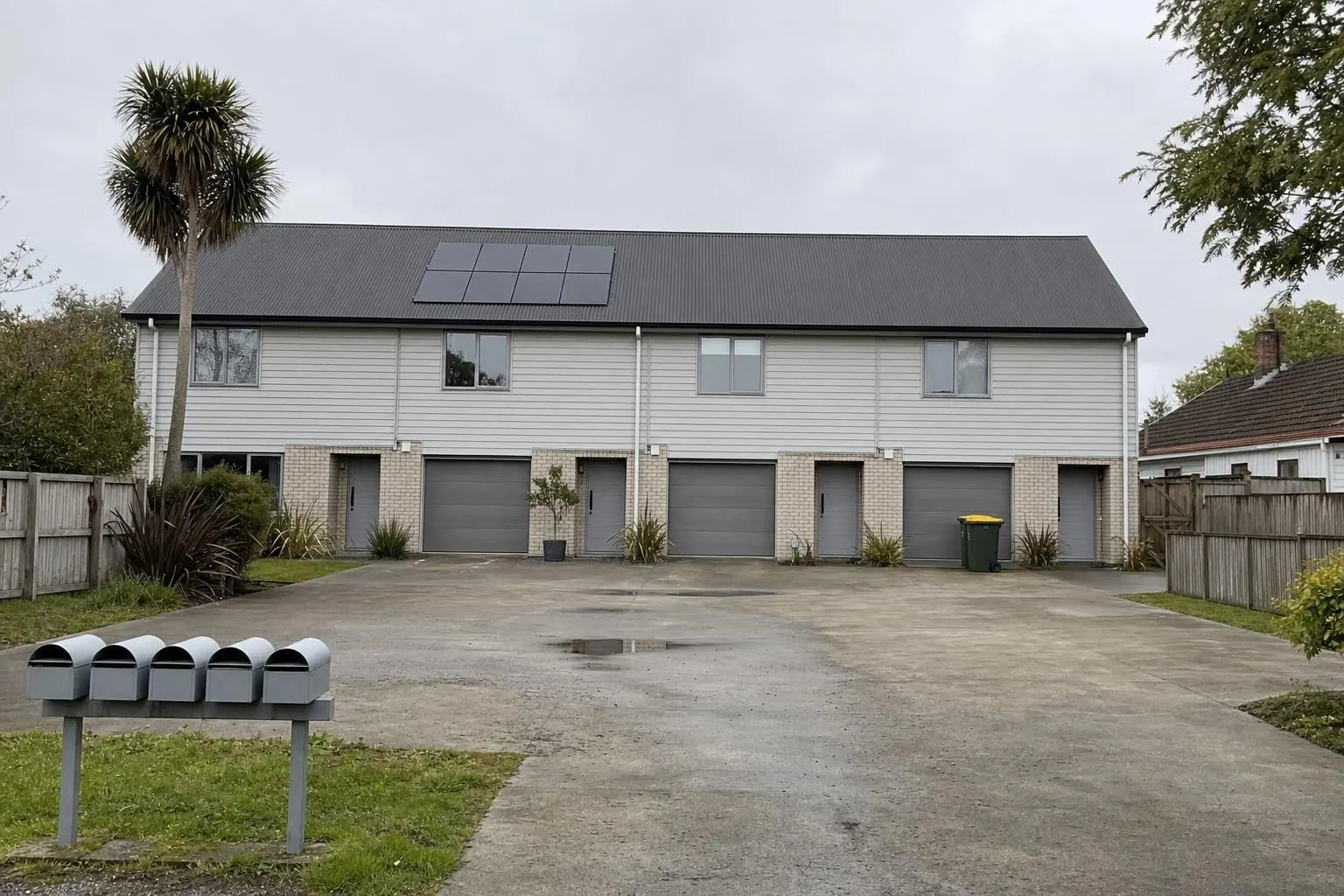
Check what kind of title you have
“Unit”, “townhouse” and “flat” describe the building, not the ownership. The rules for solar depend on the title, so check your record of title (your lawyer or the sale documents will have it) before you talk to an installer. Settled.govt.nz, the government’s home-buying guide, describes the two shared forms:
- Unit title. You own your unit and a share of the common property, and a body corporate made up of all the owners runs the development. Most apartments and many newer townhouse blocks are unit titles. The rest of this page is mostly about them.
- Cross-lease. You own a share of the whole piece of land with the other owners, and lease the flat you live in from all of them, usually for 999 years. There is no body corporate; the lease covenants set the rules. See cross-lease flats below.
A townhouse on its own freehold title is treated like any other house: no body corporate, though a shared wall or roof line and any land covenants are still worth checking. Our roof suitability guide covers the rest.
Who owns the roof in a unit title
Under the Unit Titles Act 2010, the common property is owned by the body corporate, and the owners are entitled to it as tenants in common in proportion to their ownership interests. Whether your roof is common property or inside your unit’s boundary depends on the unit plan for your development, so look at it.
Even when the roof sits inside your unit, it may not be yours to decide on alone. The Act defines “building elements” to include the roof, and requires the body corporate to repair and maintain building elements and infrastructure that relate to or serve more than one unit. A continuous roof over a terrace of townhouses, or the roof of an apartment building, serves every home under it.
Unit Titles Services, the government’s guidance service, puts it in plain terms: the body corporate repairs and maintains the common property and the parts of the building that serve more than one unit, while owners may have to look after the exterior themselves, especially where the units are detached. Detached units with their own roofs give you the most freedom; shared roofs give you the least.
What the law requires before work starts
Three parts of the Unit Titles Act apply to solar on a unit title:
- Notice. Section 80 requires an owner to notify the body corporate of any intention to carry out additions or structural alterations before the work starts.
- Written consent. The same section says an owner must not make additions or structural alterations that materially affect the use, enjoyment or ownership interest of other units or the common property without the body corporate’s written consent. Unit Titles Services’ guide to owners’ responsibilities adds that you need written consent from the body corporate and any affected owners when the work affects another unit or the common property. Roof fixings, cable runs through shared spaces and panels on a shared roof plane all point to consent being needed.
- Insurance. The body corporate must insure the buildings, and section 135 requires it to tell its insurer about additions or structural alterations to any unit before the work starts, whoever is doing it. Your consent request is how it finds out in time.
Check the body corporate’s operational rules as well. Unit Titles Services notes that rules can cover the external appearance of units, and a body corporate can change its rules by ordinary resolution at a general meeting, lodged with Land Information New Zealand before they take effect. Some developments may already have rules about roof equipment; others may adopt one after the first request.
Do not rely on an email from the chair or the body corporate manager. Ask for the decision to be made at a general meeting or by written resolution, and get it in writing with any conditions attached.
How a body corporate decides
The Act says a matter for the body corporate is decided by ordinary resolution at a general meeting unless the Act requires something else. An ordinary resolution passes with a majority of the eligible voters who vote on it. A special resolution needs 75% of those who vote. Written resolutions need a majority of all eligible voters for an ordinary resolution, or at least 75% for a special one.
Where the panels go changes what is needed. If they sit on common property and the arrangement gives you a right to use that part of the roof, a lawyer may advise putting it in a lease or licence. Section 56 lets a body corporate grant a lease or licence over common property only after a special resolution. A body corporate system for the common areas, paid from levies, is an ordinary decision about spending, though a large project may also touch the long-term maintenance plan and fund rules. Ask the body corporate manager or a lawyer which applies before the meeting, so the motion is worded correctly the first time.
Three ways to set it up
EECA explains that a solar system connects to a single ICP, the identifier for one connection to the network, and only the electricity used through that ICP is offset. That one fact decides whose bill a system cuts.

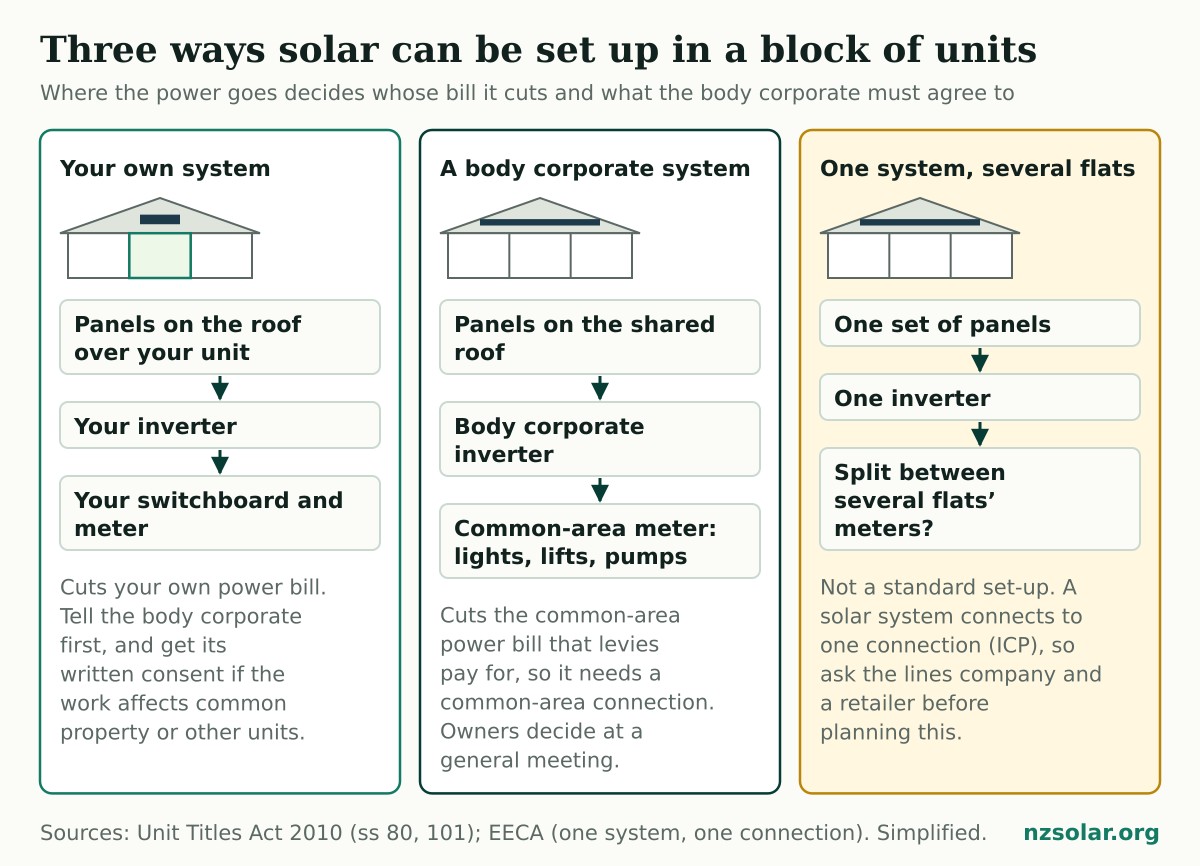
- Your own system. Panels on the part of the roof over your unit, wired to your own switchboard and meter. The savings and any export credit go to your power account. This is the common set-up for townhouses, and it is the one the section 80 consent rules are written for.
- A body corporate system. Panels on the shared roof wired to the body corporate’s own connection, if it has one for lights, lifts, gates, pumps or a car park. It cuts a bill paid from levies, so every owner shares the benefit. It suits apartment buildings with a meaningful common-area power load in the day.
- One system shared between flats. Splitting one array between several units’ meters is not a standard household set-up, because a system connects to one ICP. If the block wants this, ask the lines company and a retailer what they will accept before paying for a design.
Several owners on one roof can each have their own system, side by side. Agreeing a layout for the whole roof at the start, even if only one owner is ready now, stops the first system taking the best spot or blocking later ones.
Apartments
In an apartment building the roof is usually small for the number of homes under it, and cables from the roof to each apartment’s switchboard have to run through risers, ceilings and other common property. The Act counts wires and cables that serve units as infrastructure, which the body corporate maintains when they serve more than one unit. That makes individual systems for every apartment hard; a body corporate system for the common areas is often the practical option.
Plug-in panels for balconies are often suggested for apartments, but they are not permitted in New Zealand yet. The Electricity Authority asked households about them in September and October 2026, and no rule or date has been set. Our guide to waiting for solar policy tracks where that stands. If you rent your apartment, see our guide to solar on a rental property.
Cross-lease flats
Cross-lease titles have no body corporate, but the agreement you need can be harder to get. Settled.govt.nz says that on a cross-lease you are a part owner of every building on the land, structural changes to the property or shared areas generally need the other owners’ agreement, and even painting the exterior can need it. Its two guides differ on whether all owners or a majority must agree, which is why the lease itself matters: the covenants registered on the title set the rule for your property.
Before you get a quote on a cross-lease flat:
- Read the lease covenants about alterations and additions, or ask your lawyer to.
- Ask the other owners for written consent, with a plan showing where the panels and cables go.
- Ask your lawyer whether the work affects the flats plan. Panels on an existing roof do not change the building’s footprint, but a new structure such as a carport frame for panels might.
Who pays for what, now and later
Levies pay for maintaining the common property. The Act also lets a body corporate recover from one owner the cost of work that is substantially for the benefit of that owner’s unit only. So settle these points in the consent, not after the first leak:
- The system itself. On an individual system you pay for the panels, installation and repairs. A body corporate system is paid from levies or a fund, so check the long-term maintenance plan and any capital improvement fund.
- The roof under the panels. Who pays to remove and refit your panels when the body corporate repaints, repairs or replaces the roof? Write it down. Ask when the roof is next due for work in the long-term maintenance plan; panels last decades, so a roof due for replacement soon should be done first. Our guides to metal roofs, tile roofs and flat and membrane roofs explain what panels mean for each.
- Damage. Who pays if a fixing leaks into a neighbour’s unit, and is the installer’s workmanship warranty in your name or the body corporate’s?
- Insurance. Confirm the body corporate’s insurer has been told and whether the panels are covered as part of the building.
- Selling. Agree that the consent and its conditions pass to the next owner of your unit, and keep a copy for the sale documents.
The savings side is the same as for any home. EECA’s figures and our solar cost guide show what a system costs and saves; our guide to what size system you need helps size it for a smaller household, and the buy-back rates guide explains export credits and the tax exemption for selling surplus power from the home you live in.
Questions to put to the body corporate
Send these with your request, along with the installer’s roof layout, fixing method and cable route. A complete proposal is easier to approve at one meeting.
- Is the roof over my unit common property or within my unit on the unit plan?
- Do the operational rules say anything about roof equipment, external appearance or electrical work?
- Will you decide this by ordinary resolution at a general meeting, by written resolution, or does it need a special resolution and a lease or licence?
- What conditions will apply: approved installer, fixing method, cable route, panel colour, access for roof maintenance?
- Who pays to remove and refit the panels for roof maintenance, and when is the roof next due for work?
- Will you notify the insurer, and do you need anything from me for that?
- Would the body corporate consider a system for the common areas, or a roof layout that leaves room for other owners later?
- Will the consent pass to the next owner if I sell?
Lines company approval still applies
Body corporate consent is not the only approval. Every system still needs the lines company to approve the connection, and each unit’s system goes through its own application for that unit’s connection. In Canterbury see our guides to Orion, MainPower, EA Networks and Alpine Energy for their export limits and application steps. Ask your installer to check the lines company’s rules early if several owners on the same block plan systems.
If the answer is no
Ask for the reasons in writing and whether different conditions would change the answer: a smaller array, a different fixing method, or an agreement to pay for removal during roof work. Many objections are about leaks, appearance and future costs, and a clear proposal answers them.
If you cannot agree, Unit Titles Services says the Tenancy Tribunal handles unit title disputes, alongside the courts. Its page on operational rules explains how rules are set and enforced. Get legal advice before you start a dispute; NZ Solar is not a lawyer.
Common questions about solar on units and townhouses
Do I need body corporate approval to put solar panels on my townhouse?
On a unit title, you must tell the body corporate before any additions or structural alterations, and you need its written consent if the work materially affects other units or the common property. Panels fixed to a shared roof, or cables run through common areas, usually do. Check your unit plan and operational rules, and get the consent in writing before you sign a quote.
Who owns the roof on a unit title property?
It depends on the unit plan. The common property is owned by the body corporate. Even where the roof is inside a unit’s boundary, the Unit Titles Act counts the roof as a building element, and the body corporate must repair and maintain building elements that serve more than one unit, such as one roof over a terrace.
What vote does a body corporate need to approve solar?
Most body corporate decisions are made by ordinary resolution at a general meeting: a majority of the eligible voters who vote. If the arrangement grants a lease or licence over part of the common property, the Act requires a special resolution, which needs 75% of those who vote. Ask the body corporate manager or a lawyer which applies to your proposal.
Can one solar system supply every unit in a block?
Not in a standard household set-up. EECA explains that a solar system connects to a single ICP, so only that connection’s power use is offset. Owners can each have their own system on a shared roof, or the body corporate can install one for the common-area connection. Ask the lines company and a retailer before planning anything else.
Do I need permission for solar on a cross-lease flat?
Usually. Settled.govt.nz says cross-lease owners are part owners of every building on the land, and structural changes and even exterior painting can need the other owners’ agreement. The lease covenants on your title set the exact rule, so read them or ask your lawyer, and get written consent from the other owners before the work.
Can I use plug-in solar panels on an apartment balcony?
Not yet. Plug-in kits that connect to a wall socket are not permitted in New Zealand. The Electricity Authority asked households about them in September and October 2026 and no rule change or date has been set.
Canterbury solar quotes
Get a layout to take to your body corporate.
Tell us it is a unit title, townhouse or cross-lease, so installers can include a roof layout, fixing method and cable route you can put in front of the other owners.
Get Canterbury solar quotesSources and review date
Checked on 11 November 2026 against the Unit Titles Act 2010 (version as at 10 July 2026; sections 5, 54, 56, 80, 97, 98, 101, 104, 106, 126, 135 and 138); Unit Titles Services’ pages on owners’ responsibilities (last updated 22 October 2026), unit title maintenance (last updated 9 May 2024) and setting the operational rules (last updated 4 July 2019); Settled.govt.nz’s guides to types of ownership and cross-lease ownership; EECA’s guidance that a solar system connects to a single ICP; and the Electricity Authority’s consultation on plug-in generation. The diagram is a simplified summary, not a wiring diagram.
This page is general information, not legal advice. NZ Solar is an independent quote matching service and is not a lawyer or body corporate manager, and is not affiliated with Unit Titles Services, Settled.govt.nz or EECA. For local advice, see our Canterbury solar guide.