
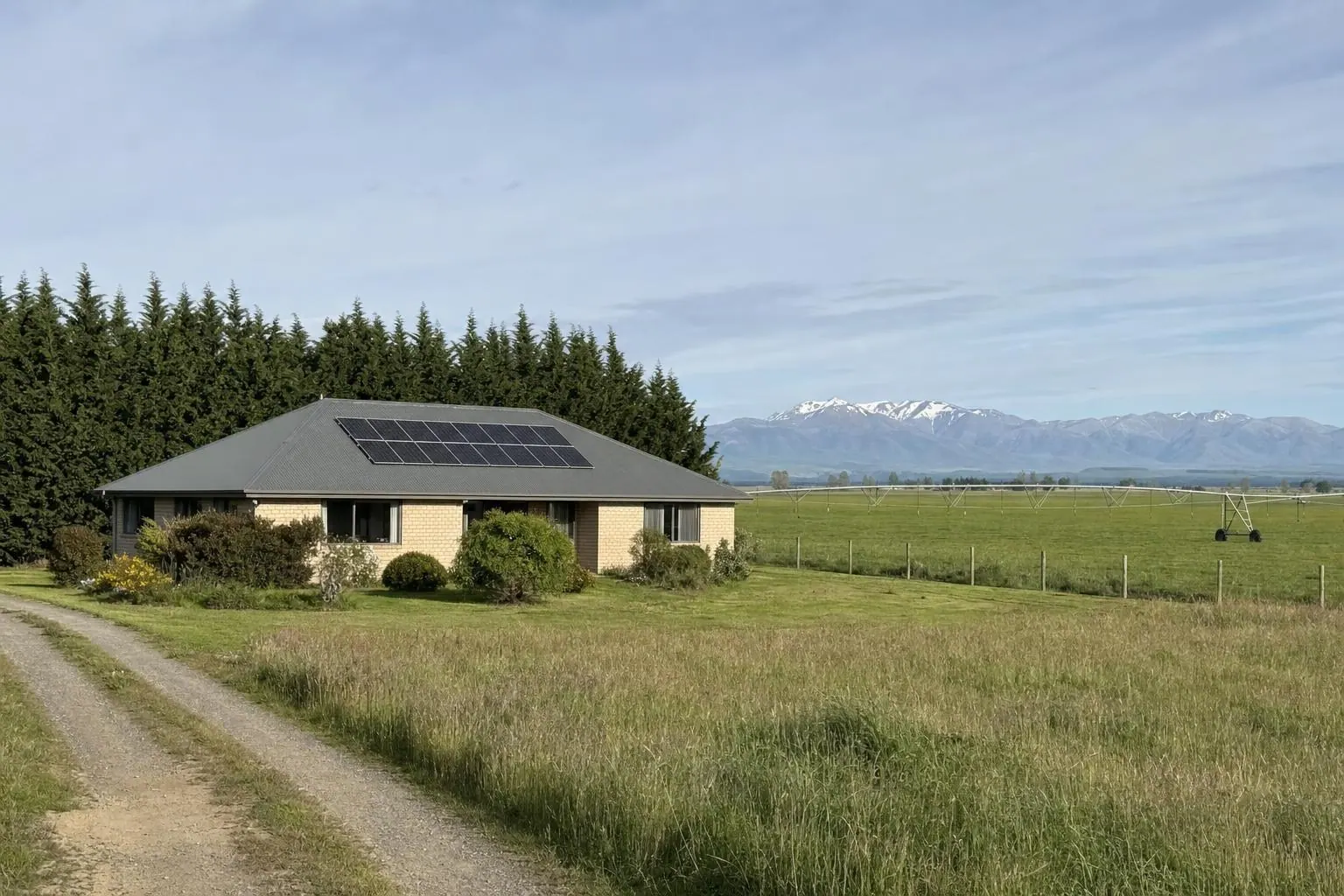
Are you on EA Networks’ network?
EA Networks (listed in Electricity Authority data as Electricity Ashburton) runs the lines across Ashburton District, between the Rakaia and Rangitata rivers. That takes in Ashburton and Tinwald, Methven, Rakaia, Mt Somers and the farmland of the plains and foothills. North of the Rakaia the lines company is Orion; south of the Rangitata it is Alpine Energy. Our Canterbury lines company table shows which network covers each district.
If the address is close to either river, check the 15-character ICP number on your power bill and ask your retailer which lines company it belongs to. Do not carry a limit, fee or approval time from Orion, MainPower or Alpine Energy into a Mid Canterbury quote. Each sets its own.
Keep the three roles apart. EA Networks approves the connection and the export limit. Your retailer arranges import/export metering and sets the price you are paid for exported power. Your installer designs the system and normally prepares the application.
Mid Canterbury homes are installing big systems. Electricity Authority EMI figures for 31 August 2026 show 731 homes with solar on EA Networks, 5.2% of its residential connections, up 27% in a year. New home systems averaged 8.5 kW in the year to August, against 7.2 kW across Canterbury, and up from 5.4 kW on the same network five years earlier, according to our Canterbury solar statistics. Systems that size are the ones most likely to run into an export limit.
Up to 10 kW, but not a default
EA Networks’ distributed generation page says it has increased the export limit for compliant single-phase connections from 5 kW up to 10 kW. It then adds a warning in plain words: customers should not infer that 10 kW is a default allocation. The 10 kW depends on approved inverters that meet its technical and safety requirements and on network capacity being available, and every application gets a technical assessment.
That is a different tone from its neighbours. Alpine Energy and MainPower both describe 10 kW as their default for homes. The national rule sits behind all of them. The Electricity Authority’s Export Limits Amendment, in force since 11 May 2026, makes 10 kW the default for straightforward connections of 10 kW or less under the simplified Part 1A process. A distributor can set a lower limit only where a network assessment shows the local network needs it, or it can offer a flexible limit that still allows at least 10 kW when the network is not constrained. The Authority’s information sheet says distributors must publish lists or maps of connections with a lower limit, and that if a connection is not listed, the 10 kW limit applies.
From 11 November 2026, the Authority requires distributors to use its standard assessment methods when they study whether a lower limit is needed. None of this changes the practical advice for an EA Networks address: get the approved export limit in writing before you sign, and make sure the quote uses that figure.
The page addresses single-phase connections only. If your supply is three-phase, as some rural connections are, ask EA Networks how it would assess export on your connection rather than assuming the single-phase figure.
An export limit is power at one moment, in kilowatts. It is not a daily allowance in kilowatt-hours. On a 6 kW array it rarely matters. On a 10 kW array on a house that is empty during the day, it can trim the middle of every sunny day. Our system sizing guide explains how panel size, inverter size and export fit together.
The six congested areas
EA Networks publishes a network congestion map and lists the areas where export limits apply. In congested areas, it says, export may be limited by up to 100% at times. That means a connection may sometimes be allowed to export nothing.
| Area, as EA Networks names it | EA Networks’ note |
|---|---|
| Lauriston area | Export limits apply |
| Methven area | Export limits apply |
| Mt Hutt area | Export limits apply |
| Overdale area, including Rakaia | Export limits apply |
| Mt Somers, Montalto and Ashburton Gorge/Lakes area | A pending application will make this area constrained |
| 22 kV feeders east and west of Tinwald | Export limits apply |
The list gives area names, not street addresses. The map on EA Networks’ page shows the boundaries, colouring each part of the network red for congested, orange for pending congestion and green for uncongested. The map PDF on its page is dated May 2026. Its separate hosting capacity map, last updated on 10 November 2025, shows how much export capacity is left at each substation; EA Networks says a figure of 0 MW means no unconstrained capacity is left, though a constrained connection may still be offered. It updates that map when a generator larger than 0.5 MW is approved, or at least twice a year.
A large solar farm or a nearby cluster of applications can change capacity between map updates. EA Networks asks customers to contact its generation team on 0800 430 460 or generation@eanetworks.co.nz to check hosting capacity and congestion before committing to a system.
Why irrigation matters
Mid Canterbury’s network carries a large summer irrigation load. EA Networks says export constraints are most likely during daylight hours when total network load is lowest. It also points to a pattern specific to irrigated country: after rain, irrigation load can fall while solar output stays high, and its modelling allows for that.
In practice, that means a sunny day after a good rain can be the worst time to export on a congested rural line. The irrigators that would normally soak up local solar are switched off, while every roof on the feeder is producing. Count on that day, not an average day, when you judge how much a congested connection might be held back.
If your address is congested
Congestion limits what you can send into the network, not what the panels can produce. It changes what is worth buying:
- Size for what you use. A forecast that counts exports the connection cannot carry will overstate the savings. Ask for a second forecast at the limit EA Networks says it would approve, including zero if that is possible on your line.
- Move load into the day. Hot water is the usual first step. Our guide to timers, diverters and batteries for hot water compares the options.
- Use your own pumps and sheds. On a farm or lifestyle block, daytime loads such as water pumps, workshops and stock water can use output that cannot be exported.
- Price a battery on its own merits. Each stored kilowatt-hour used at home avoids buying one at your import rate. Allow for storage losses and the battery’s cost; our battery or no battery guide sets out the sums.
Rural owners should also read our guide to solar on lifestyle blocks, which covers long cable runs, sheds and pumps.
Fees: two routes for a home system
EA Networks charges an application fee for every size of system, and for a home there are two prices depending on the route. These are the fees on its distributed generation page:
| System and route | Excluding GST | Including GST |
|---|---|---|
| 10 kW or less, simplified default service (Part 1A) | $140.00 | $161.50 |
| 10 kW or less (Part 1) | $310.00 | $356.50 |
| Above 10 kW, under 100 kW (Part 2) | $770.00 | $885.50 |
| 100 kW to under 1 MW (Part 2) | $1,540.00 | $1,771.00 |
| 1 MW and above (Part 2) | $7,690.00 | $8,843.50 |
EA Networks’ table shows $161.50 including GST for the Part 1A fee, although $140 plus 15% GST comes to $161.00. Ask which amount the invoice will show.
The simplified route costs less than half as much. Part 1A is the national streamlined process for straightforward small connections that meet the current inverter and installation standards, and it is the route the 10 kW default applies to. Ask your installer whether your system qualifies for it and which route they will use, because the fee, the paperwork and the limit assumptions all follow from that choice.
For comparison, Orion lists $140 plus GST for systems of 15 kW or less, MainPower charges no fee under 10 kW, and Alpine Energy’s pack lists $100 or $200 plus GST depending on the route. EA Networks says connection costs are usually nil for a small system at an existing property. Find out whether the installer’s price already includes the application fee.
From enquiry to switching on
EA Networks sets out these steps on its distributed generation page:
- Get an ICP if you need one. For a new house or a building without a connection, request a new ICP online early in the project.
- Get expert advice. Use a qualified installer for the design, connection and operation of the system.
- Check capacity first. Contact the generation team about hosting capacity and congestion before committing to a system.
- Read the guidelines for your size and apply. There are separate guidelines and forms for 10 kW or less, over 10 kW up to 300 kW, and over 300 kW.
- Approval. EA Networks starts the approval process when it receives the application, following Part 6 of the Electricity Industry Participation Code.
Its page does not give a target number of days for a decision. Ask EA Networks or your installer when the application was accepted as complete and how long the decision will take, and do not book installation until you have written approval. Your retailer also needs to arrange an import/export meter so your exports are recorded and paid for.
Inverters and later changes
EA Networks uses the Clean Energy Council’s approved inverter list. If an inverter is not on it, the application must include the inverter’s technical specifications and its certificate of approval. The relevant standards are AS/NZS 4777 for inverter systems and AS/NZS 3000, the wiring rules. Nationally, the Authority’s information sheet says applications for low-voltage generation from 11 September 2026 must use inverters meeting AS/NZS 4777.2:2020 with its “Australia A” settings.
EA Networks also says its capacity calculations assume a generator can absorb up to 30% reactive power, and that equipment with less reactive capability may reduce what you can connect. You do not need to follow the engineering, but ask the installer to confirm the chosen inverter’s settings match what EA Networks approved.
Changes after approval matter here more than on some networks. EA Networks charges a deficiency fee of $110 plus GST when generation runs outside its approved limits. Its examples include exporting more than approved, adding or swapping inverters, and adding panels that raise export above the inverter rating. If you plan to extend the system later, apply first.
A grid-connected inverter switches off when the network goes down, so solar alone will not keep the lights on in an outage. Our battery storage guide explains what backup needs.
Farm sheds and larger systems
A big roof on a shed or dairy shed can easily take more than 10 kW of panels. Above 10 kW the application moves to the Part 2 process, with the higher fees in the table above and a separate set of guidelines and forms. Expect a longer assessment, particularly on a rural line in or near one of the congested areas.
EA Networks says connections to its rural 22 kV feeders typically allow 1 to 5 MW in total, depending on distance from the substation and the remaining line capacity. That figure describes the feeder, not what one farm will be approved for, and a feeder’s spare capacity is shared by everyone who applies. For large generators, EA Networks says transmission charges may be passed on.
What your exports earn
The buy-back rate for exported power is set by your retailer, not EA Networks. Our buy-back rate guide compares the plans.
Since 1 April 2026, Electricity Authority rules have also required lines companies to credit exports at peak times. Each network sets its own rate, hours and eligibility in its price schedule. Ask your retailer how EA Networks’ peak export credit applies to your connection and how it shows on your bill. Orion’s winter peak export credit has its own hours and terms; do not use those in a Mid Canterbury forecast.
Six things to get in writing
Use these alongside our guide to common solar quote mistakes when comparing installers.
- The connection: the ICP, confirmation that it is on EA Networks, and whether the supply is single-phase or three-phase.
- The capacity check: what EA Networks’ generation team said about hosting capacity and congestion at the address, and when.
- The export assumption: the export limit the savings forecast uses, and a second forecast at a lower limit if approval is still pending or the address is congested.
- The route and fee: whether the application goes through Part 1A ($140 plus GST) or Part 1 ($310 plus GST), and who pays.
- The equipment: panel capacity and the exact inverter model, rating and settings.
- Future changes: confirmation that adding panels, a battery or another inverter later will need a fresh application.
Common EA Networks solar questions
What is EA Networks’ solar export limit?
EA Networks says it allows up to 10 kW for compliant single-phase connections, but that 10 kW is not a default allocation. Every application is assessed, and limits apply in congested areas. Get the approved limit in writing before you order.
Which areas are export-congested on EA Networks?
EA Networks lists the Lauriston, Methven and Mt Hutt areas, the Overdale area including Rakaia, the Mt Somers, Montalto and Ashburton Gorge/Lakes area, and the 22 kV feeders east and west of Tinwald. It says export in congested areas may be limited by up to 100% at times.
How much does EA Networks charge to connect home solar?
For 10 kW or less, $140 plus GST on the simplified Part 1A route, or $310 plus GST ($356.50) on Part 1. Larger systems start at $770 plus GST. Connection costs are usually nil for a small system at an existing property.
How long does EA Networks take to approve solar?
Its distributed generation page does not give a target time. It says approval follows Part 6 of the Electricity Industry Participation Code. Ask when your application was accepted as complete, and wait for written approval before installing.
Can I add more panels to my system later?
Apply to EA Networks first. It charges a $110 plus GST deficiency fee where generation runs outside approved limits, including when panels are added that raise export above the inverter rating or inverters are added or swapped.
Who do I contact about solar in Mid Canterbury?
EA Networks’ generation team is on 0800 430 460 or generation@eanetworks.co.nz. It asks people to check hosting capacity and congestion with that team before committing to a system.
Mid Canterbury solar quotes
Get the connection details into your quote.
Tell us about your property and power use so installers can respond to the same brief.
Get Canterbury solar quotesSources and review date
Checked on 19 October 2026 against EA Networks’ connecting solar and distributed generation pages, including its fee table, congested area list, congestion map notes and hosting capacity notes. The national rules are from the Electricity Authority’s Export Limits Amendment 2026 and its information sheet on new requirements for setting export limits. Solar uptake and system size figures are from the Electricity Authority’s EMI data to 31 August 2026. Confirm current requirements with EA Networks and your installer when applying.
NZ Solar is an independent quote matching service and is not affiliated with EA Networks. For broader local advice, see our Canterbury solar guide.