
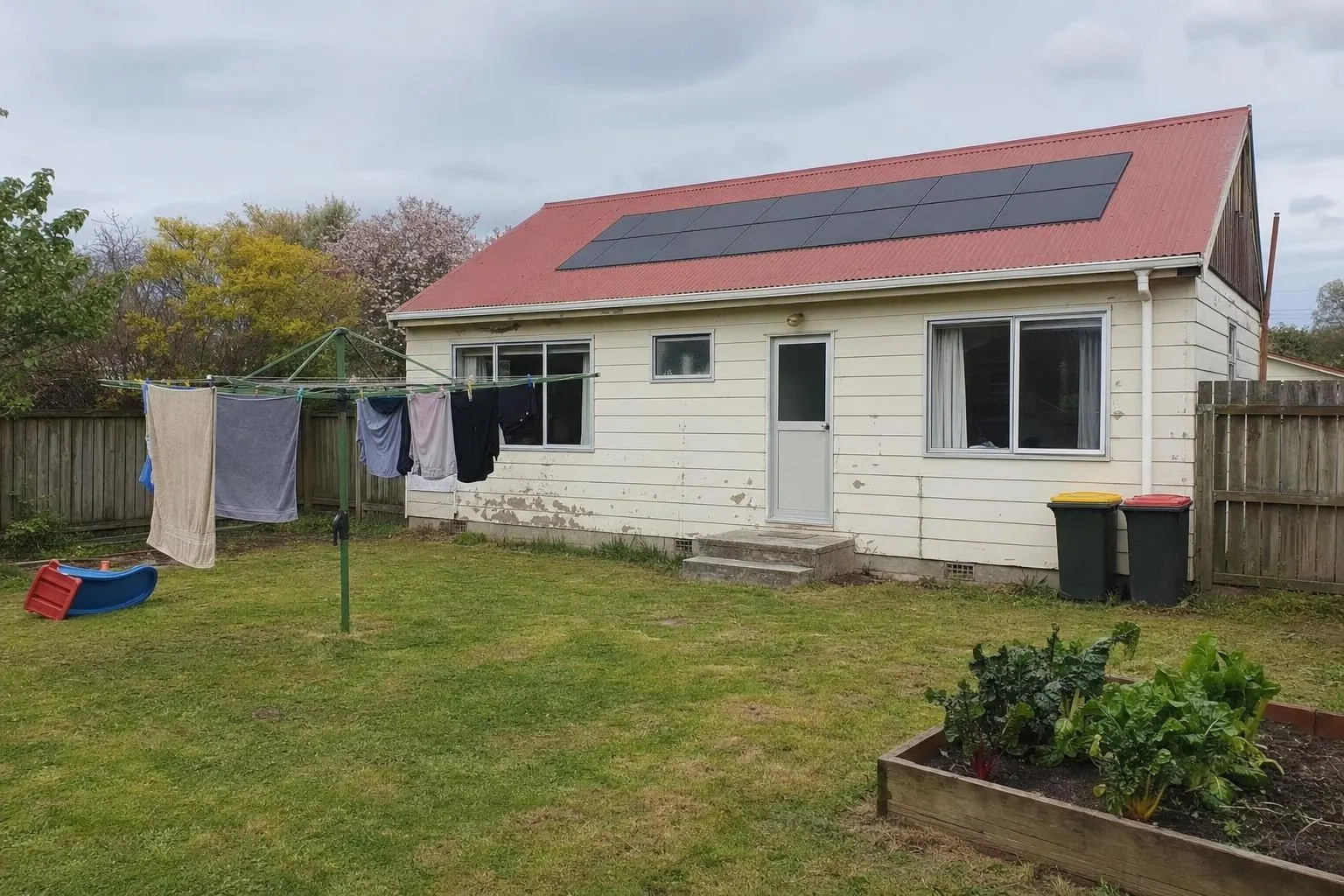
Who gets the savings
Solar saves money in two ways: the power the house uses as it is made is power nobody has to buy, and the surplus sent to the grid earns the retailer’s buy-back rate. Both land on the power account for that connection. EECA explains that a solar system connects to a single ICP, the identifier for a connection to the network, and only the electricity used through that ICP can be offset.
In most New Zealand rentals the tenant holds that account. Tenancy Services’ rule of thumb is that costs which exist only because someone lives in the property, such as power use, fall to the tenant, while costs that apply whether or not anyone lives there, such as rates, fall to the landlord. So on a typical rental:
- The landlord pays for the system, owns it, and carries the roof, insurance and repair questions.
- The tenant gets the lower power bill and any export credit, from the day the import/export meter is set up on their account.
That split is why so few rentals have solar. It is not a reason to give up on it. It means the cost and the benefit have to be brought back together, usually through the rent, and agreed before anyone signs a quote.
One point in the tenant’s favour: a tax change that took effect from the 2026–27 income year exempts income from selling surplus power from the home a person lives in, whether they own it or rent it. Our buy-back rates guide explains the exemption and how to compare export rates.
How a rent rise splits the saving
EECA’s typical price for a 5 kW system is $11,500 including standard installation and GST, and its December 2025 model puts the yearly saving in Canterbury at $1,180 for a home with electric heating and hot water. Here is how four rent rises would split that saving between landlord and tenant.
| Rent rise | Extra rent a year | Landlord’s simple payback | Tenant after the rent rise |
|---|---|---|---|
| $10 a week | $520 | 22.1 years | $660 better off |
| $15 a week | $780 | 14.7 years | $400 better off |
| $20 a week | $1,040 | 11.1 years | $140 better off |
| $25 a week | $1,300 | 8.8 years | $120 worse off |
The break-even point is about $22.70 a week: $1,180 divided by 52. Above it, the tenant pays more in rent than the panels save on EECA’s average figures. Below it, the tenant is ahead and the landlord waits longer for the money back.
Treat the table as a way to frame the conversation, not as a price. Three things move it:
- Who is home in the day. EECA’s saving assumes a household that uses most of its solar. A tenant who is out at work all day uses less of it, so more goes to export at the lower buy-back rate and the real saving is smaller. A family at home, or someone working from home, saves more.
- The tenant’s power plan. The saving depends on the import price and buy-back rate on the tenant’s own plan, which the landlord does not choose.
- Costs left out. The landlord’s figures here ignore interest, tax, insurance and inverter replacement. Simple payback is a rough guide, as our solar cost guide explains.
A smaller system often suits a rental better. Fewer panels cost less, and a tenant is more likely to use most of what a 3 kW system makes. Our guide to what size solar system you need shows how to size from the power use rather than the roof.
The rent rules that apply
Tenancy Services’ page on rent increases and reductions sets the limits a landlord works within:
- Once every 12 months. Rent can rise only 12 months after the tenancy started and 12 months after the last increase.
- 60 days’ written notice, stating the new rent and the date it starts.
- Fixed-term tenancies can have a rent increase only if the agreement allows it.
- No cap on the amount, but a tenant who thinks the new rent is well above similar homes nearby can ask for it to be reduced and then apply to the Tenancy Tribunal.
There is one route outside the 12-month cycle. Tenancy Services says a rent increase can be agreed when the landlord has improved the property, improved its facilities or services, or changed the agreement in the tenant’s favour. Its examples are adding a garage and a pool. General or necessary repairs do not count. If the tenant does not agree, the landlord can apply to the Tribunal. Solar is not named, so do not assume a tenant must accept a mid-tenancy rise because panels went on. Agree it in writing first.
The simplest time to add solar is between tenancies. The new rent is set for the new tenancy, and the advertisement can say the house has solar. Tell applicants what the panels typically save and that the savings depend on their own power use and plan.
Tenancy Services’ guidance on utilities and other payments says nothing about a landlord selling a tenant power from the landlord’s own panels. Do not set up a private arrangement to bill the tenant for solar power without legal advice. Recover the cost through the rent instead.
Tax points for landlords
Inland Revenue’s rental income guide (IR264, March 2026) does not mention solar, but its general rules point one way:
- Capital, not a repair. Repairs and maintenance are normally deductible in the year you pay for them. A capital improvement is not; its cost is depreciated instead. A new solar system adds something the house did not have, so expect it to be capital.
- Depreciation. Buildings are depreciated at 0%, but the guide says you can claim depreciation on furniture and fittings that belong to you. Ask an accountant how the panels, inverter and any battery are classed and which depreciation rate applies.
- Interest. From 1 April 2025 you can claim the interest on money borrowed to finance a rental property, subject to the guide’s rules on mixed-purpose borrowing.
- Buy-back income. If the landlord, not the tenant, holds the power account, the export credit is the landlord’s. The tax exemption for surplus solar covers people selling from the home they live in, so a landlord should not assume it applies.
This is general information from Inland Revenue’s guide, not tax advice. NZ Solar is not a tax adviser; confirm the treatment for your property with an accountant before you rely on it.
Paying for it
The cheap green loans most people hear about may not fit a rental. The bank home energy loans EECA lists from ANZ, ASB, BNZ and Westpac are top-ups to an existing home loan with that bank, and Kiwibank’s Sustainable Energy Loan is for owner-occupied homes. If your rental mortgage is with one of the four, ask whether its top-up can be used on an investment property before you assume the 0% to 1% rate. Our solar finance guide compares the options and what to check.
Whatever the finance, judge the quote on its own. A low rate does not make an oversized system on a house where nobody is home in the day a good investment.
If you are the tenant
Asking the landlord. The strongest case is the worked example above: the house is easier to let, the rent can reflect the improvement, and the tenant’s bill falls. Offer to agree a modest rent rise in writing in return. Point the landlord to this page and to our quote page if they want prices for the property.
Installing panels yourself. Tenancy Services’ rules on tenants making changes to the property say tenants must get consent first. A landlord must not decline a minor change, but a minor change has to be low risk, easily reversed, need no regulatory consent and not affect weathertightness. A roof system, with roof fixings, electrical sign-off and a lines-company application, does not fit those tests. For other changes the landlord must give written consent and must not unreasonably withhold it. If you go ahead, you pay, and anything you leave behind becomes the landlord’s property unless you agree otherwise. For most tenants that makes a roof system a poor bet unless the tenancy is long and the agreement is clear.
Plug-in kits. Small panel kits that plug into a wall socket are aimed at renters, but they are not permitted in New Zealand yet. The Electricity Authority asked households about them in September and October 2026 and no rule or date has been set. Our guide to waiting for solar policy tracks where that stands.
Moving into a rental with solar
- Check the meter. Ask your retailer to confirm the property has an import/export meter recorded on your account. Without it, exports may not be credited.
- Pick a plan with a buy-back rate. Not every plan pays for exports, and rates differ. Compare plans for the address before you move in; our buy-back rates guide shows how.
- Use power in the day. Run the dishwasher, washing machine and hot water timer while the sun is up. Our hot water guide explains timers and diverters.
- Ask how to see the output. Ask the landlord whether you can have access to the inverter’s monitoring app, so you can see when the system is working.
- Report faults in writing. If the inverter shows a fault or the output drops, tell the landlord in writing, as you would for any other problem with the property.
Landlord checklist before you sign a quote
- Talk to the tenant first and agree any rent change in writing, or plan the install between tenancies.
- Size for the house. Ask the installer for a forecast based on a typical tenant’s daytime use, and one size smaller.
- Check the network. The lines company still has to approve the connection. In Canterbury see our guides to Orion, MainPower, EA Networks and Alpine Energy.
- Check the roof. Panels last decades, so replace a tired roof first. Our roof suitability guide covers what to check.
- Tell your insurer about the system, as you would any addition to the building.
- Keep the paperwork: the itemised invoice for your accountant, the electrical certificate, warranties and the lines company’s approval.
- Arrange access for the installers and the meter change with the tenant, in writing.
- Plan for faults. Decide who the tenant should contact if the inverter stops, and put it in writing at the start of the tenancy.
Common questions about solar on a rental
Who gets the savings from solar on a rental?
Whoever holds the power account for the property. In most New Zealand rentals that is the tenant. The panels cut the power bought through the property’s connection and the retailer pays export credits to the account holder, so the landlord pays for the system and the tenant gets the bill savings unless the rent changes.
Can a landlord put the rent up after installing solar?
Rent normally rises only once every 12 months, with at least 60 days’ written notice. Tenancy Services says an increase outside that cycle can be agreed when the landlord has improved the property or its facilities, and the landlord can apply to the Tenancy Tribunal if the tenant does not agree. Its examples are a garage and a pool, not solar, so get the tenant’s agreement in writing.
How much would rent need to rise to pay for solar?
On EECA’s figures, a 5 kW system costs about $11,500 and saves about $1,180 a year in Canterbury. A rise of $20 a week returns $1,040 a year to the landlord, a simple payback of about 11 years, and leaves the tenant about $140 a year better off. Above about $22.70 a week the tenant is worse off on EECA’s average savings.
Can a tenant install solar panels on a rental?
Only with the landlord’s written consent. A roof system involves roof fixings, electrical work and a lines-company application, so it is not one of the minor changes a landlord must agree to. For other changes the landlord must not unreasonably withhold consent. The tenant pays, and anything left behind at the end of the tenancy becomes the landlord’s unless agreed otherwise.
Can renters use plug-in solar panels?
Not yet. Plug-in kits that connect to a wall socket are not permitted in New Zealand. The Electricity Authority asked households about them in September and October 2026 and no rule change or date has been set.
Is solar on a rental tax deductible?
A new solar system is an addition, not a repair, so expect it to be treated as a capital cost and depreciated rather than deducted in one year. Interest on money borrowed for the rental has been claimable again since 1 April 2025. The new tax exemption for selling surplus solar covers people selling from the home they live in, so a landlord should not assume it applies. Ask an accountant.
Canterbury solar quotes
Price solar for a rental before you talk to the tenant.
Tell us it is a rental and roughly how the household uses power, so installers can quote a system sized for the people who live there.
Get Canterbury solar quotesSources and review date
Checked on 9 November 2026 against Tenancy Services’ pages on rent increases and reductions (last updated 29 July 2026), tenants making changes to the property (last updated 26 March 2026) and utilities and other payments; Inland Revenue’s rental income guide IR264 (March 2026); EECA’s pages on solar costs and savings and on bank loans for home energy upgrades (bank details as at June 2026); and the Electricity Authority’s consultation on plug-in generation. The rent table is our arithmetic on EECA’s figures, not a forecast for any property. Tax and tenancy rules change; confirm them with Tenancy Services, Inland Revenue or an adviser before you rely on them.
NZ Solar is an independent quote matching service and is not a tax adviser, lawyer or property manager, and is not affiliated with EECA, Tenancy Services or Inland Revenue. For local advice, see our Canterbury solar guide.