
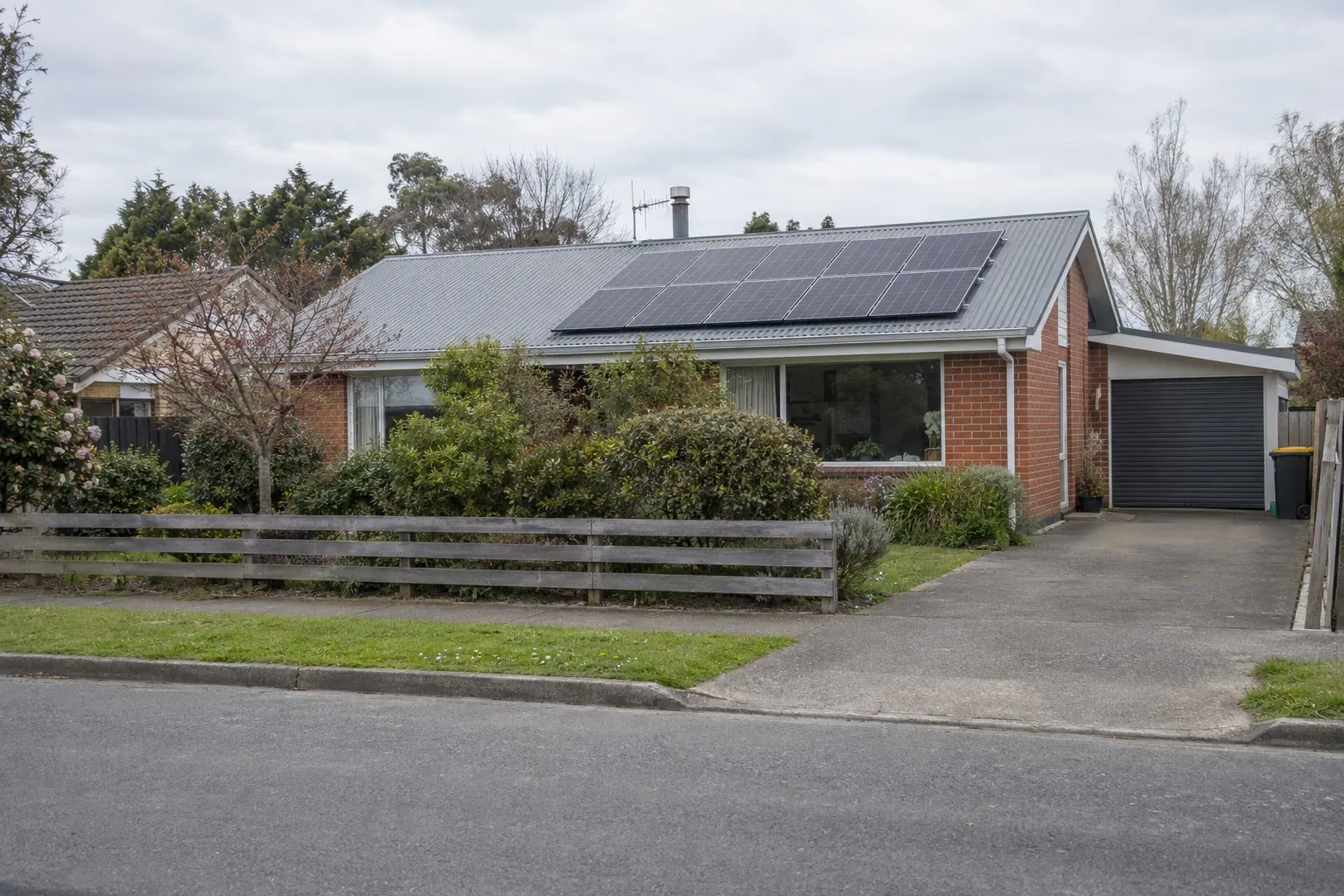
Start with the network for your address
This guide is for properties connected to Orion. A Canterbury postal address alone does not identify the lines company. Check the network against your ICP, the identifier for your electricity connection, before using an Orion limit in a quote.
Orion handles the network connection. Your electricity retailer handles the power plan and export payments. Your installer designs and configures the system. Ask who is responsible for each part so metering or paperwork does not fall between them.
Orion links to an ICP finder and publishes a list of connections with export limits below 10 kW on its generation page. A list check is useful preparation; the written approval for your property is the document to keep.
Export power is different from panel size
A panel rating, inverter rating and export limit describe different parts of a solar system. Ask for all three in the proposal.
| Number | What it describes |
|---|---|
| Panel capacity, in kW | The array’s rated output under standard test conditions. |
| Inverter capacity, in kW | The equipment’s rated power conversion output. |
| Approved export limit, in kW | The maximum power permitted to flow from the property into the network, subject to the approval conditions. |
For example, if a system supplies 7 kW of AC power while the house uses 2 kW, the remaining 5 kW is available to export. This is a simplified snapshot with no battery charging. It is not an annual generation forecast.
A 5 kW export limit does not mean a daily allowance of 5 kWh. Kilowatts measure power at a moment; kilowatt-hours measure energy over time. See our solar system sizing guide for the wider design decision.
What Orion’s 2026 export rules mean
Orion opened applications for higher export limits from 1 April 2026. Its announcement makes increases dependent on local capacity and the capabilities of the installed equipment. Existing owners can apply too. Read Orion’s export update.
The Congestion Management Policy, section 3.2, describes static limits up to 10 kW per phase where studies support them. It does not guarantee 10 kW for every connection. Static limits can be reviewed as local conditions change.
“Per phase” also matters. Have the installer confirm your supply configuration and the proposed limit on each phase. Do not multiply a headline figure by three without checking the actual connection and equipment.
If approval is pending, ask for a second forecast with a lower export allowance. That shows whether the proposed system still suits the household if the initial assumption changes.
The inverter requirement from 1 October 2026
Orion’s published policy says that from 1 October 2026 it will approve inverter-based generation applications only where the inverter is capable of dynamic exports. Communication can be built in or provided through a gateway. Check the exact model and any required gateway with the installer before ordering. See section 3.2 of the policy.
Dynamic export limits respond to network conditions. The policy describes Orion building towards that capability while using static limits in the meantime. Buying compatible hardware does not itself give a household a higher export allowance.
Ask the supplier to identify any communications equipment, connection requirements and ongoing charges in the written quote. A model name alone may not describe the complete installation.
From choosing a system to switching it on
For the under-15 kW application route, Orion sets out four stages. Your installer can handle the technical submission, but it is worth knowing where the job stands. Orion’s detailed application guide is the source for the steps below.
- Select the system. Confirm inverter compliance and the information needed for the application.
- Contact the retailer. Arrange import/export metering and discuss any meter or tariff change charges.
- Apply online and pay the application fee. Orion says processing starts after payment is received. Ask whether the installer’s price includes this fee.
- Complete approval and documentation. After approval and installation, submit the Certificate of Compliance (CoC) and Record of Inspection within ten working days. Orion says the system must not be energised until it acknowledges receipt.
Confirm which application route your design needs, especially for a larger or multi-phase installation. Ask for the current fee and expected assessment time rather than treating either as a fixed promise.
Already have solar and want to export more?
Orion requires approval before an export-limit change. Its generation page says there is no fee for submitting a generation change request; that does not cover an installer’s labour or equipment. Changes to generation plant require a CoC and Record of Inspection. Check the current change-request requirements.
Send the installer your existing approval, inverter model and recent generation records. Ask what actually constrains export now: equipment output, the approved limit, household consumption or another operating condition. Raising a limit will not create extra generation on a cloudy day.
Adding a battery also deserves a fresh check. Have the installer describe the combined system’s export behaviour and confirm the necessary application before changing settings.
Five things to get in writing
- Connection details: the ICP, network and number of phases.
- Equipment: panel capacity, inverter model and rating, plus any gateway.
- Export assumption: the requested limit, approved limit if available, and the forecast if approval is lower.
- Responsibility: who handles the application, metering, inspection and final documents.
- Price: which fees, electrical changes and communications costs are included.
Keep the export allowance separate from the export price. Network approval sets how much power can leave the property; the retailer’s plan sets what exported energy earns. Our buy-back rate guide explains how to compare that part of the bill.
Common Orion solar questions
Does every Orion home get a 10 kW export limit?
No. Local network capacity and the connection assessment affect the approved limit. Use the property’s written approval when checking the design.
Can I turn up my existing inverter’s export setting?
Arrange the approval and installer checks first. A new headline allowance does not change the conditions of an existing connection by itself.
Does a higher export limit mean a better buy-back rate?
No. A power limit and a price per unit of energy are separate. Check the retailer’s plan alongside the network approval.
Canterbury solar quotes
Get the connection details into your quote.
Tell us about your property and power use so installers can respond to the same brief.
Get Canterbury solar quotesSources and review date
Checked against Orion’s generation guidance, under-15 kW application steps, export update and Congestion Management Policy on 30 September 2026. Direct source links appear beside the relevant sections. Confirm current requirements with Orion and your installer when applying.
NZ Solar is an independent quote matching service and is not affiliated with Orion. For broader local advice, see our Canterbury solar guide.