
What has been promised
National, Labour and the Greens have each published a policy that would help households pay for solar. They are listed here in the order they were announced, using only what each party has put in writing. Where a detail is missing, we say so. We do not recommend a party.
National: Home Energy Fund (announced 25 June 2026)
- Loan: secured against the property and repaid over ten years through the rates bill, or when the house is sold. The fund pays the installer directly.
- Interest: “low, competitive”. No rate is given.
- Grant: none stated.
- Who can apply: ratepayers with at least 20% equity, in districts where the council has joined.
- Covers: solar, batteries, insulation and heat pumps.
- Timing: no date. It needs a law change first.
Labour: SolarSaver (announced 8 July 2026)
- Loan: two options. A lines company loan for solar and a battery, repaid through the power bill, or a property-linked loan repaid through rates.
- Interest: “low-interest”. No rate is given.
- Grant: up to $3,000 for low- and middle-income households.
- Who can apply: the income limits for the grant have not been published.
- Covers: solar and batteries. The rates-based loan also covers items such as hot water heat pumps.
- Timing: running within 12 months of taking office.
Greens: zero-interest clean energy loans (announced 20 July 2026)
- Loan: tied to the property and repaid through a levy. The party’s costing assumes $25,000 over 20 years.
- Interest: 0%.
- Grant: none stated.
- Who can apply: up to 90% of rateable properties, if every council joins.
- Covers: solar, batteries and energy efficiency upgrades.
- Timing: the party estimates “as little as 6 months”.
All three loan schemes build on the same idea, the Ratepayer Assistance Scheme that Local Government New Zealand has been developing with councils. The loan stays with the house, not the owner, and is collected alongside rates. Labour’s policy also includes a $30 million fund for community batteries and support for plug-in panels for renters, which do not change the sums for a homeowner buying a roof system.
This is not a full account of every party’s energy policy. ACT’s published position is about removing rules, covered below, not about loans or grants.
When any of it could start
Election day is 7 November 2026 and the Electoral Commission will declare official results on 27 November. A government then has to be formed. After the 2023 election that took just over six weeks from polling day.
Every loan scheme needs Parliament to change the law first. National’s policy says its fund requires an amendment to the Local Government Act. Local Government New Zealand’s own estimate for the Ratepayer Assistance Scheme is 12 to 18 months to be up and running once legislation has passed. Labour says its loans and grant would be running within 12 months of taking office. The Greens estimate six months.
Put those together and the earliest any household could apply is mid-2027 on the most optimistic estimate, and late 2027 or 2028 on the others. Then your council has to join. Participation is voluntary in every version.
None of the three policies says whether a system installed before the scheme opens could be moved onto a scheme loan or claim the grant afterwards. Assume it could not until a party says otherwise.
What waiting costs in Canterbury
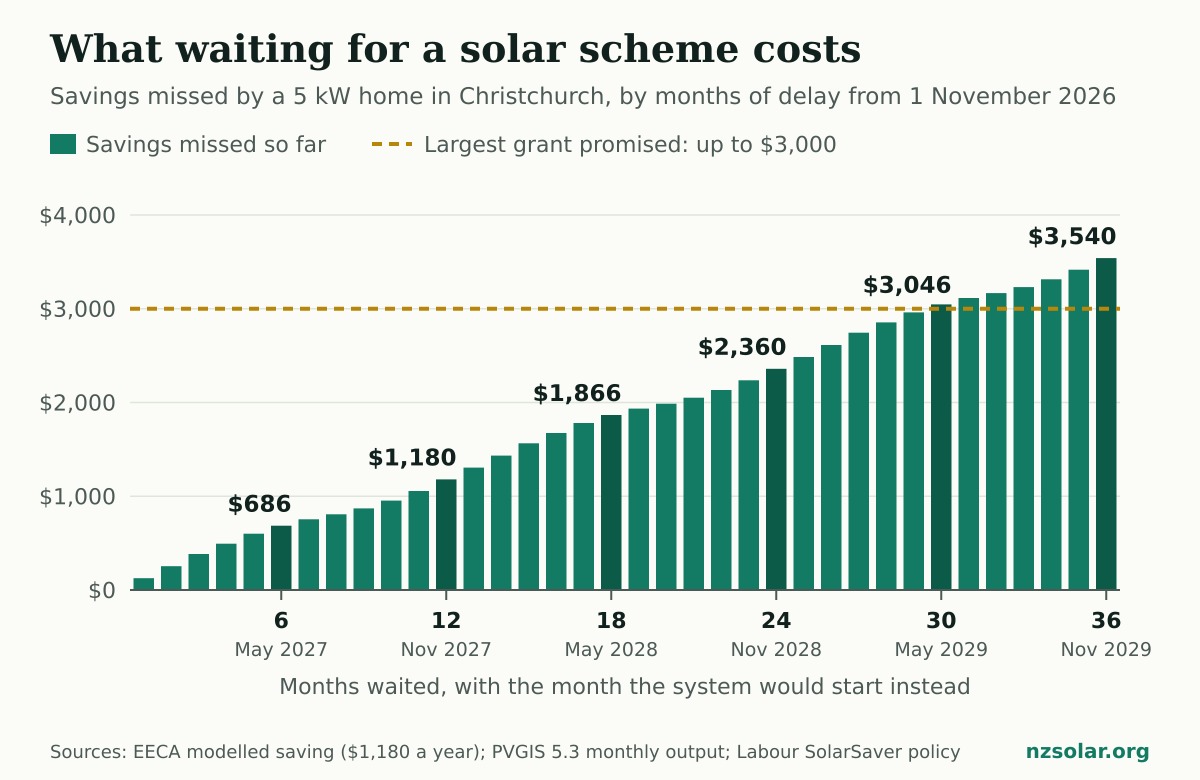
EECA’s model puts the yearly saving from a 5 kW system on a Canterbury home with electric heating and hot water at $1,180. Solar does not earn that evenly through the year. Our PVGIS analysis for Christchurch shows a north-facing system makes more than twice as much in December as in June. Splitting the $1,180 across the months in the same proportions gives the cost of each month of delay. The chart shows the running total, counted from 1 November 2026, and the table gives the same figures.

| You install instead in | Months waited | Savings missed |
|---|---|---|
| February 2027 | 3 | $384 |
| May 2027 | 6 | $686 |
| November 2027 | 12 | $1,180 |
| May 2028 | 18 | $1,866 |
| November 2028 | 24 | $2,360 |
| May 2029 | 30 | $3,046 |
The season matters. The six months from November to April hold 58% of the year’s output, worth about $686. May to October is worth about $494. Putting a decision off from spring until after the election and the summer holidays costs more than the same delay through winter.
Your own figure will differ. A home that uses most of its solar during the day, or has higher power prices than EECA assumed, loses more by waiting. A house that is empty all day loses less. The cost guide shows how to adjust the $1,180 for a quote.
Is the grant worth waiting for?
Labour’s $3,000 is the only cash on offer. On the figures above, it takes about 30 months of missed savings to cancel out the full amount. So if you were sure of receiving $3,000 and the scheme opened 12 to 18 months from now, waiting would leave you ahead by somewhere between $1,100 and $1,800.
Four conditions all have to hold:
- Labour leads the next government and keeps the policy through coalition talks.
- Your household is under the income limit. The policy says low- and middle-income households. It does not give a figure.
- You get the full amount. The policy says “up to” $3,000.
- The money has not run out. Labour has set aside $77 million over four years. That pays for about 25,700 grants at the full $3,000, across the whole country. For scale, Canterbury alone already has 14,503 homes with solar.
If your household income is clearly above average, the grant is not aimed at you and there is nothing here to wait for. If it is modest and you were going to struggle to fund the system anyway, the election result is worth knowing before you sign. Polling day is a month away.
Are the loans worth waiting for?
A cheaper loan is worth the interest it saves you, compared with the finance you can get today. That depends on which of three groups you are in.
You have a mortgage with a big bank
You probably have access to a cheap loan already. EECA’s list of bank home energy loans, dated June 2026, shows ANZ, ASB and BNZ at 1% fixed for three years on up to $80,000, and Westpac at 0% for five years on up to $50,000. Each requires an existing home loan with that bank. A 0% government loan cannot beat a 0% bank loan by enough to pay for a year’s delay. What the schemes would add is a longer term and so lower repayments. Our solar finance guide covers the bank options.
You can pay cash
A loan scheme saves you nothing. Waiting only costs you the savings in the table above.
You have no mortgage with those banks and not enough cash
This is who the schemes are built for: retired owners without a mortgage, and people whose bank has no energy loan. The table shows what $11,500, EECA’s typical price for a 5 kW system, costs to repay over ten years at different rates.
| Interest rate | Monthly repayment | Total interest |
|---|---|---|
| 0% | $96 | $0 |
| 4.25% | $118 | $2,636 |
| 7% | $134 | $4,523 |
| 10% | $152 | $6,737 |
These rates are for comparison, not offers. The 4.25% row is the rate the Greens’ costing assumes before its subsidy. Local Government New Zealand expects Ratepayer Assistance Scheme loans to be priced 2 to 2.5 percentage points below bank floating mortgage rates.
Set against savings of about $98 a month, a 0% ten-year loan roughly pays for itself from the first month. If your only alternative is borrowing at 10%, a scheme loan would save several thousand dollars in interest over the term, which is more than a year or two of missed savings. In that position waiting can be the better choice, as long as you accept that the scheme may arrive late, or not in your district.
Rule changes already agreed
Separate from the election promises, the Ministry for Regulation reviewed the rules for installing solar this year. On 10 August 2026 Cabinet agreed a package that includes making clear that most standard installations do not need a building consent, national planning rules so fewer need a resource consent, faster and more consistent lines company approvals, a more proportionate approach to electrical inspections, and legalising plug-in solar.
No dates have been set. The Ministry estimates the changes are worth $28 million to $50 million across the whole country over ten years. Shared among every installation in that time, that is a small amount per home. It will make the process simpler. It is not a reason to delay a standard roof system that already needs no consent. If your installer says yours does need one, ask why, and check our guide to Orion’s connection approval for the network side.
Canterbury councils have not signed up
A rates-based loan only exists where the council takes part. Christchurch City Council held a workshop on the Ratepayer Assistance Scheme on 12 May 2026. The council had been asked to indicate support in principle, and the workshop papers said a report would follow seeking to confirm its interest. That is not a decision to join. We have not found a decision from Selwyn, Waimakariri or any other Canterbury council.
So a Canterbury homeowner waiting for a rates-based loan is waiting on three things in a row: the election result, a law change, and a vote by their own council.
How to decide
| Your situation | What the sums say |
|---|---|
| Paying cash | Go ahead. No loan scheme helps you, and the grant only matters if your income is modest. |
| Mortgage with ANZ, ASB, BNZ or Westpac | Go ahead. Ask your bank about its energy loan first. |
| Modest income, may qualify for a grant | Get quotes now and decide after 27 November, when the result is official. |
| No mortgage, no cash, would need a personal loan | Waiting may pay. Check which government forms and whether your council joins. |
Getting quotes commits you to nothing and takes a few weeks, which is about how long it will be before the result is known. If you do go ahead with finance, ask the lender whether the loan can be repaid early without a fee. That keeps the door open if a cheaper scheme does appear.
Be wary of any sales pitch that uses the election either way. “Buy before the rules change” and “prices will jump when subsidies arrive” are both guesses. No published policy sets or caps what installers charge.
Common questions
Is there a government subsidy for solar panels in New Zealand right now?
No. There is no general grant for home solar. Several banks offer low-interest energy loans to their home loan customers, which EECA lists on its website.
If I install now, can I claim a grant later?
None of the published policies says so. Labour’s policy does not mention systems already in place. Assume a grant would not be backdated.
When could a rates-based solar loan be available in Christchurch?
Not before the law is changed and Christchurch City Council votes to take part. Local Government New Zealand estimates 12 to 18 months from legislation to launch, which points to late 2027 at the earliest.
Will solar get cheaper after the election?
No policy sets or caps installer prices. The agreed rule changes should trim consent and approval costs for some installations, but the Ministry for Regulation’s own estimate of the benefit is small per household.
Would I have to repay a rates-based loan if I sell?
The proposals differ. National’s says the loan is repaid over ten years through rates or on sale of the property. The Greens’ says some borrowers could defer repayment until sale. Labour’s describes its rates-based option as property-linked. Check the final rules before borrowing.
Method and sources
Policy details come from each party’s own published policy: National’s Home Energy Fund, Labour’s SolarSaver and the Greens’ Power for all of us policy and its full policy document. ACT’s position is from its statement of 18 May 2026. Election dates are from the Electoral Commission’s key dates. The Ratepayer Assistance Scheme timing and expected pricing are from Local Government New Zealand. The Christchurch City Council position is from its workshop agenda of 12 May 2026.
The $11,500 system price and $1,180 yearly saving are EECA’s figures for a 5 kW system in Canterbury, calculated in December 2025. Bank loan terms are from EECA’s home energy loans page; confirm them with your bank. The monthly split uses our PVGIS 5.3 analysis for a 5 kW north-facing system at 30° in Christchurch, and assumes savings follow generation month by month. Repayment figures are standard loan arithmetic with monthly payments and no fees. This article is general information, not financial advice. Information reviewed on 7 October 2026.
Canterbury solar quotes
Know your real price before the result is in.
Tell us about your home and power use. We pass that brief to installers who work in your area, and you can decide what to do with the quotes once you have them.
Get solar quotes