
Who holds the contract now
SolarZero Limited was placed into liquidation on 26 November 2024. Its own website, which now exists only to support existing subscribers, says the company’s 15,000 subscribers’ Energy Service Agreements continue. SolarZero says it does not sell or install systems any more.
The agreements allowed SolarZero to transfer its rights and obligations to someone else, and that is what happened. According to SolarZero’s customer FAQs and its About page:
| Party | Role |
|---|---|
| Public Trust, a Crown entity | Trustee of the trusts that own the solar systems, at the lenders’ request |
| Special-purpose companies | Hold the contract obligations |
| SZ Servicing Limited, a wholly owned subsidiary of Verofi Limited | Runs the contracts for the trust: customer care, billing, monitoring, repairs and house moves. It does not own the contracts or systems and is paid a servicing fee |
| SolarZero Energy Services | Bills the monthly fee, from 1 April 2025 |
Verofi’s disputes page names the two trusts as SolarZero Residential No.1 Trust and SolarZero Residential Warehouse Trust, each with its own contract servicer company, and says your contract is with one or the other. Customer care can tell you which applies to your home.
For most households the practical point is simple: you deal with SZ Servicing, still trading as SolarZero, on 0800 609 647.
What still applies
- You do not own the system. The panels, inverter and any battery belong to the trust, as they belonged to SolarZero before.
- The term. SolarZero’s FAQs describe the agreements as 20 or 25-year Energy Service Agreements. A home bought with a system already on it carries the years left from when the original owner signed up.
- Repairs and replacement. SolarZero says it is responsible for repairing and replacing the solar and battery system, whether it is a warranty claim, end of life, fire, flood or anything else except deliberate damage. It says it will keep using the battery until it affects the performance guarantees, then replace it.
- Monitoring. Systems are monitored centrally, and you can see yours in the MySolarZero dashboard and app. SolarZero notes that the battery and monitoring features do not apply to panel-only subscribers or systems with microinverters.
- The terms themselves. When Verofi took over servicing, Consumer NZ reported that customers could end their contracts only in specific circumstances, that the change of servicer was not one of them, and that Verofi needed customers’ agreement to change the terms and conditions.
What has changed
The pricing. SolarZero’s FAQs say SZ Servicing had to reassess the subsidised power rates it inherited, and moved customers from one flat rate all day to several time-of-use rates. New rates are announced by email. If your bills went up after the change, check which hours are now cheapest and move what you can, such as the dishwasher, washing machine and hot water, into the times your plan rewards. Our battery or no battery guide explains how time-of-use plans interact with a home battery.
The retailer. SolarZero’s grid power came through Pulse until 1 April 2025, and its partner is now Ecotricity. The FAQs say your Energy Service Agreement lets you change power company, but that doing so affects the savings guarantee. Get SZ Servicing to tell you in writing what you would lose before you switch, then compare that against a plan you find yourself. Our buy-back rates guide shows what other retailers pay for exported power.
An older Consumer NZ review, written before the liquidation, said SolarZero customers were locked into one retailer. That is no longer how SolarZero describes it, which is a good reason to read the current FAQs rather than older articles.
Selling a house with a SolarZero system
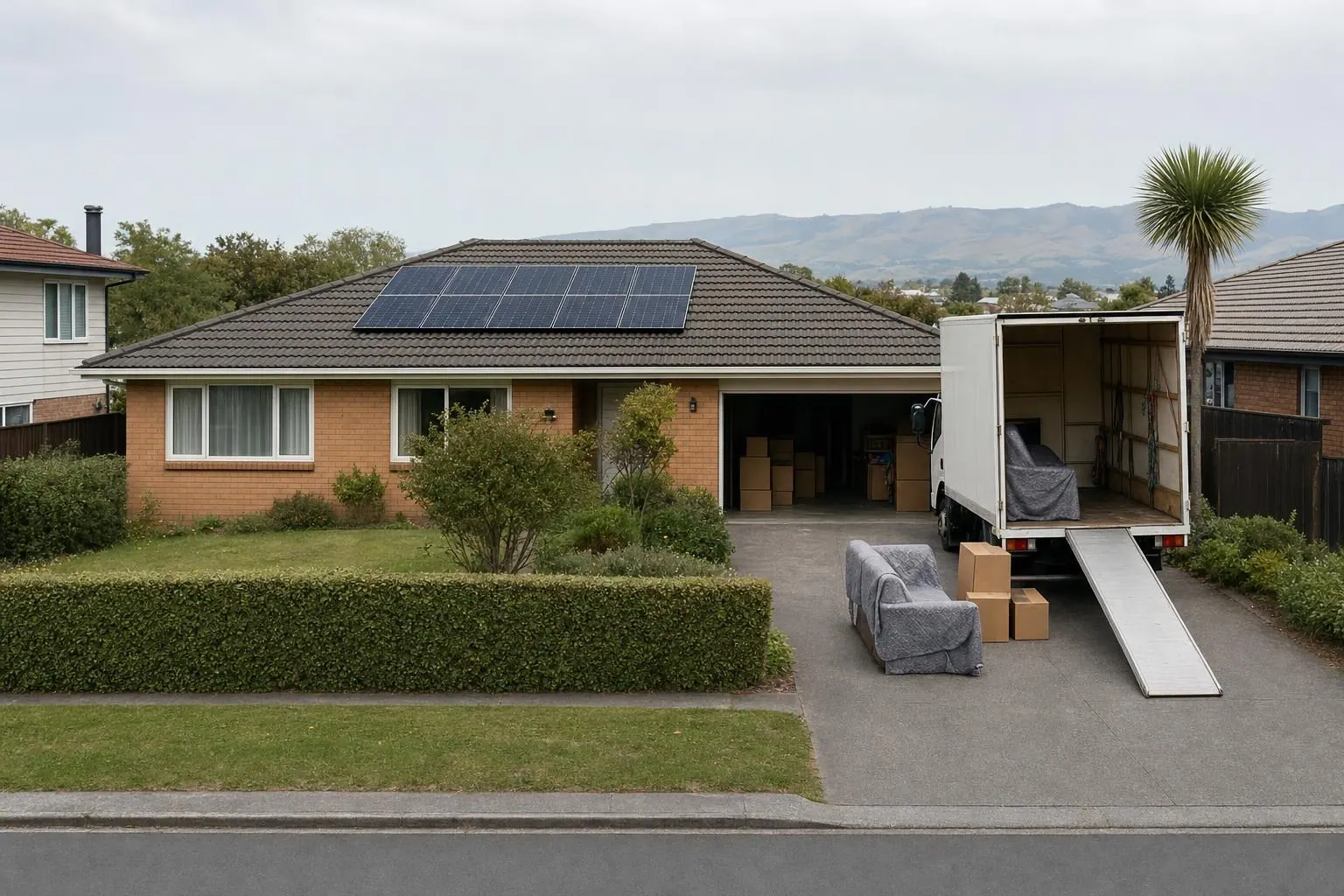
The system stays on the roof, so the agreement has to go somewhere. SolarZero says SZ Servicing has a team for customers moving house, and that it will support transferring the agreement to the new owner. Before the liquidation, Consumer NZ described three outcomes: the new owners take on the agreement, you pay out the rest of it, or you have the system moved to your next home if that roof suits. SolarZero’s current pages describe only the transfer, so ask whether the other two are still offered and on what terms.
Start before you list the house:
- Call 0800 609 647 or email transfers@solarzero.co.nz and say you are selling.
- Ask for a copy of your Energy Service Agreement, the start date and years left, the current monthly fee and the current power rates.
- Ask what the transfer process involves for a buyer, how long it takes, and whether there are any fees.
- Ask for a payout figure in writing, so you know your fallback if a buyer will not take the agreement on.
- Give all of it to your real estate agent and lawyer early. A buyer who learns about a 25-year agreement after making an offer is a buyer you may lose.
Consumer NZ warned in 2024 that the agreement could make selling a house messy and expensive. Having the paperwork ready is the best answer you can give a cautious buyer.
Buying a house with a SolarZero system
Panels on the roof are not proof the seller owns them. If the listing or the property file mentions SolarZero, a subscription or an energy service agreement, treat it as a contract you are being asked to take on, and price it in.
Ask the seller and SolarZero for:
- The agreement and the years left. You inherit the remaining term, not a fresh one.
- The monthly fee and current tariff. Compare the total with what you would pay for grid power alone and with the cost of owning a system outright; our solar cost guide has current EECA figures.
- What is installed. Panels only, or panels and a battery? Microinverters? Panel-only and microinverter systems do not get the battery and monitoring features.
- Which trust and servicer company holds it, and who to contact for faults.
- The transfer steps and any fee, and what happens if you do not want to take it on.
- The power retailer, and what you would lose under the savings guarantee if you used a different one.
Talk to your lawyer before you sign, so the agreement is covered by a condition in the sale and purchase agreement and you have time to read it. NZ Solar is not a lawyer, and this is not legal advice.
If you are buying in Christchurch and would rather own your own system later, the roof still has to suit it and the lines company still has to approve the connection. Our roof suitability guide and Orion export limits guide cover both. Do not plan any roof or electrical work around SolarZero equipment without asking SZ Servicing first.
Ending the agreement early
SolarZero’s current customer pages do not publish exit or buy-out terms, and we could not find a payout formula anywhere SolarZero or Verofi publishes. Consumer NZ reported in December 2024 that the agreements can be ended only in specific circumstances.
If you want out, ask SZ Servicing in writing for the exact clause that would let you end the agreement and the amount you would pay, and get legal advice before you agree to anything. Do not remove or disconnect the system yourself; it is not yours.
Complaints and your rights
Raise the problem with SolarZero customer care first, in writing, and keep a record. If it is not resolved, Verofi’s disputes page says SolarZero customers go to Utilities Disputes, the free scheme for complaints about energy providers. Verofi says energy service agreements are not financial services agreements, so its financial services dispute scheme is not the route for them.
SolarZero’s website terms say nothing in them affects your rights under the Consumer Guarantees Act 1993 and the Fair Trading Act 1986. If you bought a system outright from an installer rather than subscribing, the route is different; our quote guide FAQs explain what to do when an installer will not fix a fault.
If you are choosing solar now
SolarZero no longer signs up new customers, but its story is a useful test for any long contract. Before signing a subscription, lease or long finance deal, ask who owns the system, who you deal with if the company changes hands, whether prices can change, what it costs to leave, and what happens when you sell the house.
Owning the system outright, paid with savings or a loan, keeps those questions simple: the system is part of the house and there is nothing to transfer. Our solar finance guide compares green home loans and other ways to pay, and our common quote mistakes guide covers what to check in any solar contract.
Common questions about SolarZero contracts
Who owns SolarZero now?
SolarZero Limited is in liquidation. The solar systems sit in trusts with Public Trust, a Crown entity, as trustee, and special-purpose companies hold the contract obligations. SZ Servicing Limited, a subsidiary of Verofi, runs the contracts for a servicing fee and still trades as SolarZero.
Is my SolarZero contract still valid?
Yes. SolarZero says its subscribers’ Energy Service Agreements continue after the liquidation. They run for 20 or 25 years from when the original customer signed up, depending on the agreement.
Can I sell my house with a SolarZero system on the roof?
Yes. SolarZero has a team that transfers the agreement to the new owner; contact it on 0800 609 647 or transfers@solarzero.co.nz before you list. Ask for the years left, the monthly fee and a written payout figure, and give them to your agent and lawyer early.
Do I have to take over a SolarZero contract if I buy the house?
The system belongs to the trust, not the seller, so the agreement has to be transferred, paid out or otherwise settled as part of the sale. Find out the terms before you go unconditional and ask your lawyer to make the purchase conditional on them.
Can I change power company with a SolarZero system?
SolarZero says the agreement lets you change grid energy company, but that changing affects the savings guarantee. Ask SZ Servicing in writing what you would lose before you switch.
Who replaces the SolarZero battery when it fails?
SolarZero says it is responsible for repairing and replacing the solar and battery system, including at end of life, and will replace the battery once it affects the performance guarantees. Panel-only systems and those with microinverters do not include the battery features.
Where do I complain about SolarZero?
Contact SolarZero customer care first. If that does not resolve it, Verofi says SolarZero customers can take the complaint to Utilities Disputes, which is free.
Canterbury solar quotes
Want a system you own outright?
If you are buying a Canterbury home without solar, or planning for one after a subscription ends, we can match you with installers for a quote on a system that belongs to the house.
Get Canterbury solar quotesSources and review date
Checked on 13 November 2026 against SolarZero’s customer FAQs, About, Solar Subscription, Contact and website terms pages (terms updated December 2024); Verofi’s external disputes resolution page; and Consumer NZ’s “SolarZero liquidation: what to do if you’re a customer” (6 December 2024) and “SolarZero: is it worth it?” (updated 16 October 2024). SolarZero publishes no fee amounts or exit terms, so this page gives none.
This page is general information, not legal or financial advice. NZ Solar is an independent quote matching service and is not affiliated with SolarZero, SZ Servicing, Verofi, Public Trust or Utilities Disputes. For local advice, see our Canterbury solar guide.