
What the credit is
Two different payments can apply to power you export. The first is the buy-back rate from your electricity retailer, which pays for the energy itself. The second is newer: a credit from the lines company for exporting at times when its network is busiest, because that power eases the load on local lines.
The Electricity Authority has required every lines company to offer the second kind to households and small businesses since 1 April 2026. Orion’s version is called the winter peak injection price. Its delivery price schedule from 1 April 2026 sets it at 6c per kWh before GST, the same in all four of its residential price categories.
Orion also publishes a document called its Export credits policy. That one is for generators that apply for individual approval and are measured during Orion’s winter control periods, with a specific method for 30 to 750 kW plant. It is not how an ordinary home system is paid.
When it applies
Three conditions must all be true for an exported kWh to earn the credit:
| Condition | Orion’s rule |
|---|---|
| Season | 1 May to 31 August |
| Days | Monday to Friday |
| Hours | 7am to 11am and 5pm to 10pm |
| Credit | 6c per kWh exported, before GST |
| Other times | No credit from Orion |
In 2026 that season had 87 weekdays, or 783 credit hours. Midday exports, weekend exports and anything from September to April earn the retailer’s buy-back rate only.
These are the same hours Orion uses for its peak charges on power you take from the network. The difference is the season: peak charges for using power apply all year, while the export credit is limited to the four winter months.
Who qualifies
Orion’s pricing policy lists what a connection needs:
- A residential price category. Small and medium business connections up to 69 kVA are also covered.
- A communicating smart meter that records half-hourly. Orion only accepts export volumes read from communicating smart meters. Estimated or profiled volumes do not count.
- Import and export metering. The meter must record power flowing both ways, which any approved solar connection should already have.
- An approved connection. Exports are still capped by your approved export limit.
The meter condition is the one to check. If your bills show estimated readings, or your meter has stopped reporting, your retailer may have no half-hourly export data to submit for you. Ask the retailer whether the meter is communicating and when it was last read remotely.
When Orion first introduced two-way pricing in April 2025, it told customers to ask their retailer to enrol them. The 2026 schedule builds the credit into every residential category, but it is still worth asking your retailer to confirm your connection is set up to receive it before next winter.
What panels alone can earn
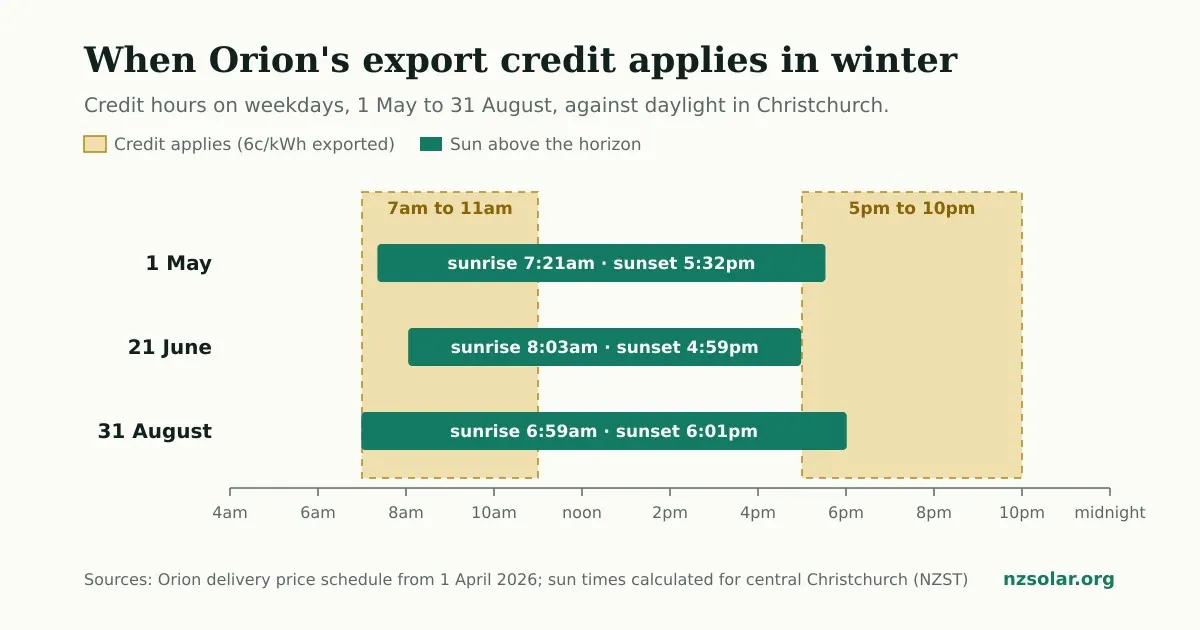
The chart at the top shows the problem. On the shortest day the sun rises at 8:03am and sets at 4:59pm in Christchurch, so the whole evening window is dark. Even on 31 August the sun sets an hour into it, and low sun on a north-facing roof produces very little.
The morning window does overlap with daylight, by about three hours in June and closer to four at each end of the season. But morning is also when a household is using power for heating, hot water and breakfast, and only the surplus is exported.
A ceiling shows the scale. Our PVGIS analysis gives a 5 kW north-facing system in Christchurch about 1,600 kWh in total from May to August. The weekday share of that is about 1,130 kWh. If every one of those units were exported at 6c, the credit would be about $68. Only generation before 11am and after 5pm counts, and in winter the sun is highest at about 12:30pm in Christchurch, so well under half of a north-facing array’s output falls in the credit hours. That puts the real ceiling below about $34 for the winter, before the house uses any of it.
An east-facing array makes more of its power in the morning and will capture a larger share. It also makes less in winter overall. Do not choose a roof face for this credit.
What a battery can earn
A battery can export in the evening window whatever the sun is doing, so it can collect the credit on every kWh it sends out between 5pm and 10pm. The sum is simple: kWh exported per weekday, times 87 weekdays, times 6c.
| Exported each weekday in credit hours | Season total | Orion credit, before GST |
|---|---|---|
| 2 kWh | 174 kWh | $10.44 |
| 5 kWh | 435 kWh | $26.10 |
| 10 kWh | 870 kWh | $52.20 |
These figures are arithmetic, not a forecast, and they assume the battery has that much to spare every weekday. In a Canterbury winter it often will not. A 5 kW system averages about 10.5 kWh on a June day before the house uses any of it, as our guide to batteries in a Canterbury winter shows.
A battery does not pay for itself on this credit. Treat it as a small extra on a battery you are buying for other reasons.
Why using it at home still wins
Orion’s own schedule shows which way round the value runs. For power a home takes from the network at peak times, Orion charges the retailer 14.2c a kWh on its standard residential categories and 17.3c on its low-user categories, before GST. For power a home sends out at winter peak, it credits 6c.
| Residential category | Charge for peak use | Credit for winter peak export |
|---|---|---|
| Standard user | 14.192c | 6c |
| Low user | 17.251c | 6c |
So each stored kWh used at home at 6pm saves a lines charge more than twice the size of the credit, and the cost of the energy as well. On a time-of-use plan that shows up as a high peak import price. Exporting stored power at peak only beats using it when your retailer’s peak buy-back rate, including whatever it passes on from Orion, is higher than the price you pay to import at the same hour. For most homes with a heat pump running, it is not.
The same logic rules out charging a battery from the grid overnight simply to export it for the credit. You pay to import, lose some energy in the battery, and earn 6c plus the buy-back rate. Ask for that sum on your own plan before changing any settings. EECA makes the same point about solar generally: using your own power usually saves more than selling it.
Is your retailer passing it on?
Orion applies the credit to its bill to your retailer. The Electricity Authority’s guidance describes it as a negative charge credited to the consumer’s retailer, and its design relies on retailers sharing it with customers through their buy-back plans. Large retailers have had to offer time-varying buy-back plans since mid-2026.
That leaves three ways it can reach you: as a separate line on the bill, folded into a higher peak buy-back rate, or not visibly at all. Ask the retailer directly:
- Do you receive Orion’s winter peak injection credit for my connection?
- How do you pass it on: a separate credit, or within the peak buy-back rate?
- Is my meter communicating, and are my exports billed on actual half-hourly reads?
- Which of your plans pays most for weekday exports between 5pm and 10pm in winter?
You can check the answer yourself. Ask the retailer for your half-hourly data for a winter month, including exports. Electricity Authority rules give you the right to request the consumption data a retailer holds about you. Add up the kWh exported on weekdays between 7am and 11am and between 5pm and 10pm, and multiply by 0.06. That is what Orion credited your retailer for the month, before GST. Compare it with what the bill shows.
Do not switch plans for the credit alone. A plan with a generous peak buy-back rate can still cost more overall once import prices and the daily charge are counted. Our buy-back rate guide sets out how to compare the whole bill.
MainPower, EA Networks and Alpine Energy
The Authority’s rule applies to every lines company, so the other three Canterbury networks must also offer a peak export credit. Each sets its own price, hours and season in its own price schedule, and they differ from Orion’s. If you live outside Orion’s area, ask your retailer for the lines company’s export credit terms for your connection. Our Canterbury guide shows which network covers each district.
Common questions
How much does Orion pay for solar exports?
Orion credits 6c per kWh, before GST, for exports on weekdays between 7am and 11am and between 5pm and 10pm, from 1 May to 31 August. It pays nothing at other times. Your retailer’s buy-back rate is separate.
Do I need a battery to get the credit?
No, but panels alone export little in those hours because the evening window is dark in winter. A battery can export in the evening window on any weekday.
Will the credit show on my power bill?
Not necessarily. Orion credits the retailer. Some retailers show a separate credit, some build it into a peak buy-back rate. Ask yours how it is passed on.
Does the credit apply in summer?
No. Orion’s 2026 schedule limits it to 1 May to 31 August. Summer exports earn the retailer’s buy-back rate only.
Will the rate be the same next winter?
Orion sets new prices each 1 April and has signalled a review of its pricing structure for April 2027. Check the new schedule before relying on 6c for winter 2027.
Method and sources
Prices, hours, season and eligibility come from Orion’s delivery price schedule and pricing policy that apply from 1 April 2026. All Orion prices here exclude GST. The requirement for lines companies to offer a peak export credit, and the description of how it is credited to retailers, come from the Electricity Authority’s decisions on new ways to empower electricity consumers and its guidance for the industry.
Sunrise and sunset times are calculated for central Christchurch in New Zealand Standard Time using standard solar position equations. The weekday count runs from 1 May to 31 August 2026 and includes public holidays that fall on weekdays; Orion’s schedule does not say whether those days are treated differently. Winter output uses our PVGIS 5.3 analysis for a 5 kW north-facing system at 30°. The earnings tables are arithmetic on those published figures. Information reviewed on 5 October 2026.
Canterbury solar quotes
Get quotes that show imports, self-use and exports separately.
Tell us about your home, power use and whether a battery is on the table. We pass that brief to installers who work in your area.
Get solar quotes