
Where plug-in solar stands in November 2026
Plug-in solar is not legal to use in New Zealand yet. The Electricity Authority’s September 2026 consultation paper says plainly that a WorkSafe prohibition notice currently prevents these products being used here, and that the notice is under review.
The direction is set, but the detail is not:
- 30 July 2026. The Ministry for Regulation released its review of the rules for home and small-scale solar, which covered rooftop, ground-mounted and plug-in systems and recommended legalising plug-in solar.
- 10 August 2026. Cabinet agreed a package of changes from that review, including legalising plug-in solar. Our guide to waiting for solar policy covers the rest of the package.
- 8 September to 6 October 2026. The Electricity Authority asked households and the industry how plug-in systems should be treated under its rules. It has not yet published a decision.
- 15 October 2026. During the election campaign, National promised that shops could sell plug-in kits within six months of a re-elected National Government, once the new safety rules are in place.
- 7 November 2026. The election was held. Official results are due on 27 November, and the timing of the next steps will depend on the government that forms.
So the answer to “when?” is that nobody has published a date. The safety standard is still being written, and the Authority says it is still considering how best to put the requirements in place.
What a plug-in kit is
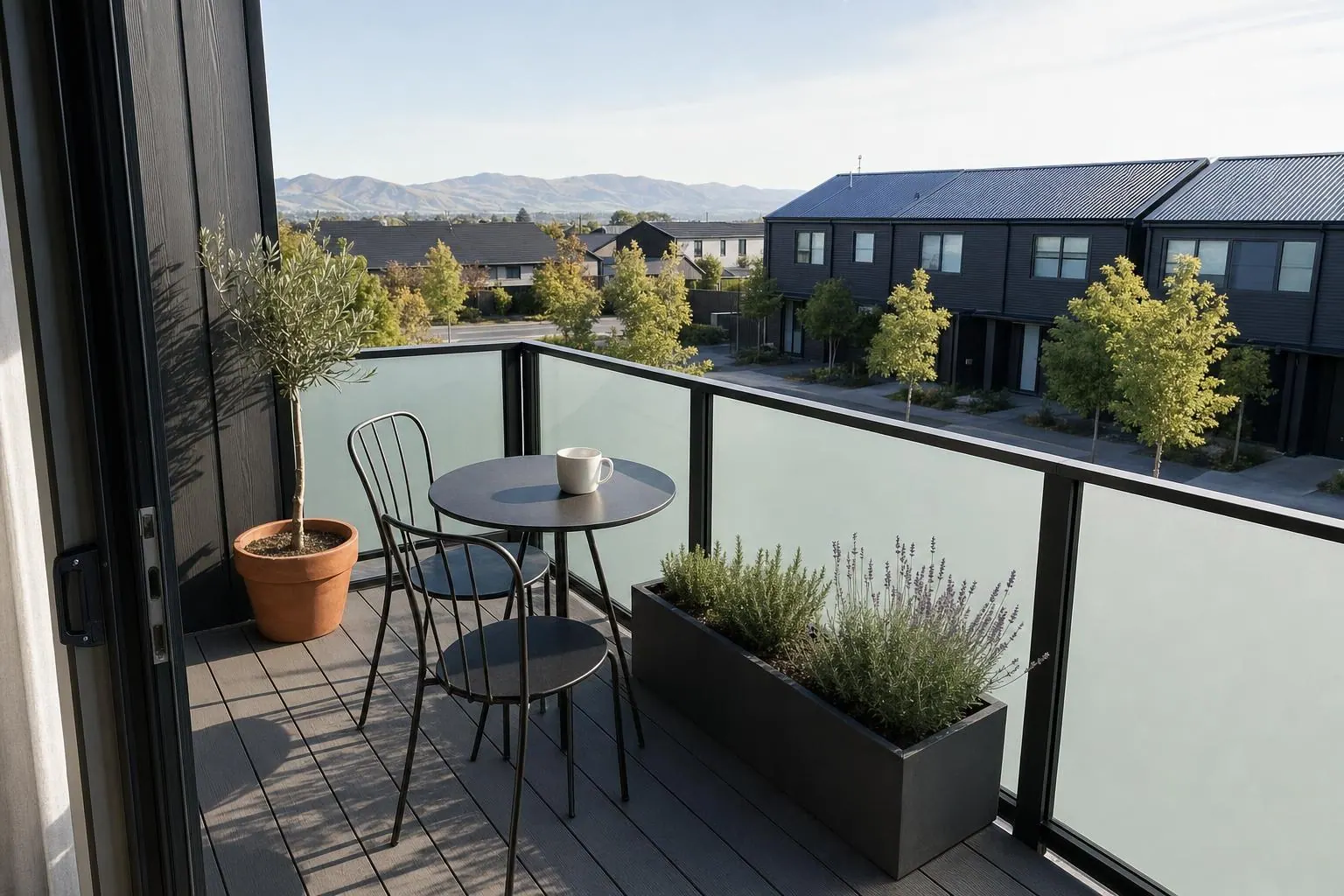
A plug-in kit is usually one or two solar panels with a small inverter built in, connected to the house through a standard three-pin socket rather than wired into the switchboard by an electrician. The panels might hang on a balcony rail, stand on a deck or lean against a sunny wall.
They are common in Europe. The Authority’s paper notes there are now more than a million plug-in systems installed in Germany alone, and that many countries cap them at 800 W of maximum export. It also says a similar limit “may or may not” be applied in New Zealand, so do not treat 800 W as the New Zealand rule.
That is a different scale from a roof system. EECA’s typical home systems run from 3 kW to 10 kW. Our guide to choosing a system size explains how installers size them to a household’s use.
What has to change before you can buy one
Three separate sets of rules stand in the way, and each one is held by a different agency.
| Rule | The problem now | What is being worked on |
|---|---|---|
| WorkSafe prohibition notice | Prevents plug-in generation being used in New Zealand | The notice is under review; the Authority does not assume any outcome |
| Installation and inverter standards | The inverter installation standard, AS/NZS 4777.1:2024, prohibits 3‑pin plugs and sockets, and the inverter standard AS/NZS 4777.2 applies only to fixed equipment | MBIE, WorkSafe, EECA, Standards New Zealand and the Authority are working on an alternative installation standard, looking at Germany’s (December 2025) and the United Kingdom’s (July 2026). The Authority says inverters must at least have anti-islanding controls |
| Electricity Authority Code | Its rules for connecting home generation assume lines company approval, technical standards and export arrangements | It consulted on whether a kit should simply be registered, as in Germany, or need the lines company’s approval, and whether the retailer should be the main point of contact |
The paper also expects changes to the Electricity (Safety) Regulations 2010 to set the boundaries for plug-in generation. Until all of this is done, a kit bought online and plugged in at home would be breaking the current rules, whatever it is sold as overseas.
Anti-islanding is the feature that matters most for safety. It shuts the inverter off when the grid goes down, so the panels cannot feed power back into lines that workers believe are dead. It is the same reason a roof system with no backup battery switches off in a power cut, which our battery storage guide explains.
What a plug-in kit would make in Christchurch
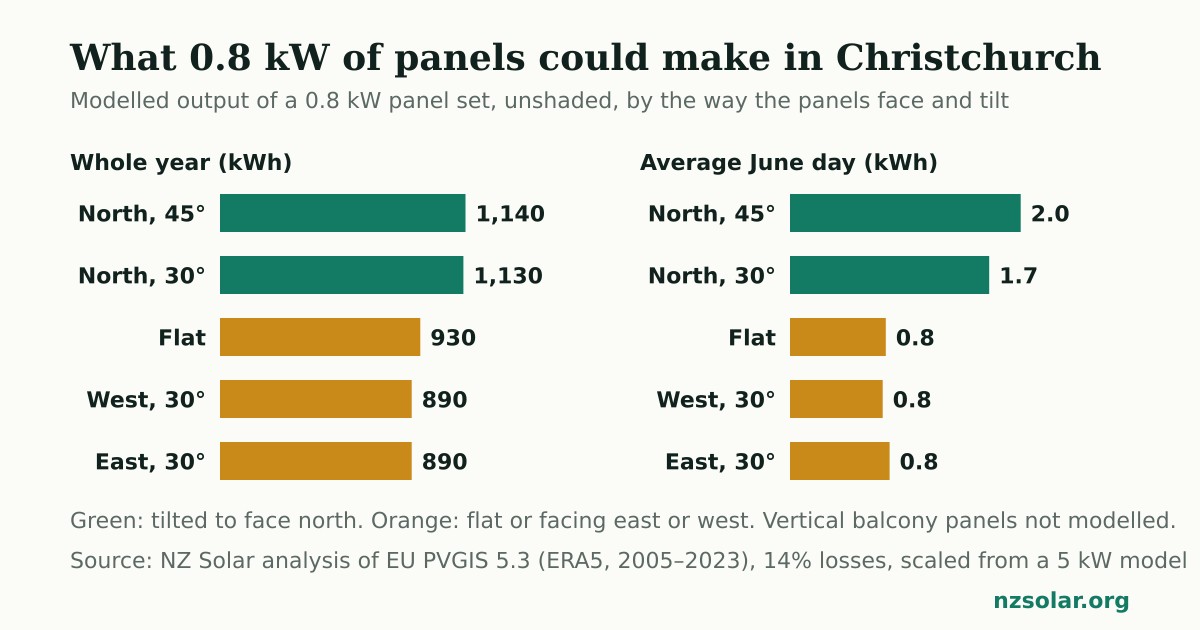
Nobody can quote a New Zealand plug-in product yet, so we modelled the output of 0.8 kW of panels in Christchurch from the same PVGIS data behind our Canterbury solar output guide. Output scales with panel capacity, so these figures are that model’s 5 kW results multiplied by 0.16. They assume no shade.

| Panels facing | Whole year | Average June day | Average December day |
|---|---|---|---|
| North, tilted 45° | 1,140 kWh | 2.0 kWh | 3.6 kWh |
| North, tilted 30° | 1,130 kWh | 1.7 kWh | 4.0 kWh |
| Flat | 930 kWh | 0.8 kWh | 4.2 kWh |
| West, tilted 30° | 890 kWh | 0.8 kWh | 3.9 kWh |
| East, tilted 30° | 890 kWh | 0.8 kWh | 3.9 kWh |
Three things push a real kit below these figures:
- Balcony panels often hang upright. We did not model vertical panels. Hung straight down they catch less of the high summer sun than any angle in the table.
- Balconies are shady. A neighbouring building, a balcony above or a tree can take a large share of the output, especially in winter when the sun is low.
- 800 W is an export cap overseas, not a panel size. Some kits carry more panel capacity than their inverter can deliver, and some less.
What is the power worth? Each unit used in the house as it is made is a unit you do not buy, so multiply by the price per kWh on your own bill. As an illustration only, at 25c to 35c a unit, 1,130 kWh is worth about $280 to $395 a year, and only if the house uses every unit as it is made. For comparison, EECA models a 5 kW roof system in Christchurch saving about $1,180 a year. Rewiring Aotearoa told 1News a typical plug-in unit could cover about 7% to 15% of an average New Zealand home’s daily electricity use.
Exports and your meter
A kit produces most around midday, and any power the house is not using at that moment flows out to the street. Whether that earns anything depends on the meter. The Authority’s paper says:
- getting paid for exports needs a meter that measures electricity flowing in both directions
- where the existing meter cannot measure exports, the household would have to weigh the cost of changing it against the benefit
- a proportion of the electricity exported from plug-in kits would likely go unmeasured
- some meter operators already set meters up to record exports when they are installed, even where there is no solar
So plan on the value coming from power used in the house during the day, such as the fridge, freezer and appliances left on standby, not from export credits. If you do get a two-way meter, our buy-back rates guide explains how retailers pay for exports.
Who plug-in solar would suit
The Authority’s paper names three groups: renters, apartment residents, and homeowners who cannot or would rather not commit to a fixed system. Each has a different next step.
- Renters. A kit that goes with you when you move is the main appeal. Until it is legal, the realistic option is asking the landlord about a roof system. Our guide to solar on a rental property explains who pays and who benefits.
- Apartments and townhouses. A balcony may be the only sunny surface you control. If the building is a unit title, ask the body corporate what its rules say about fixing things to balconies. Our guide to solar for units, townhouses and apartments covers shared-roof options.
- Homeowners with a suitable roof. A plug-in kit is not a substitute. On the figures above, a 5 kW roof system makes about six times the power of 0.8 kW of panels at the same angle, and EECA’s typical price for one is $11,500 including installation. Our solar cost guide and roof suitability guide are the place to start.
What to do now
- Do not buy a kit from an overseas website and plug it in. It is not allowed yet, it will not have been checked against a New Zealand standard that does not exist yet, and your lines company and retailer will not know it is there.
- If you own the house, do not wait for plug-in. The small size means it cannot do the job of a roof system, and the rules for roof systems are getting easier, not harder. The Authority’s same consultation proposed extending the 10 kW default export limit to more home connections. In Canterbury, our Orion export limits guide shows what applies in Christchurch, Banks Peninsula and Selwyn.
- If you rent or live in an apartment, watch for three things: WorkSafe lifting or changing its prohibition notice, a published plug-in installation standard, and the Authority’s decision on how kits are registered. Products sold here after that should say which standard they meet.
- When kits do go on sale, ask which New Zealand standard the kit is certified to, whether its inverter has anti-islanding protection, how it is registered, and whether your meter records exports.
Common questions about plug-in solar in New Zealand
Is plug-in solar legal in New Zealand?
Not yet. A WorkSafe prohibition notice currently prevents plug-in solar being used in New Zealand. Cabinet agreed on 10 August 2026 to legalise it, but the notice is still under review and the safety standard, regulations and Electricity Authority rules needed to allow it have not been finalised.
When will plug-in solar be allowed in New Zealand?
No date has been set. The Electricity Authority consulted from 8 September to 6 October 2026 and has not published a decision, and a New Zealand installation standard for plug-in kits is still being written. During the campaign National promised sales within six months of a re-elected National Government once safety rules are in place; the official election result is due on 27 November 2026.
How much power would a plug-in solar kit make in Christchurch?
On our PVGIS model, 0.8 kW of unshaded panels in Christchurch makes about 1,130 kWh a year tilted 30° to the north, about 930 kWh laid flat and about 890 kWh facing east or west. On an average June day that is 1.7 kWh tilted north and 0.8 kWh flat. Vertical balcony panels and shade would lower these figures.
Will plug-in solar be limited to 800 W in New Zealand?
That has not been decided. The Electricity Authority says many countries limit plug-in systems to 800 W of maximum export and that a similar limit may or may not be applied in New Zealand.
Can I plug a solar panel into a wall socket if I rent?
No, not under the current rules, whether you rent or own. When plug-in kits are allowed they are expected to suit renters because they need no wiring and can move with you, but until then a roof system the landlord installs is the only legal option. Our rental property guide explains how that can be made fair.
Would I get paid for the power a plug-in kit exports?
Only with a meter that records exports and a retail plan that pays for them. The Electricity Authority expects some exported power from plug-in kits to go unmeasured, so most of the value would come from power the house uses while the panels are producing.
Should I wait for plug-in solar instead of getting a roof system?
Not if you own a house with a suitable roof. A 5 kW roof system in Christchurch makes about six times as much power as 0.8 kW of panels at the same angle, and EECA models it saving about $1,180 a year there. Plug-in kits are aimed at people who cannot put panels on a roof.
Canterbury solar quotes
Own your home? Compare roof system quotes now.
Tell us about your roof and your power bill, and get quotes from solar installers who cover your part of Canterbury.
Get Canterbury solar quotesSources and review date
Checked on 16 November 2026 against the Electricity Authority’s consultation paper “Exploring plug-in generation and Code improvements for export limits and connection processes” (8 September 2026), its plug-in generation page and September 2026 household leaflet; the Ministry for Regulation’s announcements of its solar review (7 May 2026) and of Cabinet’s decisions (10 August 2026); National’s plug-in solar policy of 15 October 2026; 1News’ report of 30 July 2026; and EECA’s page on solar costs and savings. Output figures are our analysis of EU PVGIS 5.3 (PVGIS-ERA5 2005–2023, 14% system losses), the same data as our Canterbury output guide, scaled from a 5 kW system. They are modelled, not measured, and the dollar values use illustrative prices, not a retailer’s tariff.
NZ Solar is an independent quote matching service and is not affiliated with the Electricity Authority, WorkSafe, the Ministry for Regulation or EECA. Plug-in rules are changing; check the Electricity Authority’s plug-in generation page before you buy anything. For local advice, see our Canterbury solar guide.