
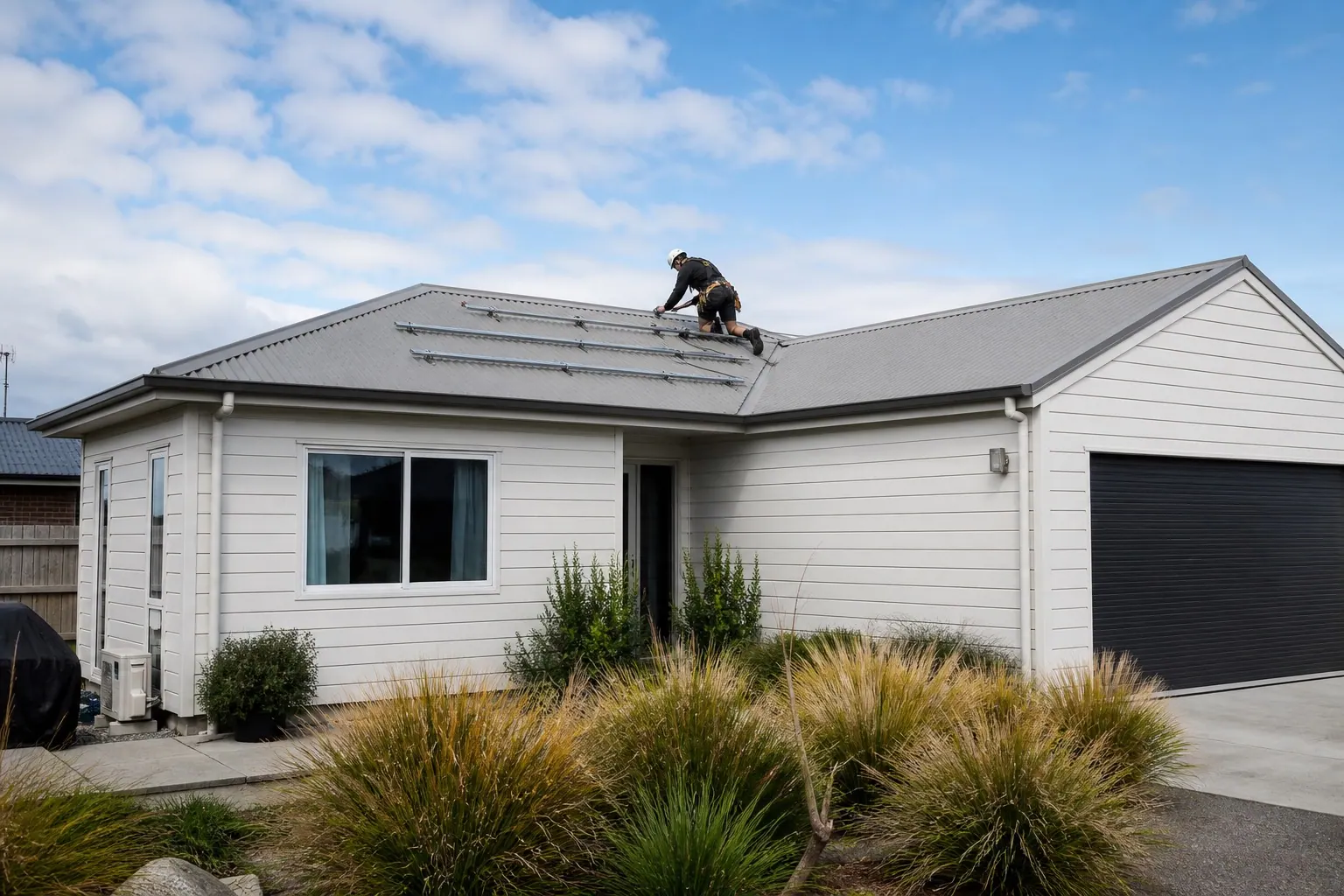
Start with a full year of electricity use
Your last bill is not enough. Canterbury demand changes sharply between a mild January and a cold July, especially in an all-electric home. Add the kWh from 12 months of bills or download the annual total from your retailer. EECA puts average New Zealand household use at about 7,000 kWh a year, but treats that only as context. [1]
The annual total tells an installer the scale of the job. It does not show how much solar you can use directly. For that, you need the daily pattern: how much power is used between morning and late afternoon, and how that changes by season.
Daily charges, retailer rates and discounts vary. Use electricity consumption in kWh. If a quote only asks what you spend each month, send the underlying kWh figures as well.
kW and kWh describe different things
kW: power at a moment
Panel capacity, inverter output and battery discharge power are stated in kilowatts. Thirteen 400 W panels add up to 5,200 W, or 5.2 kW.
kWh: energy over time
Your bill, annual solar generation and battery storage are stated in kilowatt-hours. A 10 kWh battery stores energy; it does not describe how quickly that energy can be delivered.
A 5 kW array does not produce 5 kW all day. Output rises and falls with sun angle, cloud, temperature, shade and season. This is why a quote should include estimated monthly or annual generation in kWh, along with the assumptions behind it.
Three official examples show why household context matters
EECA publishes three home profiles. They are worked examples rather than universal packages. The large example is particularly useful for Canterbury: it models a five-person rural Christchurch household that is rarely home during the day, uses 12,000 kWh a year and has an EV. [1]
| Home profile | Annual use | Panels | Panel capacity | Inverter | Battery |
|---|---|---|---|---|---|
| 2 people, often home in daytime | 5,500 kWh | 7 | 3.5 kW | 3 kW | Not essential |
| 4 people, often home in daytime | 8,000 kWh | 12 | 5.5 kW | 5 kW | Not essential |
| 5 people, rural Christchurch, EV, rarely home in daytime | 12,000 kWh | 24 | 10 kW | 9 kW | 10 kWh |
Source: EECA design examples. Household location and habits differ, so these are comparison cases rather than sizing rules.
The table also exposes a common mistake: panel count alone is not a system size. Modern panels come in different wattages. Compare the total DC panel capacity, inverter capacity and expected generation.
Your daytime load decides how much solar is valuable
Solar first supplies whatever the house is using. Surplus goes to a battery, hot-water control or the grid, depending on the design. Electricity you use directly normally avoids a retail purchase; exported electricity earns the retailer's buy-back rate. Those two values are rarely the same.
Ask the installer to split forecast generation into three buckets: direct household use, battery charging and grid export. If every kWh is valued at the full retail rate, the savings forecast is overstated. Our Canterbury buy-back guide explains how to compare the whole power plan.
Loads worth locating on the clock
- Electric hot water heating cycle
- Heat pumps and underfloor heating
- Dishwasher, washing machine and dryer
- Home office equipment
- Pool or spa filtration and heating
- EV charging
The usable roof can set the maximum before the bill does
A clean north-facing plane is straightforward, but it is not the only workable roof. East and west arrays can spread generation into the morning and afternoon. That may suit a household better than concentrating every panel around midday. Shade, hips, valleys, vents, chimneys, setbacks, roof condition and safe access all reduce the area that can actually be used.
Ask for a panel layout, not just a total panel count. It should show each roof face, panel orientation and any shade assumption. If the roof is older, compare the cost of reroofing first against removing and reinstalling panels later. For long-run metal roofs, use our Colorsteel and metal-roof solar guide.
A bigger array on the wrong roof face is not automatically a better design. The generation profile has to meet the household's load and the roof has to remain serviceable.
Panel capacity and inverter capacity do not have to match
EECA says around 20% more panel capacity than inverter capacity tends to give good value for many New Zealand homes. Panels seldom deliver their full nameplate output, so a 5.5 kW array on a 5 kW inverter can capture more energy in weaker light while clipping a small amount at the strongest peaks. [2]
This is not permission to use any combination. The inverter has voltage, current and total DC input limits, and the design must comply with its instructions and the network connection requirements. Ask the installer to state the DC-to-AC ratio and explain expected clipping.
Panel rating
13 × 400 W
Subject to full design
Size for credible future loads, not vague possibilities
An EV, second heat pump, electric hot-water cylinder, induction cooking, spa pool or extra household member can materially change annual use. Put likely changes on a timeline and estimate them separately. “We might buy an EV one day” is not enough reason to double a system without modelling when and how the car will charge.
An EV parked away from home on weekdays may charge mostly at night. More panels will not directly serve that load unless the vehicle can charge during daylight or energy is stored. A smart charger can direct surplus solar to the car, but the charger, vehicle availability and minimum charging power all matter.
Plan now
Loads likely within the next few years, known renovations, confirmed EV purchase and additional roof use.
Keep optional
Speculative loads with no timing. Ask what the design allows later and what expansion would cost.
A battery does not fix an oversized array
Battery capacity is measured in kWh; battery output is measured in kW. The first tells you roughly how much energy can be stored, while the second affects how many appliances it can support at once. EECA lists common home battery bands of roughly 5–10 kWh, 10–15 kWh and 20+ kWh, and warns that a small solar system may not fully use a large battery. [2]
Model the solar-only system first. Then show what the battery changes: self-consumption, imports, exports, backup circuits, capital cost and payback. If resilience is the goal, confirm which circuits run during an outage and whether solar can keep charging the battery while the grid is down. See the full battery-or-no-battery guide.
Installed capacity and export capacity are different
From 11 May 2026, the Electricity Authority introduced a 10 kW default static export limit for qualifying streamlined small-scale connections. A distributor can apply a lower limit where a network study shows it is needed, or offer dynamic or flexible export control. The Code also says distributors must not set a nameplate generation limit for Part 1 or Part 1A applications. [3]
That means a 10 kW export setting is not automatically a 10 kW panel cap. A home can consume solar behind the meter while export is controlled, subject to the approved design. Orion says local capability still matters and assesses export increases against network conditions. [4]
The quote should state the proposed panel capacity, inverter rating, export limit, network application path and what happens to generation when export reaches the limit.
“Add more panels later” needs an actual design path
Expansion can be possible, but it is not automatic. A string inverter may have spare input capacity, yet future panels still need compatible electrical characteristics and suitable roof space. Microinverters can make panel-by-panel additions easier, although each return visit adds labour and network paperwork may need updating. Another complete inverter-and-array system is also possible in some homes.
Ask what is genuinely reserved: inverter headroom, switchboard capacity, cable route, roof area, battery compatibility and monitoring integration. Product ranges change. A promise that the same panel will be available in five years is weak unless the design can tolerate a different module.
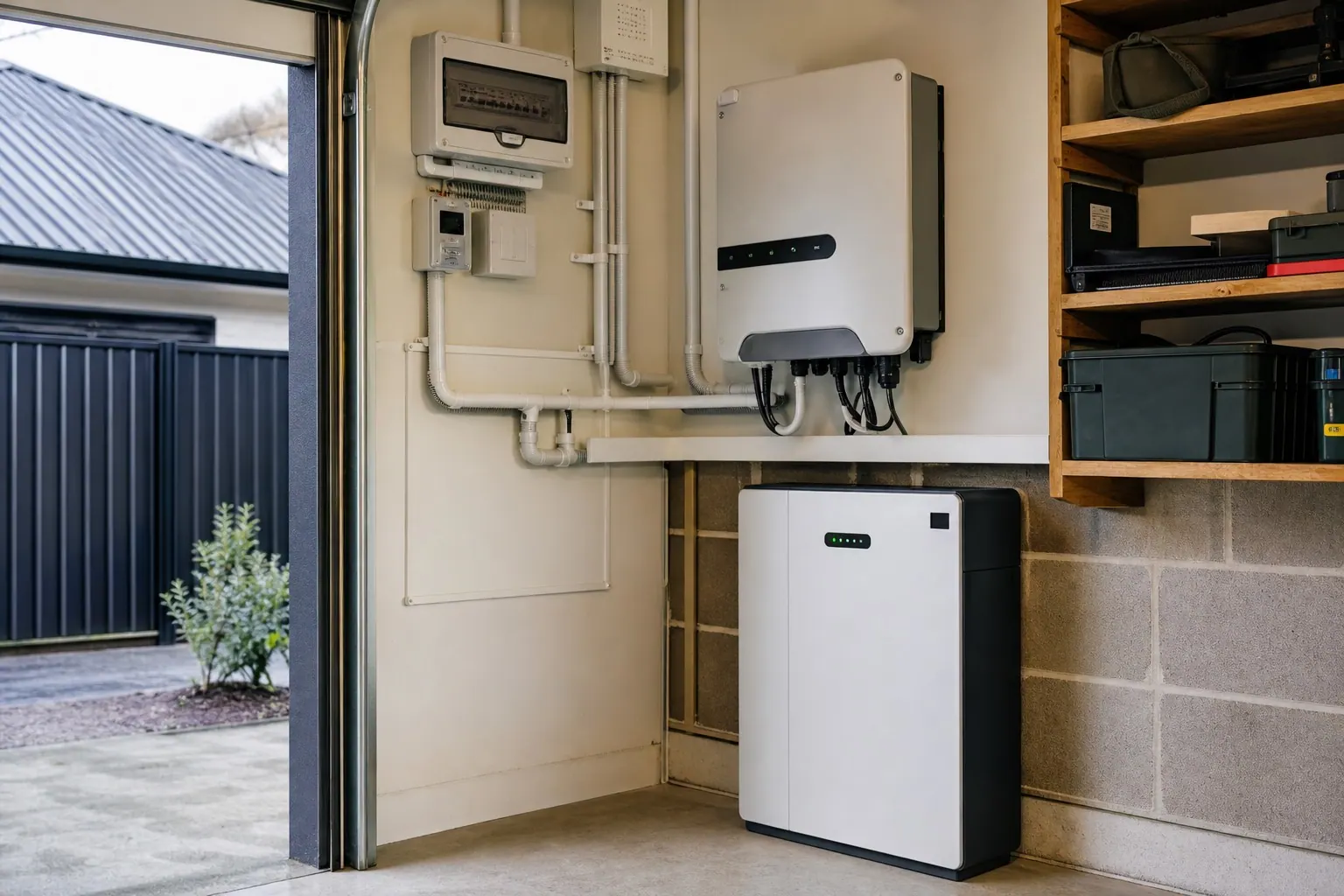
What a properly sized quote should show
| Quote item | What to look for | Why it matters |
|---|---|---|
| Annual household use | 12-month kWh total and data period | Stops sizing from a single seasonal bill |
| Usage profile | Daytime, evening and seasonal demand | Separates direct use from likely export |
| Panel array | Count, model, watts each and total DC kW | Makes panel capacity comparable |
| Inverter | Model, AC kW, phases and DC-to-AC ratio | Shows conversion and clipping assumptions |
| Generation forecast | Monthly kWh with orientation, shade and loss assumptions | Reveals whether the forecast fits the roof |
| Energy flows | Direct use, battery charging and export | Tests the savings calculation |
| Network | Export setting and approval responsibility | Prevents confusion between array and export size |
| Future changes | EV, heating, occupants and expansion path | Connects today's quote with likely demand |
If two quotes recommend different sizes, ask both installers to show the assumptions above. The better answer is not necessarily the larger system. It is the design that explains what each extra panel produces, how that energy will be used and what return it adds after export rates and installation cost.
Solar system sizing questions
What size solar system does an average New Zealand home need?
There is no universal size. EECA says average household use is about 7,000 kWh a year, while its medium example uses 5.5 kW of panels and a 5 kW inverter for an 8,000 kWh household. Use your own annual and half-hour data before treating that as a benchmark.
How many panels make a 5 kW system?
Divide 5,000 W by the rating of the proposed panel. Ten 500 W panels equal 5 kW. Thirteen 400 W panels equal 5.2 kW. Panel count without panel wattage is incomplete.
Is a 10 kW solar system too big for a house?
It depends on annual use, daytime demand, roof conditions, export control and future loads. EECA uses 10 kW of panels in its large rural Christchurch example for a five-person household using 12,000 kWh a year with an EV and limited daytime occupancy.
Will a bigger system eliminate my power bill?
Not necessarily. You may still buy electricity at night or in poor weather, and fixed daily charges can remain. Surplus generation is normally exported at a buy-back rate that may be lower than the retail rate you pay for imports.
Can panels be larger than the inverter?
Yes. EECA says around 20% more panel capacity than inverter capacity often gives good value. The final ratio must stay within equipment limits and be justified in the system design.
Should I size the system for a future EV?
Include a likely EV if you have a credible purchase plan, but model when it will charge. A car away from home during solar hours may add mostly night-time load unless workplace routines, smart charging or storage change that.
Free, no-obligation quotes
Compare systems sized around your Canterbury home.
Share your bill, household and future plans. We’ll match you with Canterbury solar quotes suited to the job you actually have.
Get my free quotes