

Typical solar panel costs in New Zealand in 2026
EECA gives the cleanest starting point because it separates system size from battery options and states that the figures include standard installation costs and GST. That makes the numbers useful for checking whether a Canterbury solar quote is broadly in the right neighbourhood.
| Example system | System size | Panels | Typical cost | Notes |
|---|---|---|---|---|
| Small home solar system | 3 kW | 7 panels | $8,500 | Includes standard install and GST |
| Medium home solar system | 5 kW | 12 panels | $11,500 | Common comparison point for average homes |
| Large home solar system | 10 kW | 24 panels | $20,000 | May need closer network/export checks |
Source: EECA. These are national comparison figures, not quoted Canterbury prices.
$8,500 divided by 3,000 watts
$11,500 divided by 5,000 watts
$20,000 divided by 10,000 watts
Those price-per-watt figures are our arithmetic from EECA's three example packages. They illustrate how fixed installation costs can be spread across a larger system; they are not a market average or a target every quote should meet.
Do not treat those numbers as a promise. A quote in Christchurch, Rolleston, Rangiora, Ashburton or Timaru can move up or down depending on roof access, electrical work, equipment selection, installer workload and whether battery storage is included.
This article is general information, not a quote, building assessment, electrical design or financial advice. Use the numbers as comparison points only, then check your own quote, roof, retailer, finance terms and local network approval.
Why Canterbury solar quotes can vary so much
Canterbury has plenty of straightforward roofs, but the easy jobs and the awkward jobs do not cost the same. A single-storey home with a clean long-run metal roof is a different quoting exercise from a steep roof, a two-storey home, a complex new-build roofline, a farm shed or a property needing switchboard work. If roof condition or roof profile is the unknown, start with our Canterbury metal roof solar guide before comparing prices.
Things that can push the price up
- Tricky roof access or extra edge protection.
- Older roofing, corrosion, or a roof near replacement.
- Switchboard upgrades or longer cable runs.
- Battery storage, EV charging or backup circuits.
- Engineering, consent or network export constraints.
Things that can make quoting cleaner
- Good north, east or west roof space with limited shade.
- Modern long-run metal roofing in sound condition.
- Easy inverter and switchboard location.
- A recent power bill and clear usage goals.
- Knowing your ICP and local electricity network.
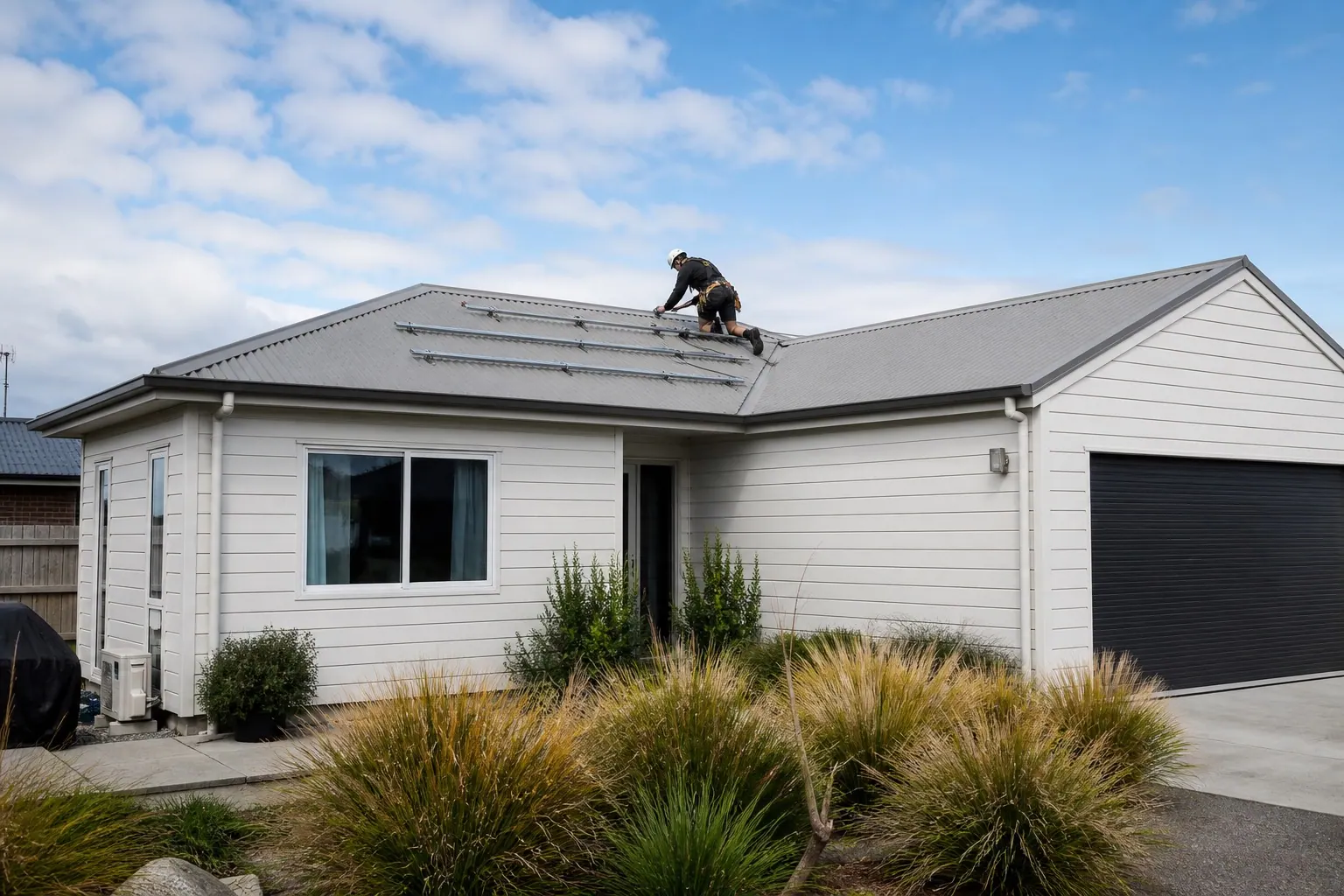
A solar quote is much more than the price of the panels
A retail panel price is not a useful estimate of the installed job. The finished system also needs an inverter, roof mounting, isolators and protection, cabling, monitoring, electrical labour, safe roof access, design, network paperwork, testing and certification. Some homes also need switchboard work, metering changes or engineering.
The core system
- Panels, inverter and mounting hardware.
- Electrical protection, cabling and isolators.
- Design, installation, testing and certification.
- Monitoring setup and handover documentation.
Site-specific allowances
- Scaffolding, edge protection and difficult access.
- Switchboard, meter or long cable-run work.
- Roof repairs, engineering or consent-related design.
- Network application fees and export controls.
If a low advertised price excludes installation or necessary electrical work, it is not comparable with a complete quote.
How many panels does a Canterbury home need?
Start with annual electricity use and when that power is used, then check usable roof area, shading, orientation, future EV or electric hot-water plans and the local export limit. EECA's current examples use 7 panels for 3 kW, 12 panels for 5 kW and 24 panels for 10 kW. Individual panel wattages vary, so panel count is not a sizing rule by itself. [6]
| Household pattern | What to investigate | Why |
|---|---|---|
| Lower use, someone home in daytime | Small system and hot-water timing | More generation can be used directly |
| Average all-electric home | Medium system matched to half-hourly data | Balances roof area, direct use and export |
| Large home, EV, spa or rural loads | Larger system plus network and phase checks | Future demand may justify more capacity |
| Most use after sunset | Solar-only and battery options priced separately | Timing changes the value of generation |
A 6.6 kW package may suit a property, but it is not a mandatory national size. EECA models several sizes and the Electricity Authority now uses a 10 kW default export limit for qualifying straightforward residential connections. Size the system from the home and network, not a package name. [5]
Solar payback in Canterbury: what the headline number misses
EECA says a typical solar payback can be 7 to 10 years in the right circumstances, especially where the household can use most of the electricity generated. It also notes that this payback does not include the cost of borrowed money or interest you might have earned on savings. [1]
The quote should show year-one savings and payback first. A 25-year number can be useful, but it is not the number to make the decision from.
For Canterbury homes, the most important payback question is usually not "how much solar can the roof make?" It is "how much of that solar can I use at home while the sun is out?" Power you use directly avoids buying electricity from the grid. Power you export depends on retailer buy-back rates and network settings. EECA notes that buy-back rates vary and that using more of your own solar generally improves the savings picture. Our Canterbury solar buy-back guide explains how to compare the whole power bill. [3]
December 2025 EECA calculation for an example address in each region's largest urban centre. Actual homes differ.
Solar battery cost in Canterbury: price it separately
EECA lists a typical battery add-on cost of $5,000 to $15,000, depending on battery type and capacity. It also lists example solar-plus-battery packages of $13,500 for a 3 kW system with a 5 kWh battery, $21,500 for a 5 kW system with a 10 kWh battery, and $40,000 for a 10 kW system with a 20 kWh battery. [1]
| Solar size | Battery size | Solar-only | Package total | Implied uplift |
|---|---|---|---|---|
| 3 kW | 5 kWh | $8,500 | $13,500 | $5,000 |
| 5 kW | 10 kWh | $11,500 | $21,500 | $10,000 |
| 10 kW | 20 kWh | $20,000 | $40,000 | $20,000 |
The uplift is our subtraction of EECA's solar-only example from its matching solar-and-battery package. It is not a standalone battery quote. Backup hardware, switchboard work, usable capacity, inverter choice and installation complexity can all change the real difference.
A battery can be a good fit if you use a lot of power after sunset, want selected backup circuits, or want to use more of your own generation. It can also make the payback longer, so it should not be bundled into the quote without a separate comparison. For a deeper breakdown, read the Canterbury solar battery guide.
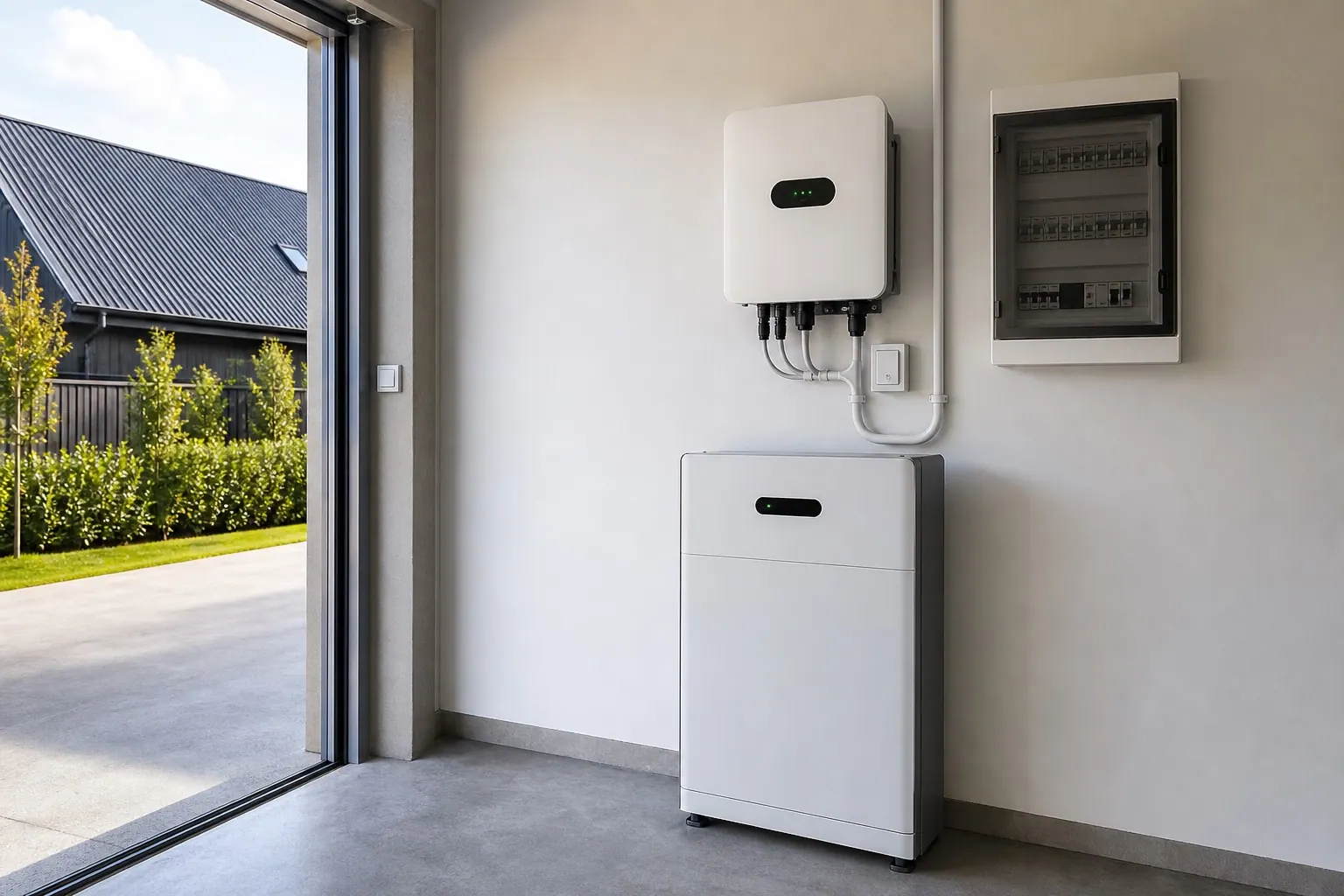
Equipment detail
Ask for batteries, inverters and switchboard work to be itemised.
That makes it easier to compare a solar-only system against a solar-plus-battery quote, and to see whether electrical work has been allowed for properly.
Should you wait for solar prices to fall?
Nobody can promise what an installed Canterbury system will cost next year. Equipment prices, exchange rates, freight, labour and compliance costs can move in different directions. The useful comparison is the possible price reduction against a year of bill savings you give up by waiting.
EECA Canterbury example
Compare current quotes instead of assuming a drop
If the roof is sound, the household plans to stay and the quote works under conservative assumptions, waiting solely for cheaper hardware may not improve the result. If the roof needs replacing or the quote is vague, waiting can be sensible for reasons that have nothing to do with panel prices.
Solar finance and green home loans in New Zealand
EECA says most major New Zealand banks offer zero or very low-interest home energy loans, often as a mortgage top-up, and that solar panels, batteries and inverters may be eligible. EECA's bank summary was current as at June 2026 and listed examples from ANZ, ASB, BNZ and Westpac. Lending criteria, terms, fees and exclusions apply. [4]
A low-rate loan can make solar easier to start, but it does not automatically make a bad quote good. Compare the system price, yearly bill reduction, repayments, what happens after the low-rate period, and whether battery storage changes the payback.
Network approval can affect the real value of solar
If your system connects to the grid, the quote needs to account for your local distributor. In Canterbury that could mean Orion, MainPower, EA Networks or Alpine Energy, depending on the property. Export approval, inverter settings and metering can affect both installation steps and expected savings.
Orion says generation must have express written approval before being connected.
MainPower lists a 10 kW default export limit for small-scale residential and business customers, subject to constraints.
Export applications, hosting capacity and local constraints still need checking before relying on export income.
The Electricity Authority's 2026 export-limit rule introduced a 10 kW default static export limit for qualifying straightforward small-scale distributed generation, but distributors can apply lower limits where a standardised network assessment justifies it. [5]
Building consent is often exempt, but the conditions still matter
Since 23 October 2025, qualifying roof-mounted arrays can be installed without building consent. MBIE says arrays under 40 square metres qualify under the exemption when its conditions are met. Larger arrays or higher design wind speeds require a Chartered Professional Engineer to design or review the work. Exempt work must still comply with the Building Code, the local district plan and the exemption conditions. [7]
Ask the installer to state whether the proposal relies on an exemption, who checks structural and weathertightness details, and whether any engineering or council work is included in the price.
Why three solar quotes can come back with three different prices
This is normal. A cheaper quote may use different equipment, assume easier roof access, leave out metering steps, skip a battery, use a smaller inverter, or make more optimistic savings assumptions. A more expensive quote may include better equipment, clearer aftercare, extra electrical work, safer roof access or more complete paperwork.
Ask each installer to show
- Total installed price including GST and every stated exclusion.
- Panel count and wattage, inverter size and exact equipment models.
- Scaffolding, switchboard, metering and network allowances.
- Expected annual generation and year-one bill reduction.
- Assumed import rate, export rate and self-use percentage.
- Network application and metering responsibilities.
- Warranty, monitoring and after-sales support.
What to have ready before asking for Canterbury solar quotes
You do not need to know the perfect system size before you ask for quotes. You just need enough detail for a good installer to stop guessing.
Canterbury solar cost questions
How much do solar panels cost in Canterbury in 2026?
EECA's typical national figures are $8,500 for a 3 kW system, $11,500 for a 5 kW system and $20,000 for a 10 kW system, including standard install and GST. Canterbury quotes may differ because of roof access, electrical work, equipment choice, battery storage and network requirements.
Is solar cheaper in Christchurch than rural Canterbury?
Not always, but Christchurch and nearby suburbs can have simpler access than some rural, farm or shed installs. Rural jobs may involve larger roofs, longer cable runs, three-phase supply, different safety planning and different export considerations.
What is a realistic solar payback period?
EECA gives 7 to 10 years as a typical payback in the right circumstances when a household uses most of the solar power generated. Borrowing costs, batteries, export rates and usage patterns can all change that.
Should I include a battery in my first quote?
It is worth pricing, but ask for the battery to be shown separately. Solar without a battery often has the cleaner financial return, while a battery may be useful for evening use, backup power or greater self-consumption.
What installed price per watt should I expect?
Dividing EECA's example package prices by system capacity gives about $2.83/W for 3 kW, $2.30/W for 5 kW and $2.00/W for 10 kW. These are derived comparison points, not a market average. Roof complexity, equipment and included work can justify a different figure.
Does a New Zealand home need a 6.6 kW system?
No. It is one possible package size, not a New Zealand rule. The right capacity depends on the home's power use, roof, export settings and future loads such as an EV or electric hot water.
Do roof-mounted solar panels need building consent?
Many installations can use the roof-mounted array exemptions introduced in October 2025, but the detailed size, wind, structural and design conditions still apply. Exempt work must comply with the Building Code and district plan.
Can finance make solar worthwhile sooner?
It can help with cashflow if you qualify for a low-interest home energy loan, but the quote still needs to stack up. Read the bank terms, check what happens after the low-rate period, and get independent financial advice if you need it.
Free, no-obligation quotes
Compare solar prices for your Canterbury home.
Answer a few quick questions about the property and power bill. We’ll match you with Canterbury solar quotes suited to your needs.
Get my free quotesSources used
- EECA: Breaking down home solar costs and savings
- EECA: Solar payback calculator
- EECA: Make the most of your home solar system
- EECA: Bank loans for home energy upgrades
- Electricity Authority: New rules encourage more solar to networks
- EECA: Planning the right home solar system for you
- MBIE Building Performance: Roof-mounted solar panel consent exemptions
- Orion: Generation connection guidance
- MainPower: Solar and distributed generation
- EA Networks: Distributed generation
- Alpine Energy: Generating electricity