
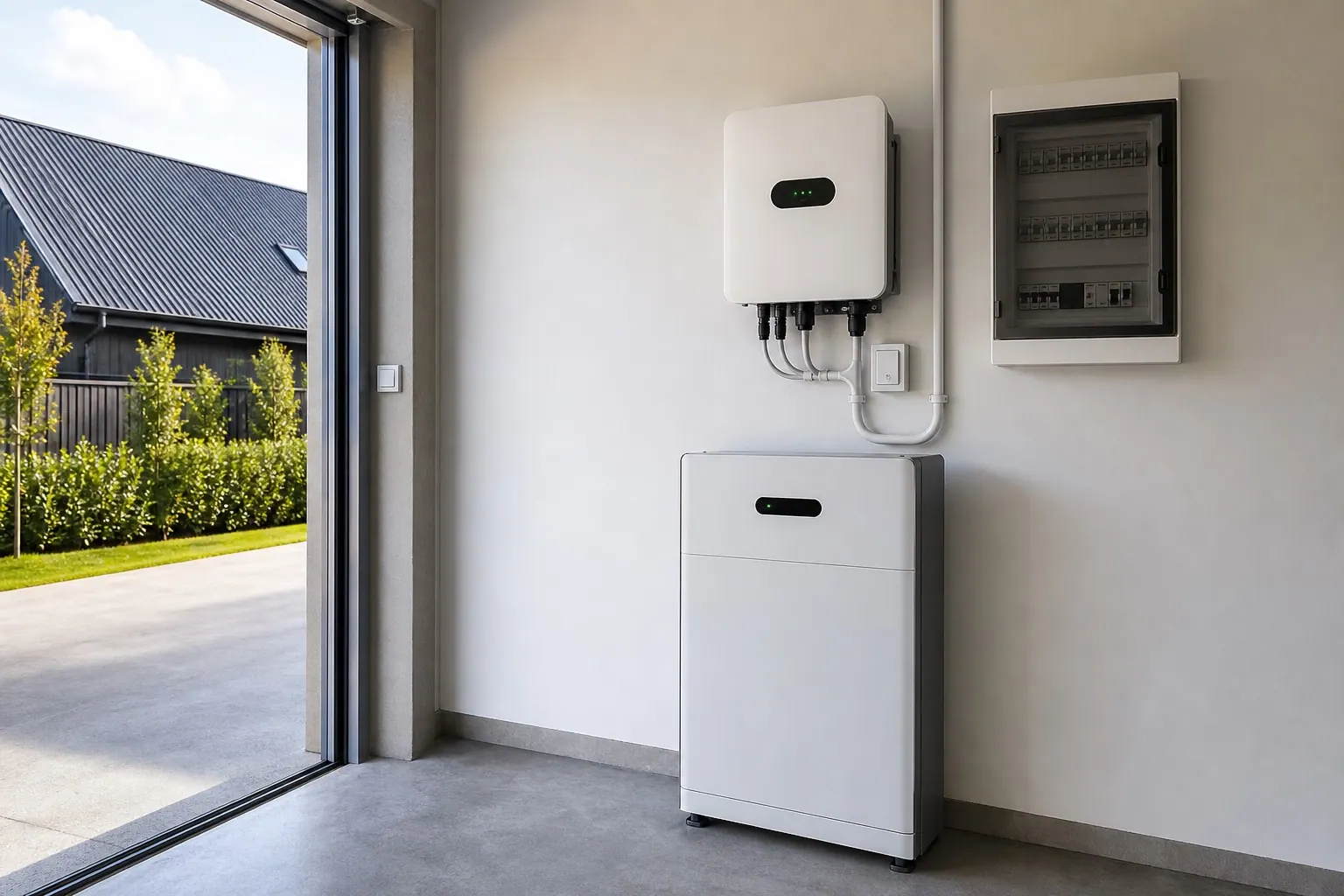
How solar battery storage works
Solar first supplies the appliances running in the home. When generation is higher than that live demand, available surplus can charge a battery. Once the battery reaches its operating limit, further surplus can be exported. When solar falls below household demand, the battery can discharge before the home imports more electricity from the grid.
Use live solar
Generation supplies the house first.
Charge storage
Available surplus fills the battery.
Export excess
Remaining energy can go to the grid.
Discharge later
Stored energy supplies later demand.
Systems can use other schedules. A battery may hold a backup reserve, charge from cheaper grid electricity or export at selected times. The operating mode changes savings, backup readiness and the number of charge cycles.
EECA says batteries are optional and solar without storage will generally give the best returns. Storage deserves separate consideration where evening use is high, loads cannot be moved into daylight, or backup has real value. [1] If you are still deciding, read our battery-or-no-battery guide.
Five numbers that should appear on every battery quote
| Specification | Unit | Meaning |
|---|---|---|
| Nominal capacity | kWh | Total stated energy capacity |
| Usable capacity | kWh | Energy available inside the permitted operating window |
| Continuous output | kW | Load the battery can sustain |
| Peak output | kW for a stated time | Short burst for starts and load changes |
| Round-trip efficiency | % | Energy returned compared with energy used to charge |
EECA notes that usable capacity is commonly around 5–10% below nominal capacity. It recommends looking for efficiency of at least 85%. [2]
Two 10 kWh batteries can have different usable energy, output, backup capability, efficiency and warranty conditions. Those differences determine what the system can do.
Choose size from actual energy flows
EECA groups common home capacities into roughly 5–10 kWh, 10–15 kWh and 20+ kWh. These are product bands, not prescriptions. A small array may not produce enough spare energy to fill a large battery regularly. A high-use household may need modest storage if it already consumes most solar in daylight. [2]
Use real data
- Download several weeks of half-hour electricity data, including winter if possible.
- Total consumption from late afternoon until solar resumes.
- Measure or model the solar exported on clear and cloudy days.
- List outage loads and their energy plus maximum simultaneous power.
- Test how often each proposed capacity would fill, empty or sit unused.
Ask for a solar-only case and at least two battery sizes, all using the same load profile and tariff. This reveals whether extra modules create usable value or mostly add reserve.
Solar battery costs in New Zealand
EECA lists a typical battery add-on cost of $5,000–$15,000, depending on type and capacity. Its complete examples include standard installation and GST. They are national comparison markers rather than Canterbury quotes. [1]
| Solar | Battery | Solar only | Package total | Difference |
|---|---|---|---|---|
| 3 kW | 5 kWh | $8,500 | $13,500 | $5,000 |
| 5 kW | 10 kWh | $11,500 | $21,500 | $10,000 |
| 10 kW | 20 kWh | $20,000 | $40,000 | $20,000 |
The difference is arithmetic from matching EECA examples, not a standalone battery quote. Final cost can include an inverter, gateway, switchboard changes, backup circuits, metering, cable runs, mounting and commissioning.
Product prices found online often mix hardware-only and installed figures. Compare complete installed scope, including GST, electrical work and backup equipment.
A battery does not automatically provide blackout power
A grid-connected inverter must stop energising the network during an outage. Backup needs equipment that safely isolates the home and forms a local supply. EECA prioritises a backup-capable inverter, enough usable capacity and dedicated essential circuits. [3]
| Question | Why it matters |
|---|---|
| Which circuits stay live? | Selected essentials need less energy than whole-home backup. |
| What is backup-mode output? | It may differ from normal grid-connected output. |
| Can solar recharge during an outage? | Some configurations can; the quote must state this. |
| What reserve is held? | More reserve improves readiness but leaves less capacity for daily savings. |
| Can large loads start? | Pumps and compressors can have high startup demand. |
Estimate runtime from the intended circuits. A fridge cycles, a pump starts abruptly and electric heating can draw continuously. Both usable kWh and available kW matter.
LFP and NMC are the main lithium-ion chemistries
EECA identifies lithium iron phosphate (LFP) and nickel manganese cobalt (NMC) as common home-storage chemistries. LFP is bulkier but offers better thermal stability; NMC has higher energy density. Lead-acid storage is larger, less efficient and shorter-lived, so it is less likely to be recommended for a standard home today. [2]
LFP
Known for thermal stability; generally uses more space for the same energy.
NMC
Higher energy density; still needs compliant installation and thermal management.
Chemistry is only one input. Controls, enclosure rating, operating limits, warranty, compatible equipment and local support also matter.
AC and DC coupling suit different installations
AC-coupled
Solar and battery use separate inverters. This can simplify a retrofit, although charging from solar involves extra conversion steps.
DC-coupled
Panels and storage connect through a shared or hybrid inverter. Solar can charge the battery before conversion to AC, reducing conversion steps.
EECA describes DC coupling as more efficient and AC coupling as practical when adding storage to existing solar. The choice also affects backup, grid charging, warranties and expansion. [2]
Adding a battery later needs a documented path
An AC-coupled battery may work alongside the current solar inverter. DC-coupled storage normally needs compatible hybrid equipment. The installer still needs to check the switchboard, meter arrangement, cable route, installation space, communications and network requirements.
If storage is deferred, ask the solar installer to name compatible equipment and likely later work. “Battery ready” should describe inverter capability, reserved switchboard capacity, warranty implications and whether backup can be added without replacing hardware.
“You can add one later” is a possibility. Compatible models and required changes make it a plan.
Battery location is a safety and service decision
EECA says New Zealand installations have rules covering the type of space, distance from exits, windows, ventilation openings and gas equipment, vehicle impact risk and fire-resistant protection. Storage may be outdoors or in a non-habitable space such as a garage or utility room, subject to the product and compliant design. [2]
WorkSafe points to AS/NZS 5139 for battery installations as best practice. Use appropriately registered, experienced electrical workers and have them select a compliant location. [4]

Read the warranty beyond the headline term
EECA says a battery should last 10 years or more depending on type, quality and use. Its quote guidance calls for at least a 10-year lithium-ion warranty. EECA also recommends checking for at least 60% retained usable capacity after 3,000 cycles. [2] [5]
Check retained capacity, cycle or throughput limits, temperature requirements, internet access, permitted operating modes, labour coverage and who handles claims. Hardware replacement can still leave diagnosis, removal or reinstallation costs unless the warranty includes them.
Ownership is generally low maintenance: keep the area clear, watch monitoring alerts, maintain required connectivity and have faults investigated. Do not open battery equipment yourself.
Grid charging only works when the tariff maths works
EECA notes that batteries can charge from the grid. That can suit time-of-use pricing or pre-charge before severe weather, but it can leave less room for the next day's solar. [2]
Compare import rates, export rates, fixed charges and time windows together. Every cycle loses some energy, so the difference between charge and discharge prices must cover efficiency losses, battery wear and programme conditions. The Electricity Authority notes that storage can shift energy toward high-demand periods, but value depends on the retailer arrangement. [6]
Use our Canterbury buy-back guide when checking the whole power plan, and update battery schedules after changing retailers.
What a complete battery quote should specify
| Item | Required detail |
|---|---|
| Battery | Manufacturer, model, chemistry, nominal and usable kWh |
| Power | Continuous and peak kW, including backup limits |
| Inverter | AC or DC coupled, model and compatibility |
| Backup | Gateway, supplied circuits and solar recharge behaviour |
| Performance | Efficiency, reserve and proposed operating schedule |
| Warranty | Years, retained capacity, cycles or throughput, labour and claims |
| Installation | Location, protection, switchboard, cables, meter and commissioning |
| Monitoring | App, connectivity, software support and ownership transfer |
| Cost | GST, hardware, installation, inspections and exclusions |
Use the same household data and tariff across every quote. If one proposal claims far greater savings, ask whether it assumes more surplus solar, cheaper overnight charging, higher peak prices, battery export income or a smaller backup reserve.
Solar battery storage questions
How much does a solar battery cost in New Zealand?
EECA lists a typical add-on range of $5,000–$15,000. Its complete installed examples range from $13,500 for 3 kW solar with 5 kWh storage to $40,000 for 10 kW solar with 20 kWh storage.
What battery size does a typical home need?
There is no universal size. EECA groups common capacities into 5–10 kWh, 10–15 kWh and 20+ kWh. Use evening demand, solar surplus, backup loads and usable capacity.
Will a battery run the whole house in an outage?
Only if designed for that load. Many homes back up selected circuits. Check output, circuit list, reserve and solar recharging while islanded.
Can I add a battery to existing solar?
Often yes. AC coupling commonly suits retrofits; DC coupling may require a compatible hybrid inverter. The switchboard, space, controls and warranties need checking.
How long will a battery last?
EECA says 10 years or more depending on quality, type and use. Compare the term with retained capacity, cycle or throughput limits and labour coverage.
Can it charge from the grid?
Many systems can. This may suit time-of-use pricing or outage preparation, but it incurs losses and can reduce room for the next day's solar.
Free, no-obligation quotes
Compare solar and battery options for your Canterbury home.
Tell us about the property, power use and backup goals. We’ll match you with Canterbury solar quotes suited to your needs.
Get my free quotes