
Why a bach is different
Solar pays best when the power is used in the house as it is made. Every kilowatt-hour you use yourself is one you don’t buy at the full retail price. Every kilowatt-hour you send to the grid earns only the retailer’s buy-back rate, which is usually less than half as much. EECA’s advice is to size a system to the electricity you normally use, because an oversized one is not cost-effective.
A bach turns that around. The panels work every day of the year, but for most of those days nobody is there. The fridge may be off, the hot water cylinder switched off at the board and the heat pump idle. On those days nearly all the output is exported. On the summer weekends and the January fortnight when the place is full, the house uses more of it, and those are also the longest, sunniest days of the year.
So the question for a bach is not whether the roof gets enough sun. On Banks Peninsula, in Hanmer or around the lakes it usually does. The question is how much of the output you will be there to use, and what the rest earns.
No low-user plan for a holiday home
Every connection pays a fixed daily charge, whether anyone is there or not. For a home you live in, retailers have had to offer a low-user plan with a capped daily charge. That rule never covered a bach. The low fixed charge regulations apply to a “home”, which they define as the principal place of residence. Meridian’s help page says it plainly: you can’t have the low user option for other premises on your account, such as a holiday home.
The regulations are revoked on 1 April 2027 in any case, so the low-user plan is going for everyone. Our guide to whether solar can get a power bill to zero explains that change.
For a bach, that means the standard daily charge. On Toast Electric’s published price list for Christchurch and central Canterbury from 1 April 2026, including GST, the standard-user daily charge is $2.0183. That is $737 a year for a bach you might use for six weeks. Solar can’t remove it, but exports can pay part of it. In the example below, a bach that uses only a tenth of its solar earns $481 a year from exports, about 65% of that daily charge.
The sums for a 3 kW system at Akaroa
To put numbers on it, we took a small 3 kW system, the smallest size EECA prices, on a north-facing roof at 30° at Akaroa. Our PVGIS analysis of Canterbury solar output puts a 5 kW system there at 7,126 kWh a year. Three-fifths of that is 4,276 kWh a year for 3 kW, an average of 15.4 kWh a day in December and 5.6 kWh a day in June.
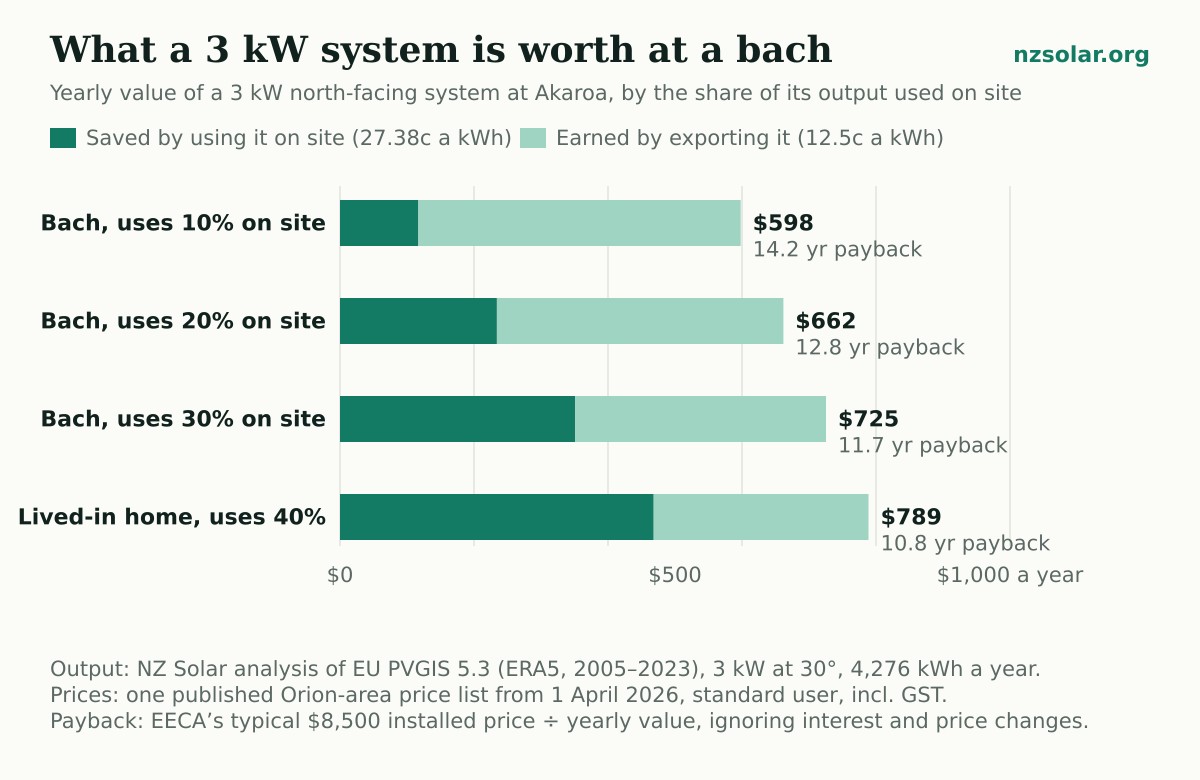
We valued the power used on site at Toast Electric’s standard uncontrolled rate of 27.38c a kWh and the exported power at its buy-back rate of 12.5c, both including GST. Payback is EECA’s typical installed price for 3 kW, $8,500 including GST, divided by the yearly value. The share used on site is an assumption, so the chart shows three of them for a bach, and a home lived in every day at the same prices for comparison.

| Share used on site | Used on site | Saved | Exported | Earned | Value a year | Simple payback |
|---|---|---|---|---|---|---|
| Bach, 10% | 428 kWh | $117 | 3,848 kWh | $481 | $598 | 14.2 years |
| Bach, 20% | 855 kWh | $234 | 3,420 kWh | $428 | $662 | 12.8 years |
| Bach, 30% | 1,283 kWh | $351 | 2,993 kWh | $374 | $725 | 11.7 years |
| Lived-in home, 40% | 1,710 kWh | $468 | 2,565 kWh | $321 | $789 | 10.8 years |
Three things stand out.
- A quiet bach still earns most of its value. Even at 10% use, exports bring in $481 a year. The gap to a lived-in home is real but not huge, because a small system on a home also exports much of its output.
- Being there more is worth about $64 a year for each extra 10%. Each extra tenth of the output used on site swaps 12.5c of export credit for 27.38c of power not bought.
- Payback is long. Twelve to fourteen years is well beyond the 7 to 10 years EECA gives for homes that use most of their solar. Panels usually outlast that, but treat a bach system as a slow return, not a quick one.
A share of 30% is realistic only if the bach is used often in daylight, for example as a near-permanent weekend place or a holiday let through summer. A bach used mostly in January and a few long weekends is closer to 10%. This is an example built from published prices and modelled output, not a forecast for your bach. Shade, roof direction and your retailer’s prices will change it.
The buy-back rate matters most
Because a bach exports most of its output, the export price moves its payback more than anything else. Here is the 10% bach from the example at three buy-back rates. The 8c and 16c columns are round numbers for comparison, not a retailer’s offer.
| Buy-back rate | Value a year | Simple payback |
|---|---|---|
| 8c a kWh | $425 | 20.0 years |
| 12.5c a kWh | $598 | 14.2 years |
| 16c a kWh | $733 | 11.6 years |
Between the 8c and 16c columns, payback differs by more than eight years. Before you buy panels, compare plans for the bach’s address on Powerswitch and read our guide to solar buy-back rates. Two points matter more for a bach than for a home:
- Check the time windows. Some plans pay a higher rate only at morning and evening peaks. A bach with panels and no battery exports mostly in the middle of the day, so a flat buy-back rate may suit it better.
- Ask what happens to credit. EECA notes that you may be able to build up credit in summer and use it against winter bills. Ask the retailer whether summer credit on the bach account carries forward or is paid out.
Sizing: smaller than you think
On a house, the case for a bigger system rests on using more of its output. On a bach that is mostly empty, extra panels add almost nothing but exports at the buy-back rate. On EECA’s typical prices, going from 3 kW at $8,500 to 5 kW at $11,500 adds $3,000. At Akaroa that adds about 2,850 kWh a year, and if nearly all of it is exported at 12.5c it earns about $356 a year, an 8 to 9 year payback on the extra panels before any change in prices. That can still make sense if the price is right, but get the installer to show the split between used and exported power for each size. Our guide to what size solar system you need covers the method.
Be wary of a quote that sizes a bach system to the roof or to your main home’s power bill. Ask for a forecast built on how often the bach is actually used.
Export limits at Canterbury baches and huts
An export-heavy system depends on the network accepting the export. Many bach settlements are at the end of long rural lines, which is where lines companies most often limit export. Find the lines company first, then check the address against its rules:
| Area | Lines company | What to check |
|---|---|---|
| Banks Peninsula, including Akaroa and the bays | Orion | The inverter requirement and export limit in our Orion export limits guide |
| Hanmer Springs, Kaikōura, Waimakariri and Hurunui | MainPower | MainPower’s application route in our MainPower guide |
| Methven, Mt Hutt, Rakaia and Mid Canterbury | EA Networks | Methven, Mt Hutt and Rakaia are among the areas where EA Networks applies export limits; see our EA Networks guide |
| Tekapo, Twizel, Fairlie and the South Canterbury river huts | Alpine Energy | Seven of Alpine’s 11 named export-congested areas are hut settlements, from Rangitata Huts to Glenavy; see our Alpine Energy guide |
| Kurow, Otematata and Omarama | Network Waitaki | Our Network Waitaki guide |
If the bach is in a congested area, a lower export limit or a requirement to turn export down at busy times can cut the export income the worked example depends on. Ask the installer to confirm the limit the lines company will approve before you accept a savings forecast. Your power bill shows the ICP number, which identifies the network for certain if the bach is near a boundary.
Batteries and power cuts
A battery stores daytime solar for the evening. That helps a home that is occupied every night, and does little for a bach that is empty most nights. EECA puts a battery at $5,000 to $15,000 on top of the system, which a bach would rarely earn back. Our battery or no battery guide sets out how to test it.
Rural lines do go down in storms, and solar on its own won’t keep the power on when they do. A grid-connected inverter switches off when the network goes down, for safety. If keeping a freezer or water pump running through outages matters, that is a backup decision and needs a battery and switching designed for it. Our battery storage guide explains what backup involves.
Going off-grid to escape the daily charge
A $737 daily charge for a place you use for a few weeks a year makes some owners ask about cutting the connection altogether. EECA’s view is that to be independent of the grid you need a very large solar system with batteries, and it lists a fuel-powered generator as the backup.
The winter numbers show why. The 3 kW system at Akaroa averages 5.6 kWh a day in June, against 15.4 kWh in December, and a run of grey days gives far less than the average. An off-grid bach needs enough panels and battery to cope with the worst week of winter you intend to use it in, plus a generator for the rest. That costs well over the $8,500 grid-tied system, and the batteries are likely to need replacing during the system’s life.
Off-grid makes most sense where there is no connection to keep, such as a new bach or hut far from the nearest line, where the connection itself would be expensive. If the bach is already connected, ask the lines company what removing the connection would cost and what it would cost to restore it later, and compare that with the daily charge over the years you expect to keep the bach. Get an off-grid design from an installer who does them, not a grid-tied quote with a battery added.
Living with it while you’re away
- Leave the system on. It keeps exporting while you’re away, and that is where most of a bach system’s value comes from. Switch it off only if the installer tells you to.
- Hot water. Many owners turn the cylinder off when they leave. That is fine. If you want hot water ready on arrival, a timer set to heat it in the middle of the day you arrive uses your own solar. Our hot water guide compares a timer, a diverter and a battery.
- Monitoring. Most inverters report through an app over wifi. Many baches have no internet, so ask whether the inverter can report another way, or accept that you will check the meter readings on your power bill instead.
- A holiday let. Guests who are there in daylight use more of the output, which helps the sums. Decide whether the guests’ power use is included in what you charge.
- Near the sea. Salt spray is hard on fixings and frames. Ask whether the panel and mounting warranties cover a site as close to the sea as yours, and how the fixings are protected.
- Insurance. Tell your insurer about the system, as you would for any addition to the building.
Six things to get in writing
- The usage assumption: how many days a year the forecast assumes the bach is occupied, and the share of output used on site.
- The split: a month-by-month forecast of output used and output exported, for the system size quoted and one size smaller.
- The prices used: the import rate, buy-back rate and daily charge in the savings forecast, on the standard-user plan.
- The network: the lines company, the export limit it is expected to approve at this address, and who makes the application.
- Monitoring: how you will know the system is working if the bach has no wifi.
- Coastal and site conditions: the corrosion protection and warranty cover for the site, and the roof fixing method. Our guide to solar on metal roofs covers the common bach roof.
Common questions about bach solar
Is solar worth it on a bach?
It can be, slowly. A bach exports most of what its panels make, so it earns mainly the buy-back rate. In our Akaroa example a 3 kW system is worth $598 to $725 a year if the bach uses 10% to 30% of the output, a simple payback of 11.7 to 14.2 years on EECA’s typical $8,500 price. A better buy-back rate shortens that most.
Can I put my bach on a low-user power plan?
No. The low fixed charge regulations apply only to a principal place of residence, and Meridian, for one, says a holiday home can’t have the low user option. The regulations end on 1 April 2027 in any case.
Will solar cover the bach’s daily charge?
Partly. A 3 kW system at Akaroa that exports 90% of its output earns about $481 a year at 12.5c a kWh. The standard daily charge on one published Christchurch price list is $737 a year, so exports cover about 65% of it.
Should a bach have a battery?
Usually not for savings, because the bach is empty most evenings and EECA prices a battery at $5,000 to $15,000. A battery is worth considering only if you need backup power in outages, and then it needs to be designed for that.
Can I take my bach off-grid to avoid the daily charge?
You can, but EECA says it takes a very large solar system with batteries, plus a generator as backup. A 3 kW system at Akaroa averages 5.6 kWh a day in June. Off-grid suits a site with no existing connection better than a connected bach.
Does it matter which lines company the bach is on?
Yes. Export limits are set by the lines company, and several bach and hut settlements are in areas where export is limited, including seven of the 11 areas Alpine Energy names as export-congested and EA Networks’ Methven and Mt Hutt areas. Confirm the limit before relying on export income.
Canterbury solar quotes
Tell installers how often the bach is used.
Give us the address and how many weeks a year someone is there, so installers quote a system sized for the bach, not the roof.
Get Canterbury solar quotesSources and review date
Checked on 6 November 2026 against the Electricity (Low Fixed Charge Tariff Option for Domestic Consumers) Regulations 2004 (version as at 1 April 2026), Meridian’s help page on standard and low user options, Toast Electric’s published Orion-area price list valid from 1 April 2026, and EECA’s pages on solar costs and savings and on planning a home solar system. Output figures are from our PVGIS 5.3 analysis (PVGIS-ERA5, 2005 to 2023) for Akaroa, scaled from 5 kW to 3 kW. Lines-company details are from our guides to each network, written from each company’s own published rules in October 2026. Confirm prices with your retailer and export limits with the lines company and your installer.
NZ Solar is an independent quote matching service and is not affiliated with EECA, any retailer or any lines company. For broader local advice, see our Canterbury solar guide.