
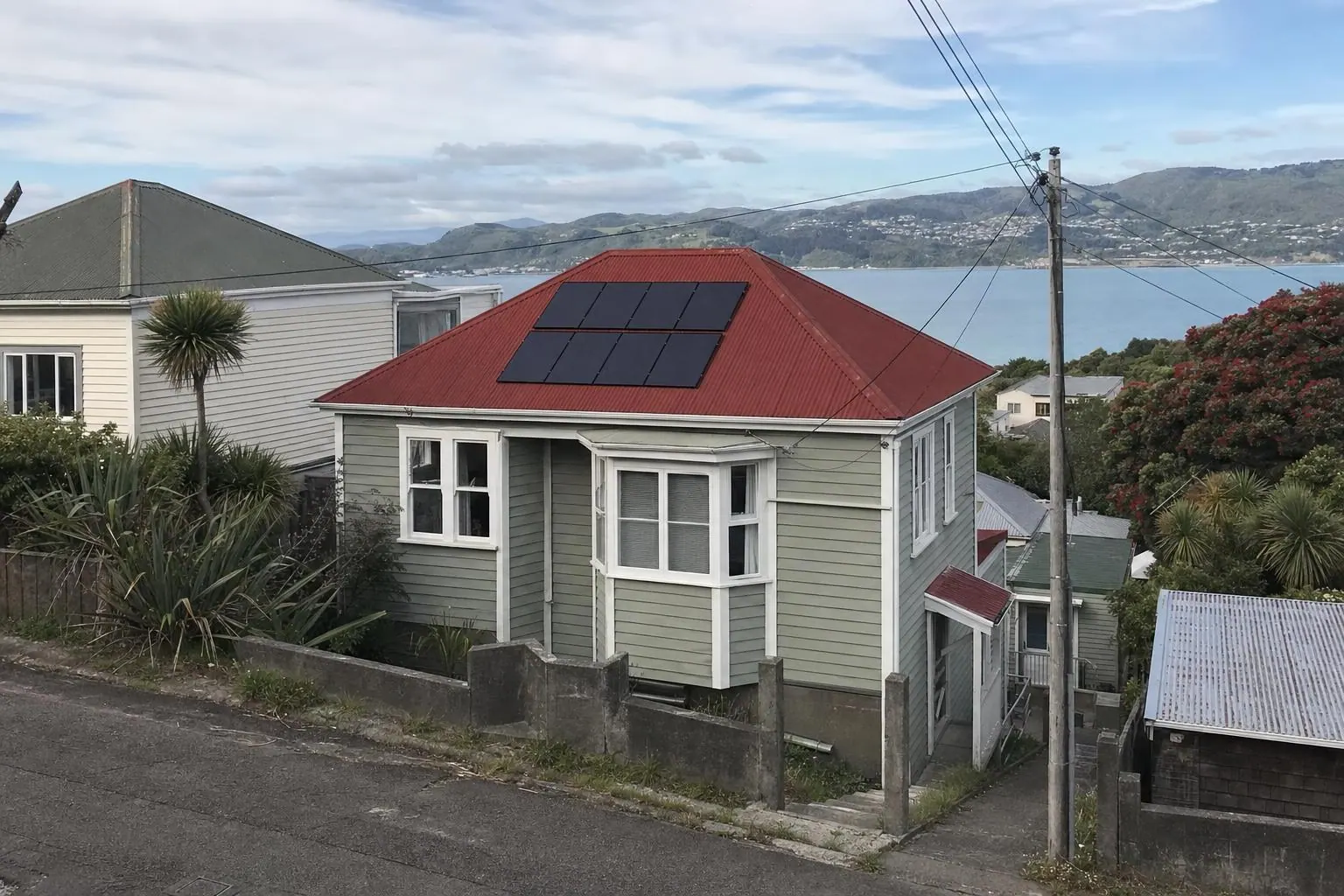
Are you on Wellington Electricity’s network?
Wellington Electricity is the lines company for Wellington City, Lower Hutt, Upper Hutt and Porirua. It owns the poles, cables and transformers that carry power to your house. It does not send you a power bill; your retailer does.
The rest of the Wellington region is not in that list, so do not assume from the region alone. The reliable check is the 15-character ICP number on your power bill: ask your retailer which lines company it belongs to, or call Wellington Electricity on 04 915 6100.
Keep the three roles apart. Wellington Electricity approves the connection and decides how much you can export. Your retailer arranges import/export metering, sets the price it pays for exported power, and is the party Wellington Electricity charges if congestion charges apply. Your installer designs the system and usually lodges the application.
Solar is less common on this network than in most of the country. Electricity Authority EMI figures for 31 August 2026 show 4,384 homes with solar on Wellington Electricity’s network, 2.7% of homes, up 19% from 3,683 a year earlier. Their systems average 5.4 kW. Across New Zealand, 4.2% of homes have solar.
| Area | Homes with solar | Share of homes | A year earlier | Average system |
|---|---|---|---|---|
| Wellington Electricity network | 4,384 | 2.7% | 3,683 | 5.4 kW |
| Wellington region (all networks) | 7,718 | 3.6% | 6,444 | 5.7 kW |
| New Zealand | 84,091 | 4.2% | 71,040 | 5.8 kW |
Our regional solar uptake rankings compare all 16 regions and 38 network areas and explain how the figures are counted.
Flexible export limits, not a fixed 10 kW
The Electricity Authority’s export limits Code change, in force since 11 May 2026, makes 10 kW the default for straightforward small home connections, though a lines company can set a lower limit where a standard network assessment justifies it. Other lines companies have set a 10 kW figure: Orion in Christchurch allows 10 kW per phase where its network has capacity, and Aurora Energy in Otago allows up to 10 kW.
Wellington Electricity took a different route from the same date. Its generating your own electricity page says that rather than set a fixed 10 kW limit, it uses a price signal to get solar owners to lower their export to 5 kW when parts of its network become congested. Its connection policy, revised on 7 May 2026, says a higher export limit depends on the customer or retailer accepting responsibility for paying those congestion charges.
The reasoning is in its January 2026 submission to the Electricity Authority. Wellington Electricity said its low-voltage street lines start to run into significant constraints once more than about 30% of the homes on them have solar, that a blanket 10 kW limit would congest the network and force it to act retrospectively, and that it preferred a limit of around 5 kW during congestion with 10 kW allowed when the power can be used within the same street.
For most homes this matters less than it sounds. An export limit is measured in kilowatts, which is power at one moment, not a daily allowance in kilowatt-hours. A typical 5 to 6 kW system only exports more than 5 kW for short spells around midday on clear days, when the house is using little. Our system sizing guide explains how panel size, inverter size and export fit together.
The congestion charge
Wellington Electricity says it will publish operating envelope schedules on its website, from time to time, for the parts of its network it identifies as congested. Each schedule applies to specific time periods. Your retailer is told in advance when one applies to your connection, and a congestion charge is passed to the retailer for exports above the published threshold.
When we checked on 30 October 2026, neither Wellington Electricity’s generation page nor its congestion policy gave a rate for the charge, and it does not name congested suburbs in text. Its generation page has a congestion map, which it says is approximate and may not be up to date. On its own figures, congestion is some way off for most streets: about 3% of homes on its network have solar, and it does not expect congestion until that reaches about 20%.
Wellington Electricity lists three ways to avoid the charge:
- use more of your own power when the panels are producing, for example by heating hot water or charging an electric car in the middle of the day
- store surplus in a home battery
- turn down export so it stays within the operating envelope
The charge goes to your retailer, not to you, so how it reaches your bill depends on the retailer. Before you sign, ask your retailer whether it passes Wellington Electricity’s congestion charges on to solar customers, and how. Our guides to using solar for hot water and whether a battery pays cover the cheapest ways to use more of your own power.
From application to switching on
Systems of 10 kW or less go through Wellington Electricity’s online application. Larger systems, and some smaller ones where the network needs a closer look, get an individual assessment.
- Quote and design. The installer agrees a system with you, including the export it will request.
- Application. The installer, the solar company or you as the owner completes the online form. It asks for the ICP, the number of phases, the total maximum export requested, the panel and inverter make and model, any battery, any export control device, and the home’s minimum load.
- Payment and review. Once payment is confirmed, Wellington Electricity says it will contact you within 10 working days with an update on the application.
- Written approval. Wellington Electricity issues a formal approval certificate setting out the terms. The form requires a declaration that nothing will be connected before written approval arrives.
- Installation and meter. A registered electrician installs the system. Your retailer arranges an import/export meter and may charge for the change.
- Paperwork. The installer sends Wellington Electricity the certificate of compliance and record of inspection. Its connection policy asks for these within 3 working days of switching on; the application form allows 10 business days. Ask for them to go straight away.
If contract terms are not agreed within 30 days, the regulated terms in Part 6 of the Electricity Industry Participation Code apply. For a home system this is normally the outcome, and it is not something you need to negotiate.
What it costs to apply
Wellington Electricity’s current fees are published on its generation page:
| System size | Application fee | Inspection fee |
|---|---|---|
| Under 10 kW | $100 | $60 |
| 10 kW to 100 kW | $500 | $120 |
| 100 kW to 1 MW | $1,000 | $1,200 |
So a typical home system costs $160 in network fees. That is about the same as Orion and EA Networks in Canterbury and Network Waitaki in North Otago, and more than MainPower, which charges nothing for small home systems. Ask whether the installer’s price includes these fees and the retailer’s meter change. Our solar panel cost guide covers what else should be in the price.
Inverter rules
Wellington Electricity uses the Clean Energy Council’s approved inverter list, the Australian list that MainPower, EA Networks and Alpine Energy in Canterbury also use. If the inverter is not on it, the installer must supply a declaration of conformity with AS/NZS 4777.2:2020, and Wellington Electricity says the application will take longer without it. Ask for the exact inverter model on the quote.
The settings matter as much as the model. The application form requires a declaration that the inverter is set to the “Australia A” voltage response, frequency and protection settings in that standard, which the Electricity Authority’s Code now makes the national default for small systems. In plain terms, the inverter turns its output down when the street’s voltage rises too high. Wellington Electricity says voltage rise is the most common constraint on its network, which is why it pays close attention to these settings.
Its revised connection policy also calls for smart inverters that can export up to their limit when the network is not congested and adjust export in real time by remote control, or follow a set schedule. That is how a flexible limit works in practice, so ask the installer to confirm the inverter can do it. Wellington Electricity says the process will become automatic once it can see smart inverters and connection agreements across its network.
A grid-connected inverter switches off when the network goes down, so solar alone will not keep the lights on in an outage. Our battery storage guide explains what backup needs.
Raising an older limit or adding a battery
Many older Wellington systems were approved at lower export limits. Wellington Electricity has a separate application for an export limit increase where nothing else about a system of 10 kW or less changes. If your installer says your existing inverter is capable of more export, this is the cheaper route than a new application.
Adding a battery, more panels or a new inverter is a system change, made on the same online form. The form asks for battery details and any active export control device, so tell Wellington Electricity before the work is done, not after.
Six things to get in writing
Use these alongside our guide to common solar quote mistakes when comparing installers.
- The connection: the ICP, confirmation that it is on Wellington Electricity, and whether the supply is single-phase or three-phase.
- The export request: the maximum export the application will ask for, and whether your street shows congestion on Wellington Electricity’s map.
- The savings forecast: how much of it relies on exporting above 5 kW, and what it looks like if a congestion charge applies.
- The equipment: panel capacity and the exact inverter model, with confirmation that it is on the approved list, will be set to Australia A, and can adjust export remotely or on a schedule.
- The fees: whether the $100 application and $60 inspection fees and the meter change are in the price.
- The paperwork: who lodges the application, who tells the retailer, and who sends the certificate of compliance and record of inspection.
Common Wellington Electricity solar questions
What is Wellington Electricity’s solar export limit?
Wellington Electricity does not set a fixed 10 kW limit. Since 11 May 2026 it has used flexible export limits: homes can export more when the network has room, but in congested areas a charge applies to exports above 5 kW during published periods. Check the figure in your approval certificate.
How much is the congestion charge?
Wellington Electricity had not published a rate when we checked on 30 October 2026. The charge is passed to your retailer for exports above the threshold during published operating envelope periods, so ask your retailer how it would reach your bill.
How much does Wellington Electricity charge to connect solar?
For a system under 10 kW, a $100 application fee and a $60 inspection fee. Wellington Electricity does not say whether GST is included. Your retailer may also charge for the meter change.
How long does approval take?
Wellington Electricity says it will contact you within 10 working days of confirming payment with an update on the application. Applications with an inverter that is not on the approved list and no declaration of conformity take longer.
Who applies to Wellington Electricity for my solar connection?
Usually the installer, through Wellington Electricity’s online form. The form also accepts applications from the solar company or the owner of the system.
Do I need approval to add a battery?
Yes. Adding a battery is a system change, and the application form asks for battery details and any export control device. Apply before the battery is installed.
Solar quotes
Get the connection details into your quote.
Tell us about your property and power use so installers can respond to the same brief.
Get solar quotesSources and review date
Checked on 30 October 2026 against Wellington Electricity’s generating your own electricity page and fee table, its page for systems of 10 kW or less, its online application form for systems of 10 kW or less, its network connection policy for distributed generation and its congestion and interruption management policy (both revised 7 May 2026), its 25 October 2024 letter on distributed generation process changes, its 2012 brochures for systems under and over 10 kW, and its January 2026 submission to the Electricity Authority on a 10 kW default export limit; and against the Electricity Authority’s export limits Code amendment. Canterbury and North Otago fee comparisons are from our guides to each network, checked between 8 and 26 October 2026. Solar uptake figures are from the Electricity Authority’s EMI data to 31 August 2026. Confirm current requirements with Wellington Electricity and your installer when applying.
NZ Solar is an independent quote matching service and is not affiliated with Wellington Electricity. For Canterbury networks, see our Canterbury solar guide.