
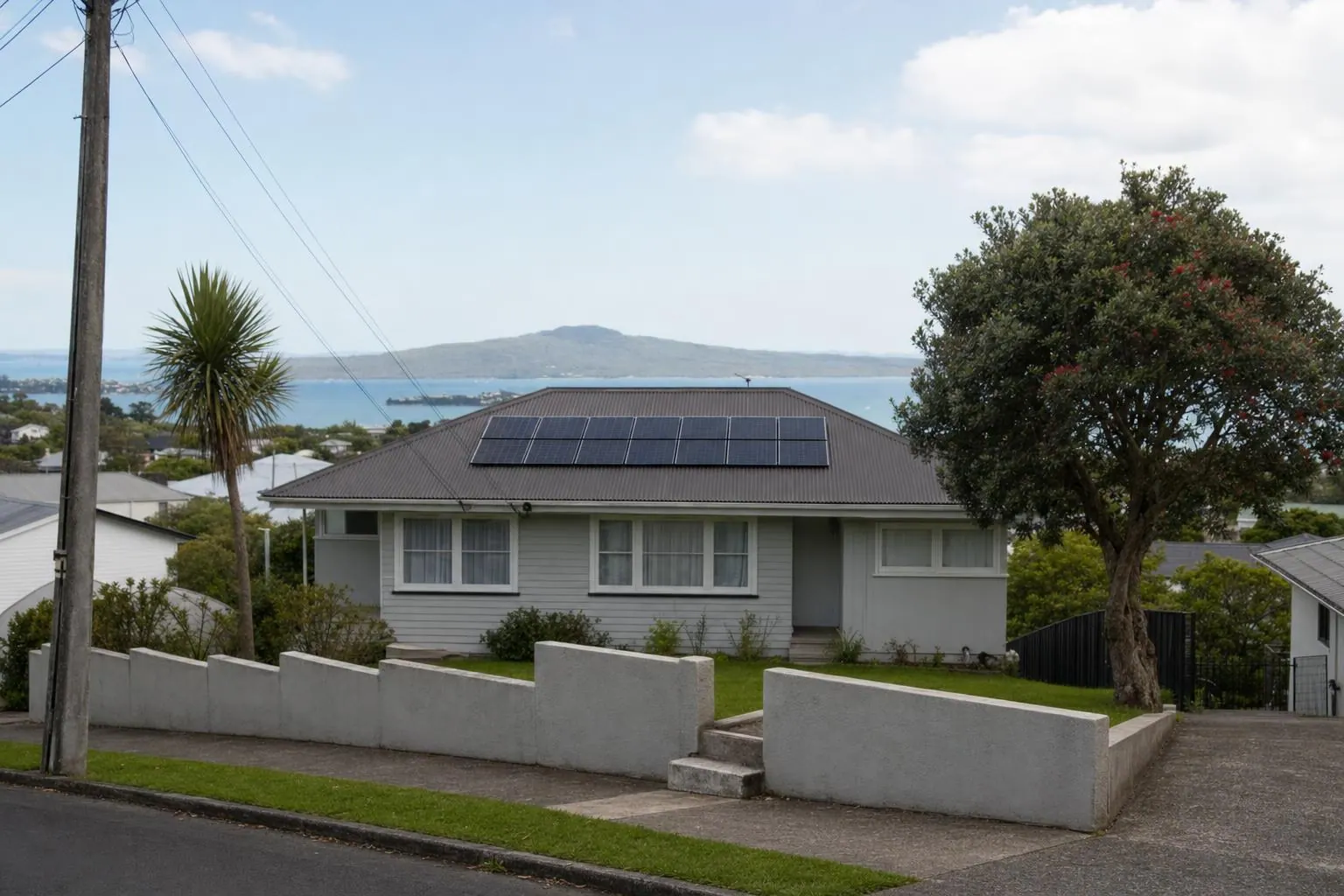
Are you on Vector’s network?
Vector owns the poles, lines and transformers that supply most Auckland homes. Its pricing splits customers between an Auckland network and a Northern network, and the Electricity Authority’s EMI data names the two areas Auckland and Waitemata. The south of the region, around Pukekohe and Franklin, is on a different network, which the Authority’s data lists as Counties.
Vector does not send you a power bill; your retailer does. The reliable check is the ICP number on that bill: Vector’s application form asks for it, and your retailer can tell you which lines company it belongs to.
Keep the three roles apart. Vector approves the connection and sets the export limit. Your retailer arranges import/export metering and sets the price it pays for exported power. Your installer designs the system and usually sends the application.
Auckland has more solar homes than any other region, but a smaller share of its homes have solar than most of the country. Of the 38 network areas in New Zealand, Waitemata ranks 29th and Auckland 34th. Electricity Authority EMI figures for 31 August 2026:
| Network area | Homes with solar | A year earlier | Share of homes | Average system |
|---|---|---|---|---|
| Waitemata | 7,161 | 6,233 | 3.0% | 5.6 kW |
| Auckland | 6,891 | 6,200 | 2.0% | 5.2 kW |
| New Zealand | 84,091 | 71,040 | 4.2% | 5.8 kW |
Our regional solar uptake rankings compare all 38 areas and explain how the figures are counted.
A 10 kW limit that can move
Since 11 May 2026, Vector has offered eligible single-phase homes what it calls a dynamic export connection. Its application form says it will ordinarily offer a default dynamic export limit of 10 kW, or the inverter’s nameplate capacity if that is less. Vector brought the start forward from 1 July 2026 and renamed the offer; older Vector documents call it a flexible export connection.
Dynamic means the limit is not fixed in your approval. Vector sends the inverter its export limit over the internet, based on what the local network can take at the time. Vector’s FAQ says it expects to reduce limits only temporarily, “very rarely” in most cases, and typically when very sunny weather coincides with low electricity demand in your area. That is the moment when many roofs on one street are all exporting and the local voltage rises.
The system that sends those signals is still being rolled out. Vector’s FAQ says it expects its dynamic export management system to become available later in 2026 and that it will contact customers with instructions once it is live.
Vector says it does not expect congestion for systems of 10 kW or less anywhere on its network over the next 12 months, though it still assesses each application. Unlike Powerco or Alpine Energy, it publishes no list of constrained areas.
Vector’s pages describe the 10 kW offer for single-phase homes only. If your property has three-phase supply, ask your installer what Vector will approve before you size the system for export.
A limit in kilowatts is power at one moment, not a daily allowance. A typical home system exports near its peak only for short spells around midday, so a limit that drops briefly on the sunniest days costs far less than the headline figure suggests. Our system sizing guide explains how panel size, inverter size and export fit together. Wellington Electricity also uses flexible limits, but manages busy areas with a charge on exports above 5 kW rather than by turning inverters down.
The 2.5 kW fallback
The dynamic limit only applies when Vector can reach the inverter. Its application form says that if the inverter is not CSIP-enabled, is not connected to the internet, or is not connected to Vector’s management system, Vector will offer a fixed export limit of 2.5 kW instead.
The same 2.5 kW applies if the internet connection drops after installation, for as long as the inverter is offline. That makes the household Wi-Fi part of the solar system. Points to raise with your installer:
- Where the inverter will be mounted, and whether the Wi-Fi signal reaches it reliably. A garage or an outside wall at the far end of the house can be a weak spot.
- Whether a wired network connection is possible if the signal is poor.
- What you need to do to reconnect the inverter if you change your router, Wi-Fi password or internet provider.
Before May 2026, Vector gave single-phase homes a fixed limit of up to 5 kW. So the trade is simple: up to twice the old limit if the inverter stays online, half of it if it does not.
From application to switching on
- Quote and design. The installer agrees a system with you and checks the inverter is on the approved list and supports CSIP.
- Application. The installer, or you as the ICP holder, sends Vector’s application form for systems up to 10 kW by email. Vector asks for the address, ICP number and the amount of export in the subject line. The form covers the inverter, any batteries and the export limit sought, and the declaration can be signed by the installer or the ICP holder.
- Vector’s review. Vector aims to reply within 10 business days if the inverter is on its approved list, and within 30 business days if it is not or the application needs more assessment.
- Installation. Vector says to install once the application is approved, and the system must not run or export until it is. Your retailer arranges a meter that records import and export separately, and you agree an export price with the retailer.
- Paperwork back to Vector. After installation Vector wants a signed certificate of compliance and record of inspection from a registered electrical worker, a photo of each inverter’s nameplate showing the model and serial number, and a photo of the inverter settings. Its web page asks for the certificate within 10 working days of installation.
Vector says an approval is cancelled, with an email to the applicant, if the system is not installed within the time the Electricity Authority’s Code allows. If your installer has a long waiting list, ask when the approval will lapse.
The process is about to change. Vector’s pages say new Electricity Authority requirements take effect on 1 December 2026 to make the process more consistent across New Zealand, that it is updating its application process to match, and that the current process applies until then. If your installation will straddle that date, ask your installer which process the application is on.
What it costs to apply
Vector’s page for systems of 10 kW or less lists no application fee. Its fees start above 10 kW, and Vector says they follow Schedule 6.5 of the Electricity Authority’s Code:
| System size | Application fee | On-site observation and testing, if Vector inspects |
|---|---|---|
| Up to 10 kW | None listed | None listed |
| Over 10 kW to under 100 kW | $770 | $180 |
| 100 kW to under 1 MW | $1,540 | $1,850 |
| 1 MW or more | $7,690 | $1,850 |
Vector’s fee table does not say whether GST is included. The amounts match MainPower’s, which MainPower lists as excluding GST. Vector says it does not refund the application fee if an application is declined. For an ordinary home system under 10 kW, the costs that remain are the installer’s paperwork and the retailer’s meter change, so ask whether both are in the quote. Our solar panel cost guide covers what else should be in the price.
Vector does not pay you for exported power. Its page says it is no longer allowed to make payments to new distributed generation, so your earnings come from your retailer’s buy-back rate. Our buy-back rates guide compares them.
Inverter rules
Vector requires inverters that comply with AS/NZS 4777.2:2020. It has adopted the Clean Energy Council’s approved inverter list, the Australian list that several Canterbury lines companies also use, in place of its own. For the dynamic limit, the inverter must also support CSIP, the Common Smart Inverter Profile, which is the communication standard Vector uses to send export limits.
If the inverter is not on the list, the application needs the inverter’s datasheet, a certificate of suitability showing it complies with AS/NZS 4777.2:2020, and, optionally, certification that it supports CSIP. Expect the slower 30 business day review.
Vector’s settings can be applied by choosing the “Australia A” default in the inverter, and it recommends that existing systems update their voltage settings to the same. Those settings include volt-watt and volt-var responses. In plain terms, the inverter turns its output down, or absorbs some reactive power, when the street’s voltage rises too high. On a single-phase connection the volt-watt response starts at 253 volts and cuts output to 20% at 260 volts. That can trim a little export on a sunny day with little load nearby, and it is separate from the dynamic limit.
A grid-connected inverter stops exporting when the network goes down, so solar alone will not keep the lights on in an outage. Our battery storage guide explains what backup needs.
Batteries, EVs and older systems
Vector’s application form asks how many batteries are installed, their storage capacity in kWh and their maximum charge and discharge rates, so adding a battery to an existing system needs a new application. Vector also counts two-way electric vehicle charging, such as vehicle-to-grid, as generation if it can send power into the network. Our battery or no battery guide shows how to judge a battery on what it saves.
Systems approved under Vector’s previous process have a fixed export limit of up to 5 kW. Vector’s FAQ says existing systems may need retrofitting or upgrading to join the dynamic scheme, so ask your installer whether your inverter supports CSIP before you apply for more.
Six things to get in writing
Use these alongside our guide to common solar quote mistakes when comparing installers.
- The connection: the ICP, confirmation that it is on Vector, and whether the supply is single-phase or three-phase.
- The inverter: the exact model, with confirmation that it is on the Clean Energy Council list and supports CSIP.
- The internet link: where the inverter goes, how it connects to your network, and what happens to the export limit if it drops offline.
- The export assumption: the limit the savings forecast uses, 10 kW or 2.5 kW, and that it matches Vector’s approval.
- The timing: how long until Vector replies, when the installation is booked, and when the approval would lapse.
- The paperwork: who sends the application, who tells the retailer, and who sends the certificate of compliance, record of inspection and inverter photos to Vector.
Common Vector solar questions
What is Vector’s solar export limit?
Up to 10 kW for an eligible single-phase home, as a dynamic limit that Vector can lower temporarily when the local network is busy. The inverter must support CSIP and stay connected to the internet. Without that, Vector offers a fixed 2.5 kW.
What is a CSIP inverter?
CSIP is the Common Smart Inverter Profile, a communication standard that lets a lines company send an export limit to the inverter over the internet. Vector needs it for the dynamic 10 kW limit. Ask your installer to confirm the exact model supports it.
Does Vector charge to connect solar?
Vector lists no application fee for systems of 10 kW or less. Above 10 kW it charges $770 to $7,690 depending on size, plus $180 or $1,850 if it observes testing on site.
How long does Vector take to approve solar?
Vector aims to reply within 10 business days if the inverter is on the approved list, and within 30 business days if it is not or needs more assessment.
What happens if my Wi-Fi goes down?
Vector’s application form says the inverter falls back to a fixed 2.5 kW export limit for as long as it is disconnected. The panels keep supplying the house; only export above 2.5 kW is affected.
Do I need approval to add a battery?
Yes. Vector’s application form asks for battery details, so the battery needs to be in an approved application before it is connected.
Solar quotes
Get the connection details into your quote.
Tell us about your property and power use so installers can respond to the same brief.
Get solar quotesSources and review date
Checked on 2 November 2026 against Vector’s pages on connecting power generation of 10 kW or less and more than 10 kW, its Dynamic DG Export Connections FAQ (May 2026), its earlier flexible export connections FAQ, its application form for distributed generation up to 10 kW (version 2, June 2026), its Congestion Management Policy (May 2026) and its electricity distribution pricing methodology. Vector’s pages give no address lookup for its network boundary, no three-phase export figure and no fee for systems of 10 kW or less, so this guide does not state them. Solar uptake figures are from the Electricity Authority’s EMI data to 31 August 2026. Confirm current requirements with Vector and your installer when applying.
NZ Solar is an independent quote matching service and is not affiliated with Vector. For Canterbury networks, see our Canterbury solar guide.